
Pulp Fiction, 1912 · page 132 of 238
The Argosy, April 1912 — page 132: what you’re looking at
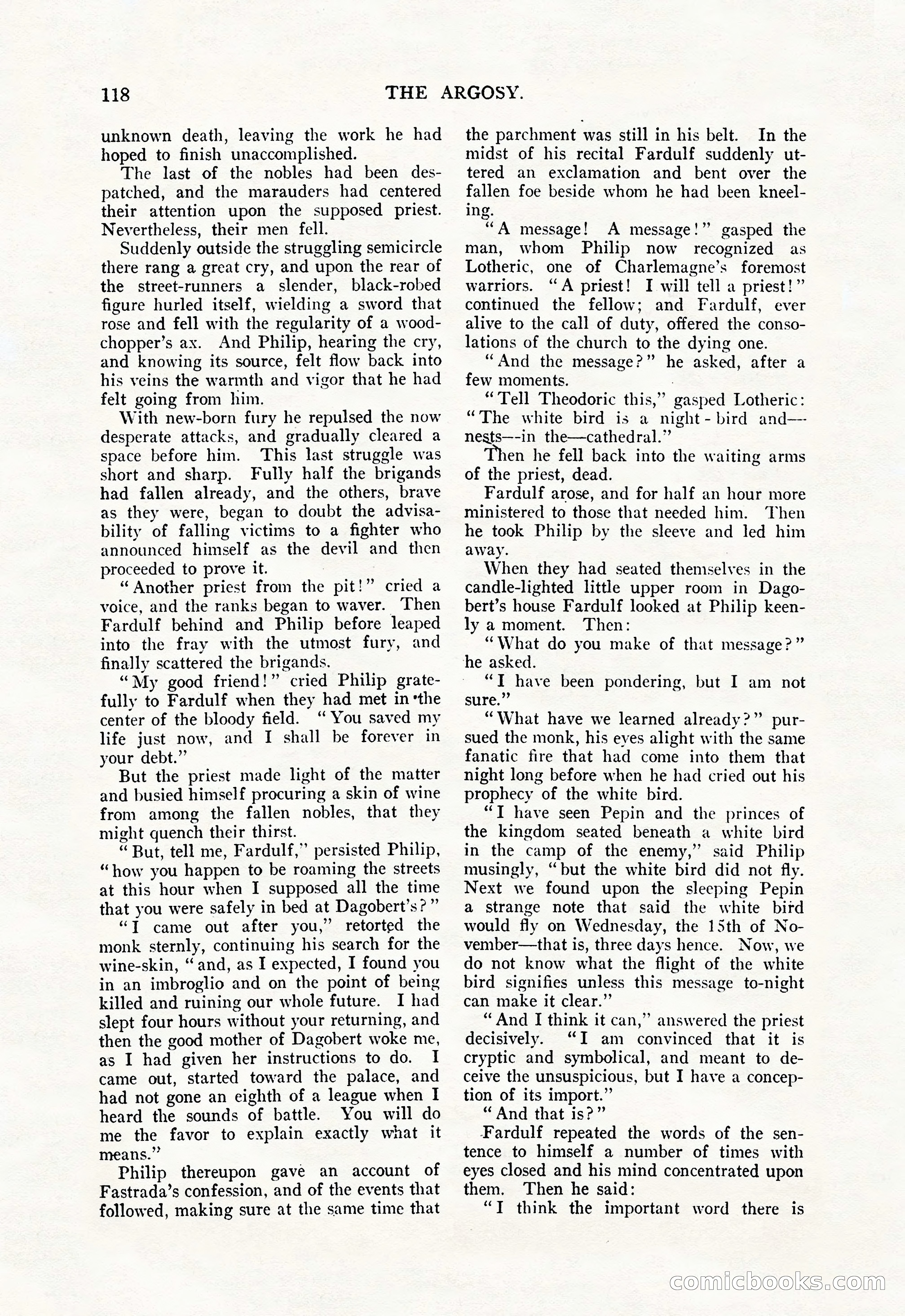
A restored page from Pulp Fiction, 1912. Page through the whole issue in the reader above.
📄 Transcribed text from this page (OCR, searchable)
Machine-transcribed from the original scan — historical spelling and the odd misread are preserved.
118 THE ARGOSY. unknown death, leaving the work he had hoped to finish unaccomplished. The last of the nobles had been des- patched, and the marauders had centered their attention upon the supposed priest. Nevertheless, their men fell. Suddenly outside the struggling semicircle there rang a great cry, and upon the rear of the street-runners a slender, black-robed figure hurled itself, wielding a sword that rose and fell with the regularity of a wood- chopper’s ax. And Philip, hearing the cry, and knowing its source, felt flow back into his veins the warmth and vigor that he had felt going from him. With new-born fury he repulsed the now desperate attacks, and gradually cleared a space before him. This last struggle was short and sharp. Fully half the brigands had fallen already, and the others, brave as they were, began to doubt the advisa- bility of falling victims to a fighter who announced himself as the devil and then proceeded to prove it. . “ Another priest from the pit!” cried a voice, and the ranks began to waver. Then Fardulf behind and Philip before leaped into the fray with the utmost fury, and finally scattered the brigands. “My good friend!” cried Philip grate- fully to Fardulf when they had met in ‘the center of the bloody field. ‘“ You saved my life just now, and I shall be forever in your debt.”’ But the priest made light of the matter and busied himself procuring a skin of wine from among the fallen nobles, that they might quench their thirst. “ But, tell me, Fardulf,” persisted Philip, ‘how you happen to be roaming the streets at this hour when I supposed all the time that you were safely in bed at Dagobert’s?”’ “T came out after you,” retorted the monk sternly, continuing his search for the wine-skin, “and, as I expected, I found you in an imbroglio and on the point of being killed and ruining our whole future. I had slept four hours without your returning, and then the good mother of Dagobert woke me, as I had given her instructions to do. I came out, started toward the palace, and had not gone an eighth of a league when I heard the sounds of battle. You will do me the favor to explain exactly what it means.” Philip thereupon gave an account of Fastrada’s confession, and of the events that followed, making sure at the same time that the parchment was still in his belt. In the midst of his recital Fardulf suddenly ut- tered an exclamation and bent over the fallen foe beside whom he had been kneel- ing. “A message! A message!” gasped the man, whom Philip now recognized as Lotheric, one of Charlemagne’s foremost warriors. “A priest! I will tell a priest!” continued the fellow; and Fardulf, ever alive to the call of duty, offered the conso- lations of the church to the dying one. “And the message?” he asked, after a few moments. . “Tell Theodoric this,” gasped Lotheric: “The white bird is a night - bird and— nests—-in the—cathedral.” ren he fell back into the waiting arms of the priest, dead. Fardulf arose, and for half an hour more ministered to those that needed him. Then he took Philip by the sleeve and led him away. 7 When they had seated themselves in the candle-lighted little upper room in Dago- bert’s house Fardulf looked at Philip keen- ly a moment. Then: “What do you make of that message?” he asked. “T have been pondering, but I am not sure.” “What have we learned already?” pur- sued the monk, his eves alight with the same fanatic fire that had come into them that night long before when he had cried out his prophecy of the white bird. “T have seen Pepin and the princes of the kingdom seated beneath a white bird in the camp of the enemy,” said Philip musingly, “but the white bird did not fly. Next we found upon the sleeping Pepin a strange note that said the white bird would fly on Wednesday, the 15th of No- vember—that is, three days hence. Now, we do not know what the flight of the white bird signifies unless this message to-night can make it clear.”’ “And I think it can,” answered the priest decisively. “I am convinced that it is cryptic and symbolical, and meant to de- ceive the unsuspicious, but I have a concep- tion of its import.” “And that is?” Fardulf repeated the words of the sen- tence to himself a number of times with eyes closed and his mind concentrated upon them. Then he said: “TY think the important word there is comicaoolkks