
Pulp Fiction, 1912 · page 130 of 238
The Argosy, April 1912 — page 130: what you’re looking at
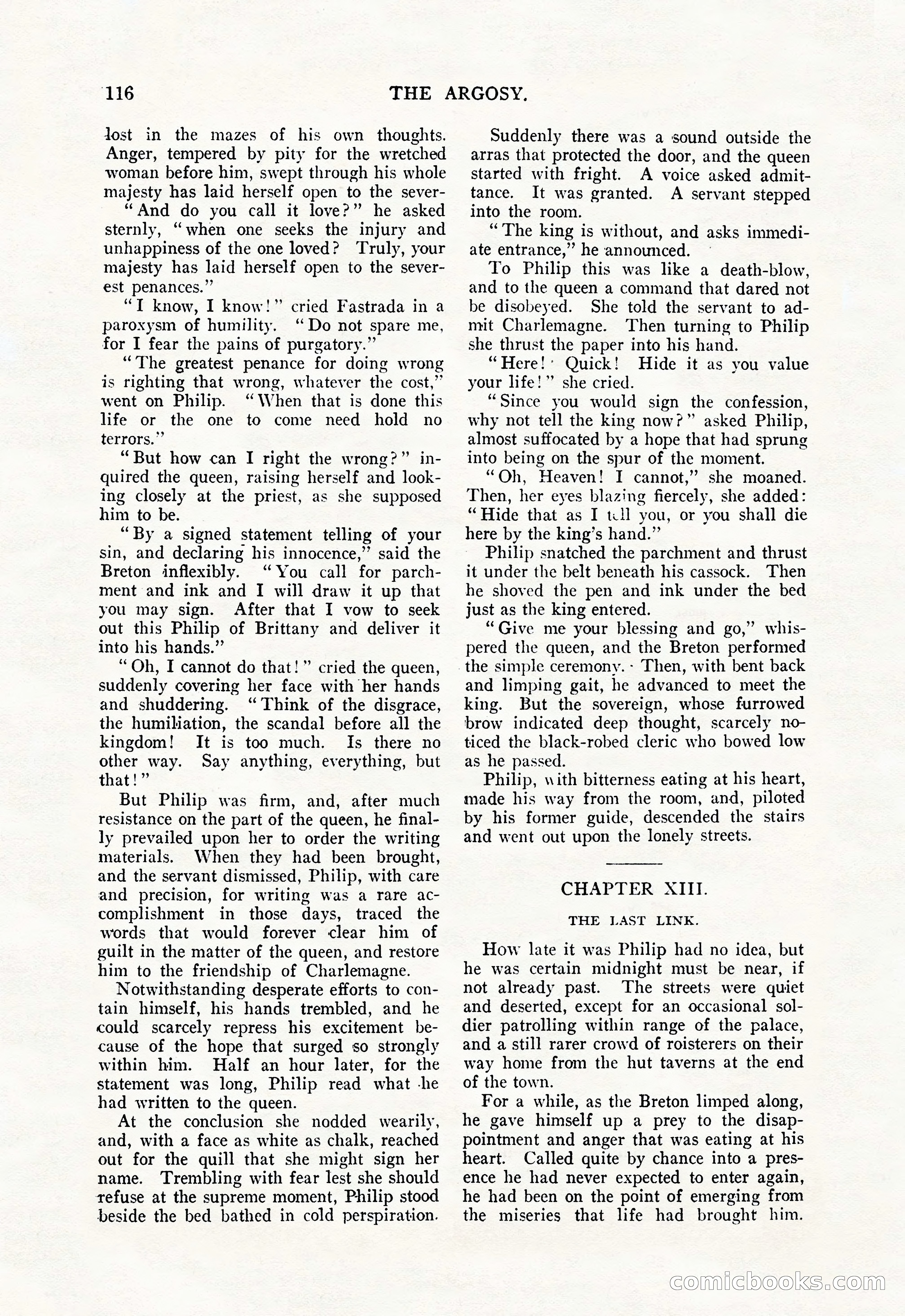
A restored page from Pulp Fiction, 1912. Page through the whole issue in the reader above.
📄 Transcribed text from this page (OCR, searchable)
Machine-transcribed from the original scan — historical spelling and the odd misread are preserved.
116 lost in the mazes of his own thoughts. Anger, tempered by pity for the wretched woman before him, swept through his whole majesty has laid herself open to the sever- “And do you call it love?” he asked sternly, “when one seeks the injury and unhappiness of the one loved? Truly, your majesty has laid herself open to the sever- est penances.” “T know, I know!” cried Fastrada in a paroxysm of humility. ‘Do not spare me, for I fear the pains of purgatory.” “The greatest penance for doing wrong is righting that wrong, whatever the cost,” went on Philip. “When that is done this life or the one to come need hold no terrors.” “But how can I right the wrong?” in- quired the queen, raising herself and look- ing closely at the priest, as she supposed him to be. “By a signed statement telling of your sin, and declaring his innocence,” said the Breton inflexibly. “You call for parch- ment and ink and I will draw it up that you may sign. After that I vow to seek out this Philip of Brittany and deliver it into his hands.” “Oh, I cannot do that!” cried the queen, suddenly covering her face with her hands and shuddering. “Think of the disgrace, the humiliation, the scandal before all the kingdom! It is too much. Is there no other way. Say anything, everything, but that!” But Philip was firm, and, after much resistance on the part of the queen, he final- ly prevailed upon her to order the writing materials. When they had been brought, and the servant dismissed, Philip, with care and precision, for writing was a rare ac- complishment in those days, traced the words that would forever clear him of guilt in the matter of the queen, and restore him to the friendship of Charlemagne. Notwithstanding desperate efforts to con- tain himself, his hands trembled, and he could scarcely repress his excitement be- cause of the hope that surged so strongly within him. Half an hour later, for the statement was long, Philip read what -he had written to the queen. At the conclusion she nodded wearily, and, with a face as white as chalk, reached out for the quill that she might sign her name. Trembling with fear lest she should refuse at the supreme moment, Philip stood beside the bed bathed in cold perspiration. THE ARGOSY. Suddenly there was a sound outside the arras that protected the door, and the queen started with fright. A voice asked admit- tance. It was granted. A servant stepped into the room. “The king is without, and asks immedi- ate entrance,” he announced. To Philip this was like a death-blow, and to the queen a command that dared not be disobeyed. She told the servant to ad- mit Charlemagne. Then turning to Philip she thrust the paper into his hand. “ Here!’ Quick! Hide it as you value your life!” she cried. “Since you would sign the confession, why not tell the king now?” asked Philip, almost suffocated by a hope that had sprung into being on the spur of the moment. “Oh, Heaven! I cannot,” she moaned. Then, her eyes blazing fiercely, she added: “Hide that as I t.}] you, or you shall die here by the king’s hand.” Philip snatched the parchment and thrust it under the belt beneath his cassock. Then he shoved the pen and ink under the bed just as the king entered. ““Give me your blessing and go,” whis- pered the queen, and the Breton performed the simple ceremony. - Then, with bent back and limping gait, he advanced to meet the king. But the sovereign, whose furrowed brow indicated deep thought, scarcely no- ticed the black-robed cleric who bowed low as he passed. Philip, with bitterness eating at his heart, made his way from the room, and, piloted by his former guide, descended the stairs and went out upon the lonely streets. CHAPTER XIII. THE LAST LINK. How late it was Philip had no idea, but he was certain midnight must be near, if not already past. The streets were quiet and deserted, except for an occasional sol- dier patrolling within range of the palace, and a still rarer crowd of roisterers on their way home from the hut taverns at the end of the town. For a while, as the Breton limped along, he gave himself up a prey to the disap- pointment and anger that was eating at his heart. Called quite by chance into a pres- ence he had never expected to enter again, he had been on the point of emerging from the miseries that life had brought him. COMmiiclooo S