
Pulp Fiction, 1912 · page 129 of 238
The Argosy, April 1912 — page 129: what you’re looking at
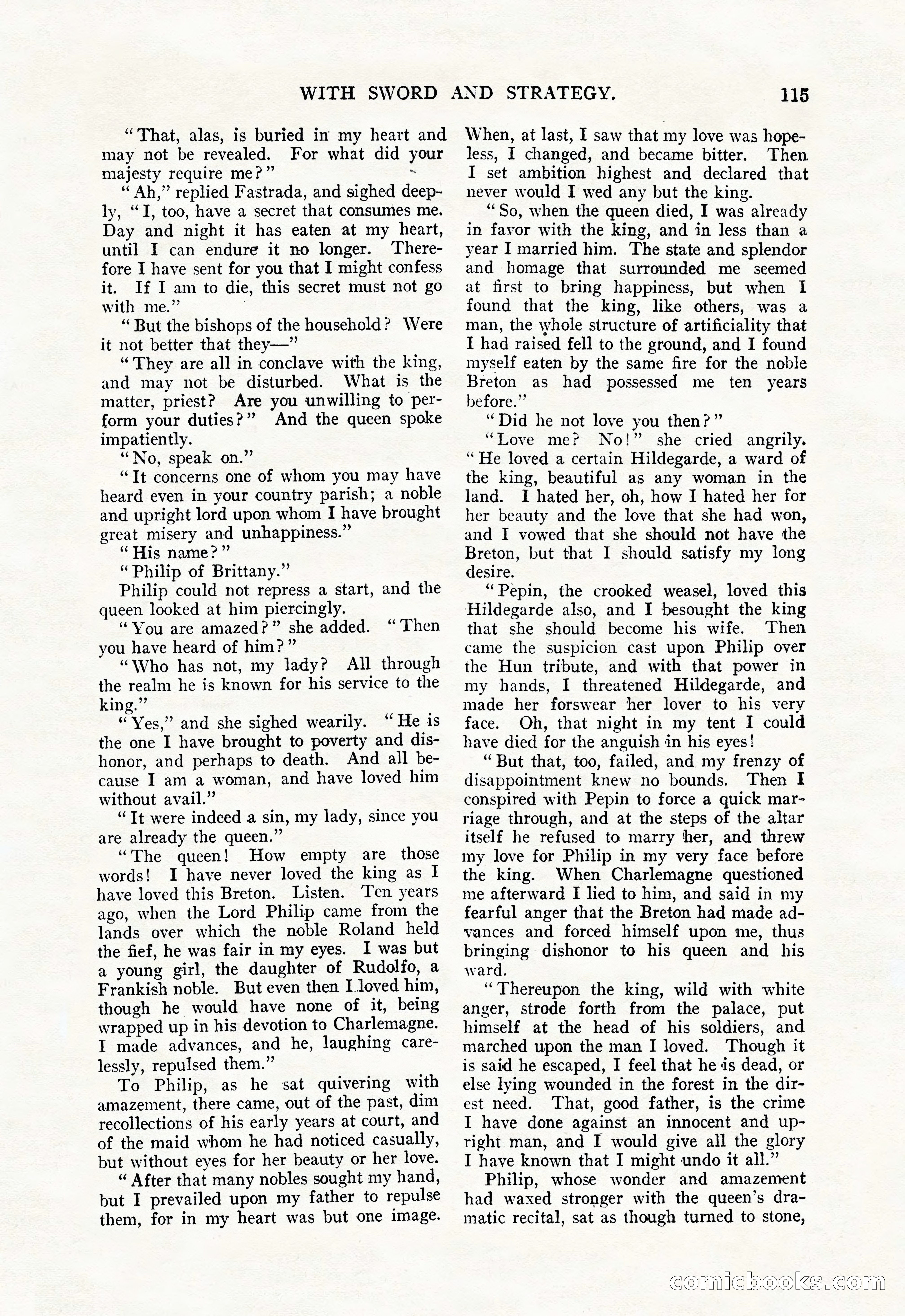
A restored page from Pulp Fiction, 1912. Page through the whole issue in the reader above.
📄 Transcribed text from this page (OCR, searchable)
Machine-transcribed from the original scan — historical spelling and the odd misread are preserved.
WITH SWORD AND STRATEGY, 115 “That, alas, is buried in my heart and may not be revealed. For what did your majesty require me?” * “Ah,” replied Fastrada, and sighed deep- ly, “I, too, have a secret that consumes me. Day and night it has eaten at my heart, until I can endure it no longer. ‘There- fore I have sent for you that I might confess it. If I am to die, this secret must not go with me.” : “But the bishops of the household? Were it not better that they—” “They are all in conclave with the king, and may not be disturbed. What is the matter, priest? Are you unwilling to per- form your duties?” And the queen spoke impatiently. “No, speak on.” “Tt concerns one of whom you may have heard even in your country parish; a noble and upright lord upon whom I have brought great misery and unhappiness.” “His name?” “Philip of Brittany.” Philip could not repress a start, and the queen looked at him piercingly. “Vou are amazed?” she added. “ Then you have heard of him?”’ “Who has not, my lady? All through the realm he is known for his service to the king.” “Ves,” and she sighed wearily. “ He is the one I have brought to poverty and dis- honor, and perhaps to death. And all be- cause I am a woman, and have loved him without avail.” “Tt were indeed a sin, my lady, since you are already the queen.” “The queen! How empty are those words! I have never loved the king as I have loved this Breton. Listen. Ten years ago, when the Lord Philip came from the lands over which the noble Roland held the fief, he was fair in my eyes. I was but a young girl, the daughter of Rudolfo, a Frankish noble. But even then I.loved him, though he would have none of it, being wrapped up in his devotion to Charlemagne. I made advances, and he, laughing care- lessly, repulsed them.” To Philip, as he sat quivering with amazement, there came, out of the past, dim recollections of his early years at court, and of the maid whom he had noticed casually, but without eyes for her beauty or her love. “ After that many nobles sought my hand, but I prevailed upon my father to repulse them, for in my heart was but one image. When, at last, I saw that my love was hope- less, I changed, and became bitter. Then I set ambition highest and declared that never would I wed any but the king. “So, when the queen died, I was already in favor with the king, and in less than a year I married him. The state and splendor and homage that surrounded me seemed at first to bring happiness, but when I found that the king, like others, was a man, the whole structure of artificiality that I had raised fell to the ground, and I found myself eaten by the same fire for the noble Breton as had possessed me ten years before.” “Did he not love you then?” ‘Love me? No!” she cried angrily. “He loved a certain Hildegarde, a ward of the king, beautiful as any woman in the land. I hated her, oh, how I hated her for her beauty and the love that she had won, and I vowed that she should not have the Breton, but that I should satisfy my long desire. “Pepin, the crooked weasel, loved this Hildegarde also, and I besought the king that she should become his wife. Then came the suspicion cast upon Philip over the Hun tribute, and with that power in my hands, I threatened Hildegarde, and made her forswear her lover to his very face. Oh, that night in my tent I could have died for the anguish in his eyes! “ But that, too, failed, and my frenzy of disappointment knew no bounds. Then I conspired with Pepin to force a quick mar- riage through, and at the steps of the altar itself he refused to marry her, and threw my love for Philip in my very face before the king. When Charlemagne questioned me afterward I lied to him, and said in my fearful anger that the Breton had made ad- vances and forced himself upon me, thus bringing dishonor to his queen and his ward. “Thereupon the king, wild with white anger, strode forth from the palace, put himself at the head of his soldiers, and marched upon the man I loved. Though it is said he escaped, I feel that he is dead, or else lying wounded in the forest in the dir- est need. That, good father, is the crime I have done against an innocent and up- right man, and I would give all the glory I have known that I might undo it all.” Philip, whose wonder and amazement had waxed stronger with the queen’s dra~ matic recital, sat as though turned to stone, comicaoolkks CO