
Pulp Fiction, 1912 · page 119 of 238
The Argosy, April 1912 — page 119: what you’re looking at
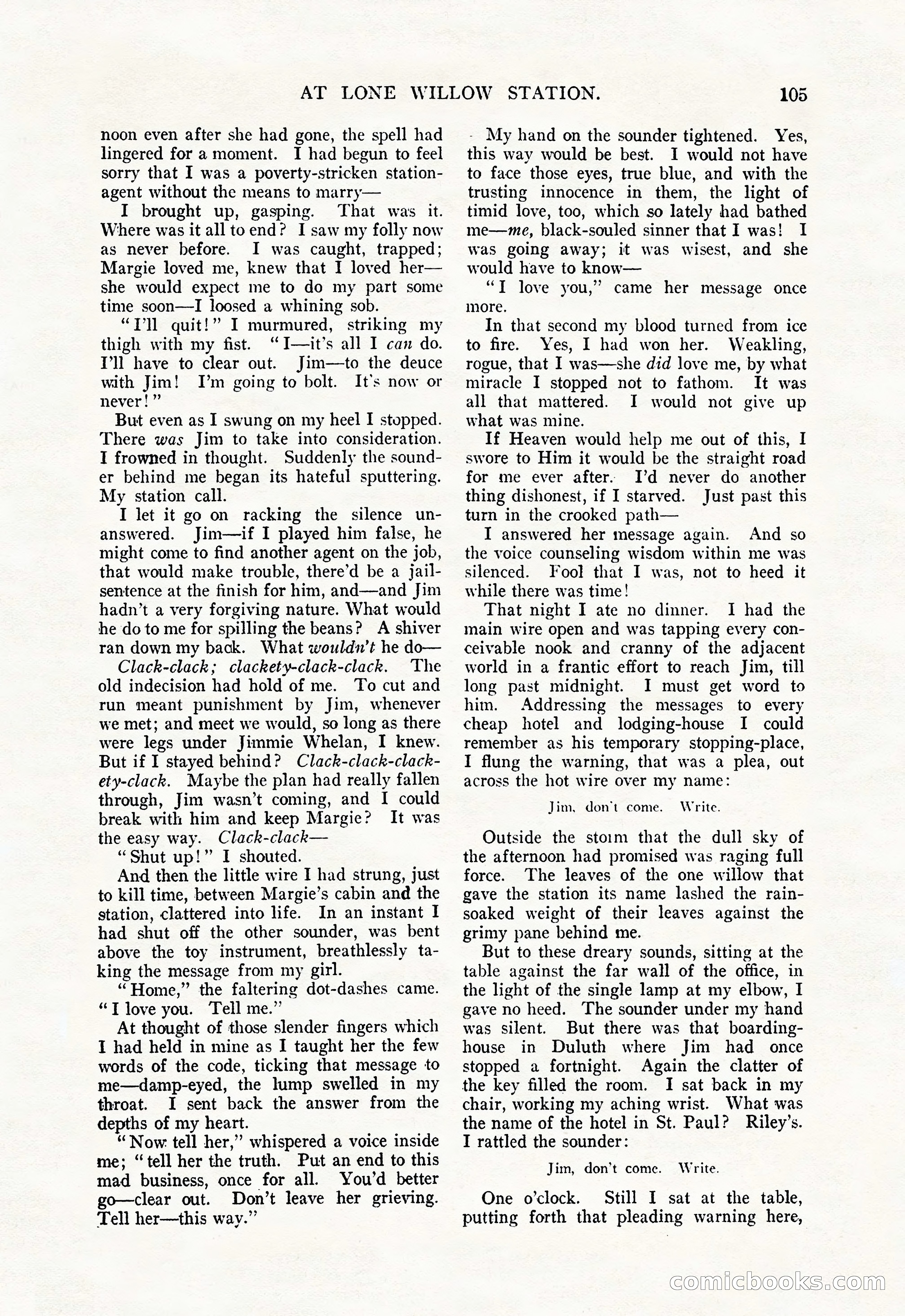
A restored page from Pulp Fiction, 1912. Page through the whole issue in the reader above.
📄 Transcribed text from this page (OCR, searchable)
Machine-transcribed from the original scan — historical spelling and the odd misread are preserved.
AT LONE WILLOW noon even after she had gone, the spell had lingered for a moment. I had begun to feel sorry that I was a poverty-stricken station- agent without the means to marry— I brought up, gasping. That was it. Where was it all toend? I saw my folly now as never before. I was caught, trapped; Margie loved me, knew that I loved her— she would expect me to do my part some time soon—I loosed a whining sob. “Yl quit!” I murmured, striking my thigh with my fist. ‘I—it’s all I can do. Tl have to clear out. Jim—to the deuce with Jim! I’m going to bolt. It’s now or never!” But even as I swung on my heel I stopped. There was Jim to take into consideration. I frowned in thought. Suddenly the sound- er behind me began its hateful sputtering. My station call. I let it go on racking the silence un- answered. Jim—if I played him false, he might come to find another agent on the job, that would make trouble, there’d be a jail- sentence at the finish for him, and—and Jim hadn’t a very forgiving nature. What would he do to me for spilling the beans? A shiver ran down my back. What wouldn’t he do— Clack-clack; clackety-clack-clack. ‘The old indecision had hold of me. To cut and run meant punishment by Jim, whenever we met; and meet we would, so long as there were legs under Jimmie Whelan, I knew. But if I stayed behind? Clack-clack-clack- ety-clack. Maybe the plan had really fallen through, Jim wasn’t coming, and I could break with him and keep Margie? It was the easy way. Clack-clack— “Shut up!” I shouted. And then the little wire I had strung, just to kill time, between Margie’s cabin and the station, clattered into life. In an instant I had shut off the other sounder, was bent above the toy instrument, breathlessly ta- king the message from my girl. “Home,” the faltering dot-dashes came. “T love you. Tell me.” At thought of those slender fingers which I had held in mine as I taught her the few words of the code, ticking that message to me—damp-eyed, the lump swelled in my throat. I sent back the answer from the depths of my heart. “Now tell her,” whispered a voice inside me; “tell her the truth. Put an end to this mad business, once for all. You'd better go—clear out. Don’t leave her grieving. Tell her—this way.” STATION. 105 - My hand on the sounder tightened. Yes, this way would be best. I would not have to face those eyes, true blue, and with the trusting innocence in them, the light of timid love, too, which so lately had bathed me—wme, black-souled sinner that I was! I was going away; it was wisest, and she would have to know— ‘““T love you,’ came her message once more. In that second my blood turned from ice to fire. Yes, I had won her. Weakling, rogue, that I was—she did love me, by what miracle I stopped not to fathom. It was all that mattered. I would not give up what was mine. If Heaven would help me out of this, I swore to Him it would be the straight road for me ever after. I’d never do another thing dishonest, if I starved. Just past this turn in the crooked path— I answered her message again. And so the voice counseling wisdom within me was silenced. Fool that I was, not to heed it while there was time! That night I ate no dinner. I had the main wire open and was tapping every con- ceivable nook and cranny of the adjacent world in a frantic effort to reach Jim, till long past midnight. I must get word to him. Addressing the messages to every cheap hotel and lodging-house I could remember as his temporary stopping-place, I flung the warning, that was a plea, out across the hot wire over my name: Jim, don’t come. Write. Outside the storm that the dull sky of the afternoon had promised was raging full force. The leaves of the one willow that gave the station its name lashed the rain- soaked weight of their leaves against the grimy pane behind me. But to these dreary sounds, sitting at the table against the far wall of the office, in the light of the single lamp at my elbow, I gave no heed. The sounder under my hand was silent. But there was that boarding- house in Duluth where Jim had once stopped a fortnight. Again the clatter of the key filled the room. I sat back in my chair, working my aching wrist. What was the name of the hotel in St. Paul? Riley’s. I rattled the sounder: Jim, don’t come. One o'clock. Still I sat at the table, putting forth that pleading warning here, Write. GoMmiGcdoo S CO