
Pulp Fiction, 1912 · page 118 of 238
The Argosy, April 1912 — page 118: what you’re looking at
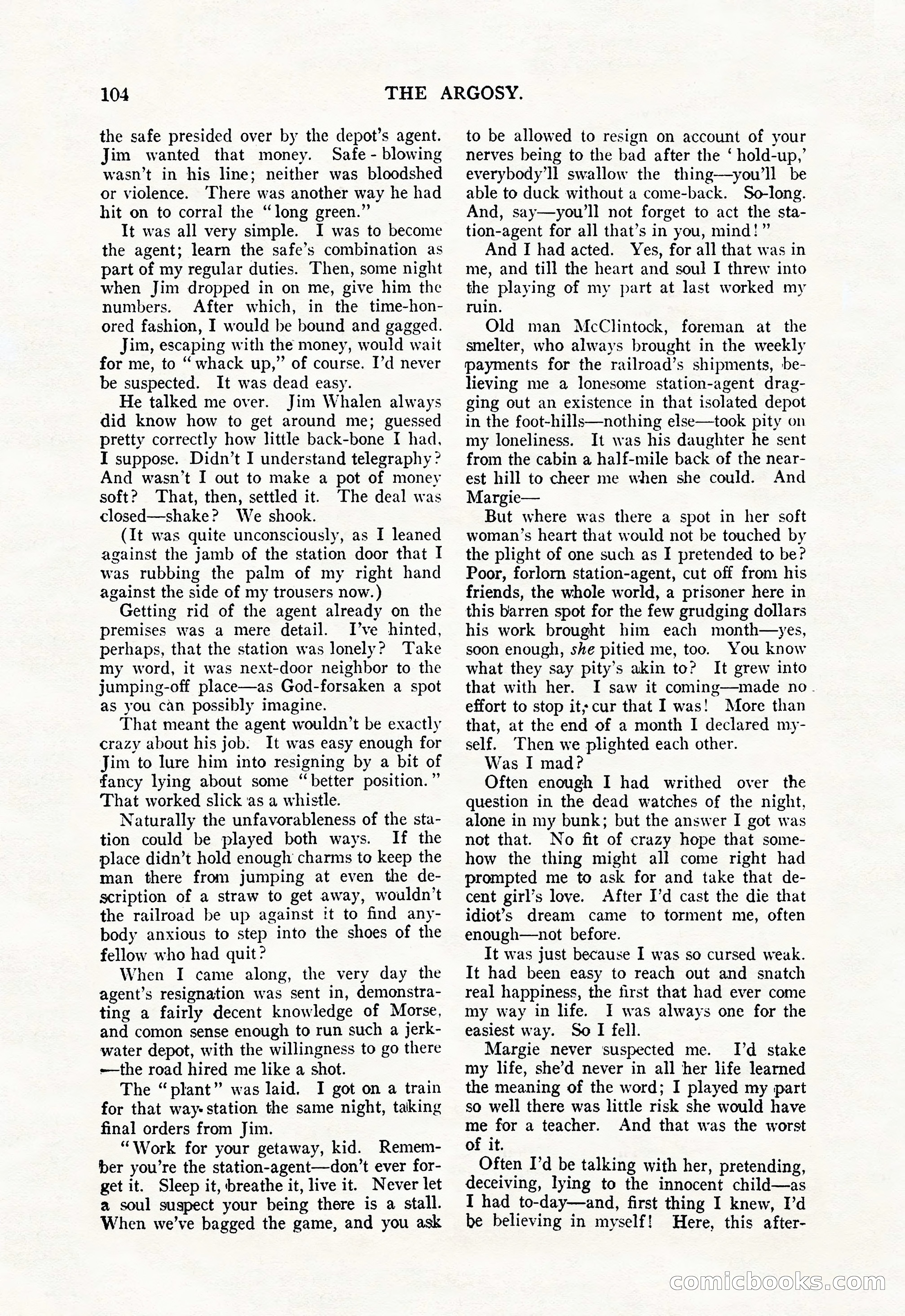
A restored page from Pulp Fiction, 1912. Page through the whole issue in the reader above.
📄 Transcribed text from this page (OCR, searchable)
Machine-transcribed from the original scan — historical spelling and the odd misread are preserved.
104 THE ARGOSY. the safe presided over by the depot’s agent. Jim wanted that money. Safe - blowing wasn’t in his line; neither was bloodshed or violence. There was another way he had hit on to corral the “long green.” It was all very simple. I was to become the agent; learn the safe’s combination as part of my regular duties. Then, some night when Jim dropped in on me, give him the numbers. After which, in the time-hon- ored fashion, I would be bound and gagged. Jim, escaping with the money, would wait for me, to “ whack up,” of course. I’d never be suspected. It was dead easy. He talked me over. Jim Whalen always did know how to get around me; guessed pretty correctly how little back-bone [ had, I suppose. Didn’t I understand telegraphy ? And wasn’t I out to make a pot of money soft? That, then, settled it. The deal was closed—shake? We shook. (It was quite unconsciously, as I leaned against the jamb of the station door that I was rubbing the palm of my right hand against the side of my trousers now.) Getting rid of the agent already on the premises was a mere detail. I’ve hinted, perhaps, that the station was lonely? Take my word, it was next-door neighbor to the jumping-off place—as God-forsaken a spot as you can possibly imagine. That meant the agent wouldn’t be exactly crazy about his job. It was easy enough for Jim to lure him into resigning by a bit of fancy lying about some “better position.” That worked slick ‘as a whistle. Naturally the unfavorableness of the sta- tion could be played both ways. If the place didn’t hold enough charms to keep the man there from jumping at even the de- scription of a straw to get away, wouldn’t the railroad be up against it to find any- body anxious to step into the shoes of the fellow who had quit? When I came along, the very day the agent’s resignation was sent in, demonstra- ting a fairly decent knowledge of Morse, and comon sense enough to run such a jerk- water depot, with the willingness to go there -~—the road hired me like a shot. The “plant” was laid. I got on a train for that way-station the same night, taking final orders from Jim. “Work for your getaway, kid. Remem- ber you’re the station-agent—don’t ever for- get it. Sleep it, breathe it, live it. Never let a soul suspect your being there is a stall. When we’ve bagged the game, and you ask to be allowed to resign on account of your nerves being to the bad after the ‘ hold-up,’ everybody’ll swallow the thing—you’ll be able to duck without a come-back. So-long. And, say—you’ll not forget to act the sta- tion-agent for all that’s in you, mind!” And I had acted. Yes, for all that was in me, and till the heart and soul I threw into the playing of my part at last worked my ruin. Old man McClintock, foreman at the smelter, who always brought in the weekly payments for the railroad’s shipments, be- heving me a lonesome station-agent drag- ging out an existence in that isolated depot in the foot-hills—nothing else—took pity on my loneliness. It was his daughter he sent from the cabin a half-mile back of the near- est hill to cheer me when she could. And Margie— But where was there a spot in her soft woman’s heart that would not be touched by the plight of one such as I pretended to be? Poor, forlorn station-agent, cut off from his friends, the whole world, a prisoner here in this barren spot for the few grudging dollars his work brought him each month—yes, soon enough, she pitied me, too. You know what they say pity’s akin to? It grew into that with her. I saw it coming—made no. effort to stop itscur that I was! More than that, at the end of a month I declared my- self. Then we plighted each other. Was I mad? Often enough I had writhed over the question in the dead watches of the night, alone in my bunk; but the answer I got was not that. No fit of crazy hope that some- how the thing might all come right had prompted me to ask for and take that de- cent girl’s love. After I’d cast the die that idiot’s dream came to torment me, often enough—not before. It was just because I was so cursed weak. It had been easy to reach out and snatch real happiness, the first that had ever come my way in life. I was always one for the easiest way. So I fell. Margie never suspected me. I'd stake my life, she’d never in all her life learned the meaning of the word; I played my part so well there was little risk she would have me for a teacher. And that was the worst of it. Often I’d be talking with her, pretending, deceiving, lying to the innocent child—as I had to-day—and, first thing I knew, I’d be believing in myself! Here, this after- comicaoolkks (CO