
Pulp Fiction, 1909 · page 87 of 266
The Argosy, Vol. 61, No. 4 — page 87: what you’re looking at
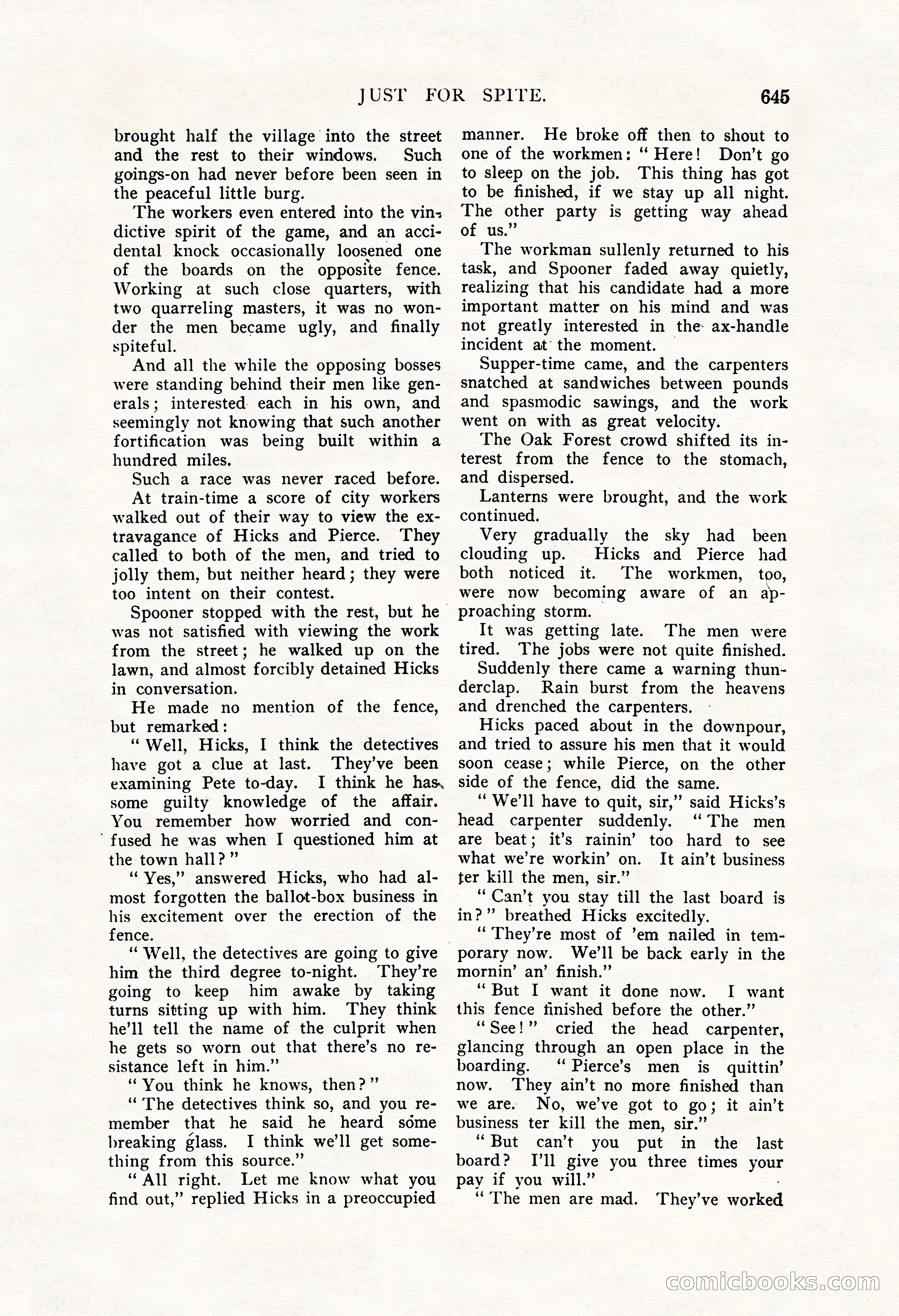
A restored page from Pulp Fiction, 1909. Page through the whole issue in the reader above.
📄 Transcribed text from this page (OCR, searchable)
Machine-transcribed from the original scan — historical spelling and the odd misread are preserved.
JUST brought half the village into the street and the rest to their windows. Such goings-on had never before been seen in the peaceful little burg. The workers even entered into the vin- dictive spirit of the game, and an acci- dental knock occasionally loosened one of the boards on the opposite fence. Working at such close quarters, with two quarreling masters, it was no won- der the men became ugly, and finally spiteful. And all the while the opposing bosses were standing behind their men like gen- erals; interested each in his own, and seemingly not knowing that such another fortification was being built within a hundred miles. Such a race was never raced before. At train-time a score of city workers walked out of their way to view the ex- travagance of Hicks and Pierce. They called to both of the men, and tried to jolly them, but neither heard; they were too intent on their contest. Spooner stopped with the rest, but he was not satisfied with viewing the work from the street; he walked up on the lawn, and almost forcibly detained Hicks in conversation. He made no mention of the fence, but remarked: “Well, Hicks, I think the detectives have got a clue at last. They’ve been examining Pete to-day. I think he has. some guilty knowledge of the affair. You remember how worried and con- ' fused he was when I questioned him at the town hall?” ‘“‘ Ves,” answered Hicks, who had al- most forgotten the ballot-box business in his excitement over the erection of the fence. ‘Well, the detectives are going to give him the third degree to-night. They’re going to keep him awake by taking turns sitting up with him. They think he’ll tell the name of the culprit when he gets so worn out that there’s no re- sistance left in him.” “You think he knows, then?” “The detectives think so, and you re- member that he said he heard some breaking glass. I think we'll get some- thing from this source.” “ All right. Let me know what you find out,” replied Hicks in a preoccupied FOR SPITE. porary now. 645 manner. He broke off then to shout to one of the workmen: “ Here! Don’t go to sleep on the job. This thing has got to be finished, if we stay up all night. The other party is getting way ahead of us.” The workman sullenly returned to his task, and Spooner faded away quietly, realizing that his candidate had a more important matter on his mind and was not greatly interested in the ax-handle incident at the moment. Supper-time came, and the carpenters snatched at sandwiches between pounds and spasmodic sawings, and the work went on with as great velocity. The Oak Forest crowd shifted its in- terest from the fence to the stomach, and dispersed. ) Lanterns were brought, and the work continued. Very gradually the sky had _ been clouding up. Hicks and Pierce had both noticed it. The workmen, too, were now becoming aware of an ap- _ proaching storm. It was getting late. The men were tired. The jobs were not quite finished. Suddenly there came a warning thun- derclap. Rain burst from the heavens and drenched the carpenters. Hicks paced about in the downpour, and tried to assure his men that it would soon cease; while Pierce, on the other side of the fence, did the same. “We'll have to quit, sir,” said Hicks’s head carpenter suddenly. ‘The men are beat; it’s rainin’ too hard to see what we’re workin’ on. It ain’t business ter kill the men, sir.” “Can’t you stay till the last board is in?”’ breathed Hicks excitedly. “ They’re most of ’em nailed in tem- We'll be back early in the mornin’ an’ finish.” “ But I want it done now. I want this fence finished before the other.”’ “See!’’ cried the head carpenter, glancing through an open place in the boarding. “ Pierce’s men is quittin’ now. ‘They ain’t no more finished than we are. No, we've got to go; it ain’t business ter kill the men, sir.” “But can’t you put in the last board? I’ll give you three times your pav if you will.” “The men are mad. They’ve worked OO (©