
Pulp Fiction, 1909 · page 86 of 266
The Argosy, Vol. 61, No. 4 — page 86: what you’re looking at
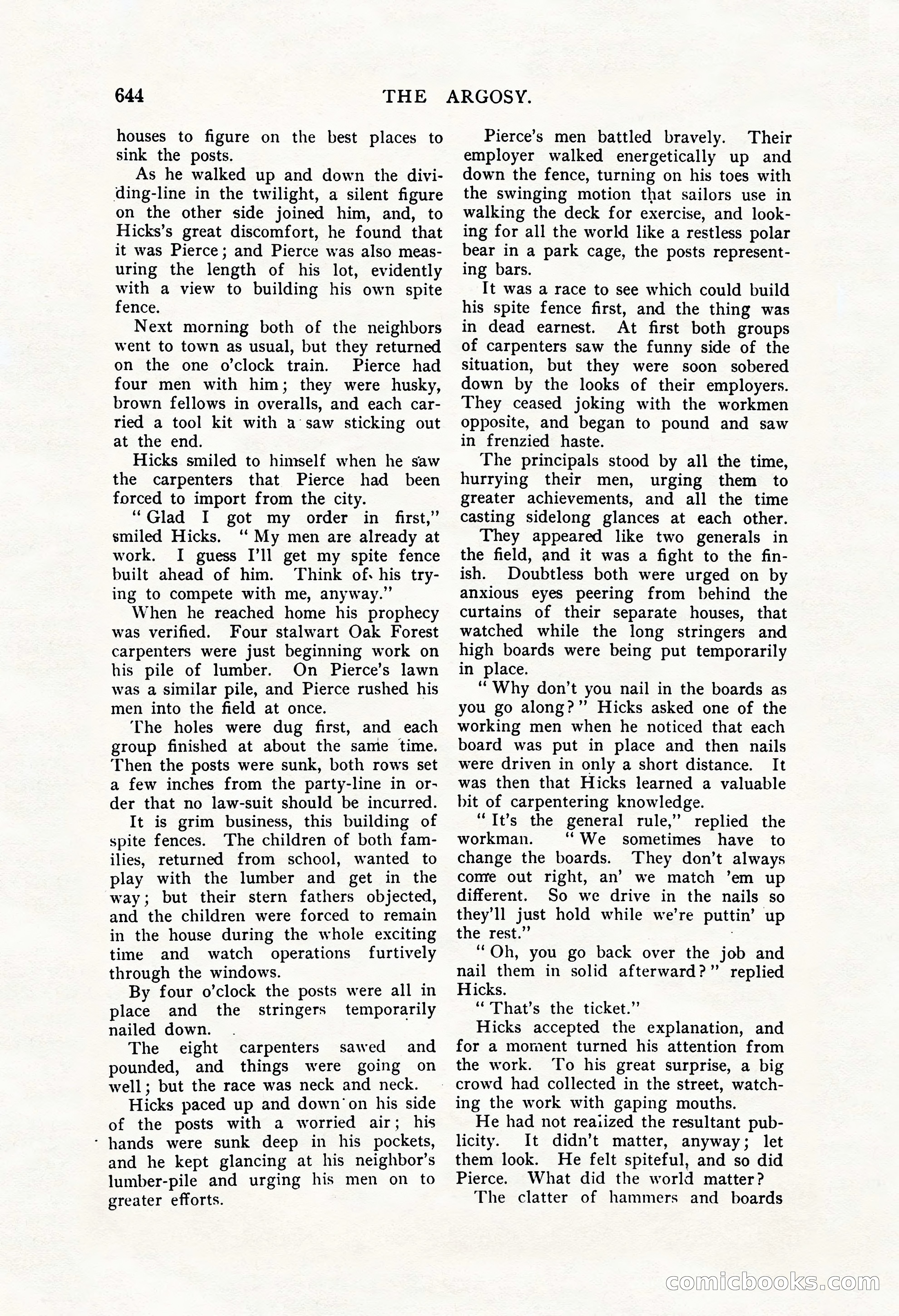
A restored page from Pulp Fiction, 1909. Page through the whole issue in the reader above.
📄 Transcribed text from this page (OCR, searchable)
Machine-transcribed from the original scan — historical spelling and the odd misread are preserved.
644 houses to figure on the best places to sink the posts. As he walked up and down the divi- ding-line in the twilight, a silent figure on the other side joined him, and, to Hicks’s great discomfort, he found that it was Pierce; and Pierce was also meas- uring the length of his lot, evidently with a view to building his own spite fence. Next morning both of the neighbors went to town as usual, but they returned on the one o'clock train. Pierce had four men with him; they were husky, brown fellows in overalls, and each car- ried a tool kit with a saw sticking out at the end. Hicks smiled to himself when he saw the carpenters that Pierce had been forced to import from the city. “Glad I got my order in first,” smiled Hicks. ‘‘ My men are already at work. I guess I’ll get my spite fence built ahead of him. Think of. his try- ing to compete with me, anyway.” When he reached home his prophecy was verified. Four stalwart Oak Forest carpenters were just beginning work on his pile of lumber. On Pierce’s lawn was a similar pile, and Pierce rushed his men into the field at once. The holes were dug first, and each group finished at about the same time. Then the posts were sunk, both rows set a few inches from the party-line in or- der that no law-suit should be incurred. It is grim business, this building of spite fences. The children of both fam- ilies, returned from school, wanted to play with the lumber and get in the way; but their stern fathers objected, and the children were forced to remain in the house during the whole exciting time and watch operations furtively through the windows. By four o’clock the posts were all in place and the stringers temporarily nailed down. The eight carpenters sawed and pounded, and things were going on well; but the race was neck and neck. Hicks paced up and down on his side of the posts with a worried air; his - hands were sunk deep in his pockets, and he kept glancing at his neighbor’s lumber-pile and urging his men on to greater efforts. THE ARGOSY. Pierce’s men battled bravely. Their employer walked energetically up and down the fence, turning on his toes with the swinging motion that sailors use in walking the deck for exercise, and look- ing for all the world like a restless polar bear in a park cage, the posts represent- ing bars. It was a race to see which could build his spite fence first, and the thing was in dead earnest. At first both groups of carpenters saw the funny side of the situation, but they were soon sobered down by the looks of their employers. They ceased joking with the workmen Opposite, and began to pound and saw in frenzied haste. The principals stood by all the time, hurrying their men, urging them to greater achievements, and all the time casting sidelong glances at each other. They appeared like two generals in the field, and it was a fight to the fin- ish. Doubtless both were urged on by anxious eyes peering from behind the curtains of their separate houses, that watched while the long stringers and high boards were being put temporarily in place. “Why don’t you nail in the boards as you go along?” Hicks asked one of the working men when he noticed that each board was put in place and then nails were driven in only a short distance. It was then that Hicks learned a valuable bit of carpentering knowledge. ‘It’s the general rule,’ replied the workman. ‘“We sometimes have to change the boards. They don’t always come out right, an’ we match ’em up different. So we drive in the nails so they’ll just hold while we’re puttin’ up the rest.” ; ‘Oh, you go back over the job and nail them in solid afterward?” replied Hicks. ‘“That’s the ticket.” Hicks accepted the explanation, and for a moment turned his attention from the work. To his great surprise, a big - crowd had collected in the street, watch- ing the work with gaping mouths. He had not reaiized the resultant pub- licity. It didn’t matter, anyway; let them look. He felt spiteful, and so did Pierce. What did the world matter? The clatter of hammers and _ boards EO OO (©