
Pulp Fiction, 1909 · page 70 of 266
The Argosy, Vol. 61, No. 4 — page 70: what you’re looking at
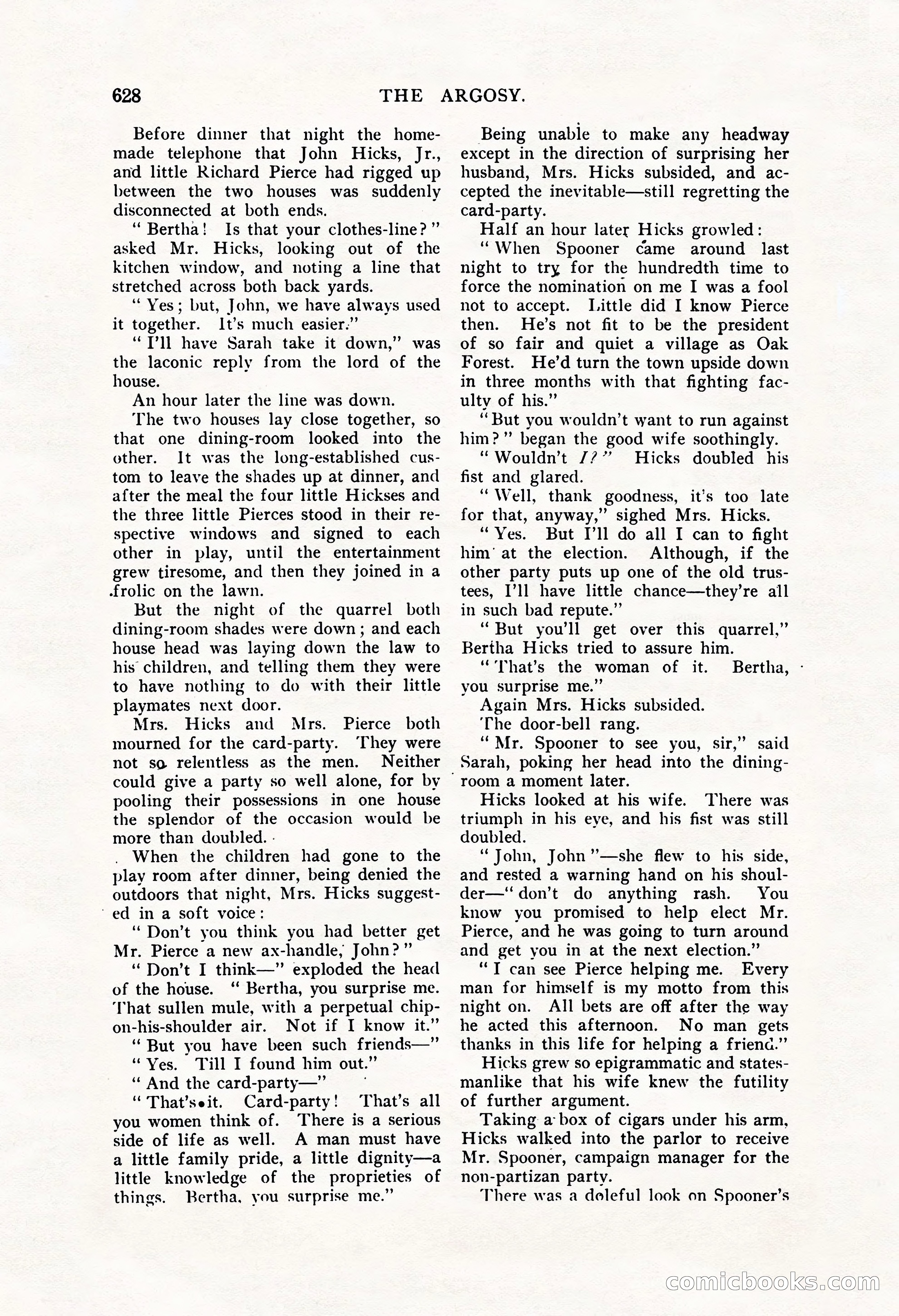
A restored page from Pulp Fiction, 1909. Page through the whole issue in the reader above.
📄 Transcribed text from this page (OCR, searchable)
Machine-transcribed from the original scan — historical spelling and the odd misread are preserved.
628 Before dinner that night the home- made telephone that John Hicks, Jr., and little Richard Pierce had rigged up between the two houses was suddenly disconnected at both ends. ‘Bertha! Is that your clothes-line? ” asked Mr. Hicks, looking out of the kitchen window, and noting a line that stretched across both back yards. “Yes; but, John, we have always used it together. It’s much easier.” ‘*T’ll have Sarah take it down,” was the laconic reply from the lord of the house. An hour later the line was down. The two houses lay close together, so that one dining-room looked into the other. It was the long-established cus- tom to leave the shades up at dinner, and after the meal the four little Hickses and the three little Pierces stood in their re- spective windows and signed to each other in play, until the entertainment grew tiresome, and then they joined in a frolic on the lawn. But the night of the quarrel both dining-room shades were down; and each house head was laying down the law to his children, and telling them they were to have nothing to do with their little playmates next door. Mrs. Hicks and Mrs. mourned for the card-party. ‘They were not so relentless as the men. Neither could give a party so well alone, for by pooling their possessions in one house the splendor of the occasion would be more than doubled. - When the children had gone to the play room after dinner, being denied the outdoors that night, Mrs. Hicks suggest- ~ ed in a soft voice: ‘Don’t you think you had better get Mr. Pierce a new ax-handle, John?” “Don’t I think—” exploded the head of the house. ‘‘ Bertha, you surprise me. That sullen mule, with a perpetual chip- on-his-shoulder air. Not if I know it.” ‘But you have been such friends—” “Ves. Till I found him out.” “And the card-party—”’ “That’seit. Card-party! That’s all you women think of. There is a serious side of life as well. A man must have a little family pride, a little dignity—a little knowledge of the proprieties of things. Bertha, you surprise me.” Pierce both THE ARGOSY. Being unable to make any headway except in the direction of surprising her husband, Mrs. Hicks subsided, and ac- cepted the inevitable—still regretting the card-party. Half an hour later Hicks growled: ‘“When Spooner came around last night to try for the hundredth time to force the nomination on me I was a fool not to accept. Little did I know Pierce then. He’s not fit to be the president of so fair and quiet a village as Oak Forest. He’d turn the town upside down in three months with that fighting fac- ultyv of his.” ‘But you wouldn’t want to run against him?” began the good wife soothingly. “Wouldn’t 7?” Hicks doubled his fist and glared. “Well, thank goodness, it’s too late for that, anyway,’ sighed Mrs. Hicks. “Yes. But Ill do all I can to fight him’ at the election. Although, if the other party puts up one of the old trus- tees, I’ll have little chance—they’re all in such bad repute.” ‘But you'll get over this quarrel,” Bertha Hicks tried to assure him. ‘That’s the woman of it. you surprise me.” Again Mrs. Hicks subsided. ‘The door-bell rang. ‘“Mr. Spooner to see you, sir,” said Sarah, poking her head into the dining- room a moment later. Hicks looked at his wife. There was triumph in his eye, and his fist was still doubled. ‘John, John ”’—she flew to his side, and rested a warning hand on his shoul- der—‘‘ don’t do anything rash. You know you promised to help elect Mr. Pierce, and he was going to turn around and get you in at the next election.” ““T can see Pierce helping me. Every man for himself is my motto from this night on. All bets are off after the way he acted this afternoon. No man gets thanks in this life for helping a friend.” Hicks grew so epigrammatic and states- manlike that his wife knew the futility of further argument. Taking a box of cigars under his arm, Hicks walked into the parlor to receive Mr. Spooner, campaign manager for the non-partizan party. There was a doleful look on Spooner’s EO OO Bertha, -