
Pulp Fiction, 1909 · page 69 of 266
The Argosy, Vol. 61, No. 4 — page 69: what you’re looking at
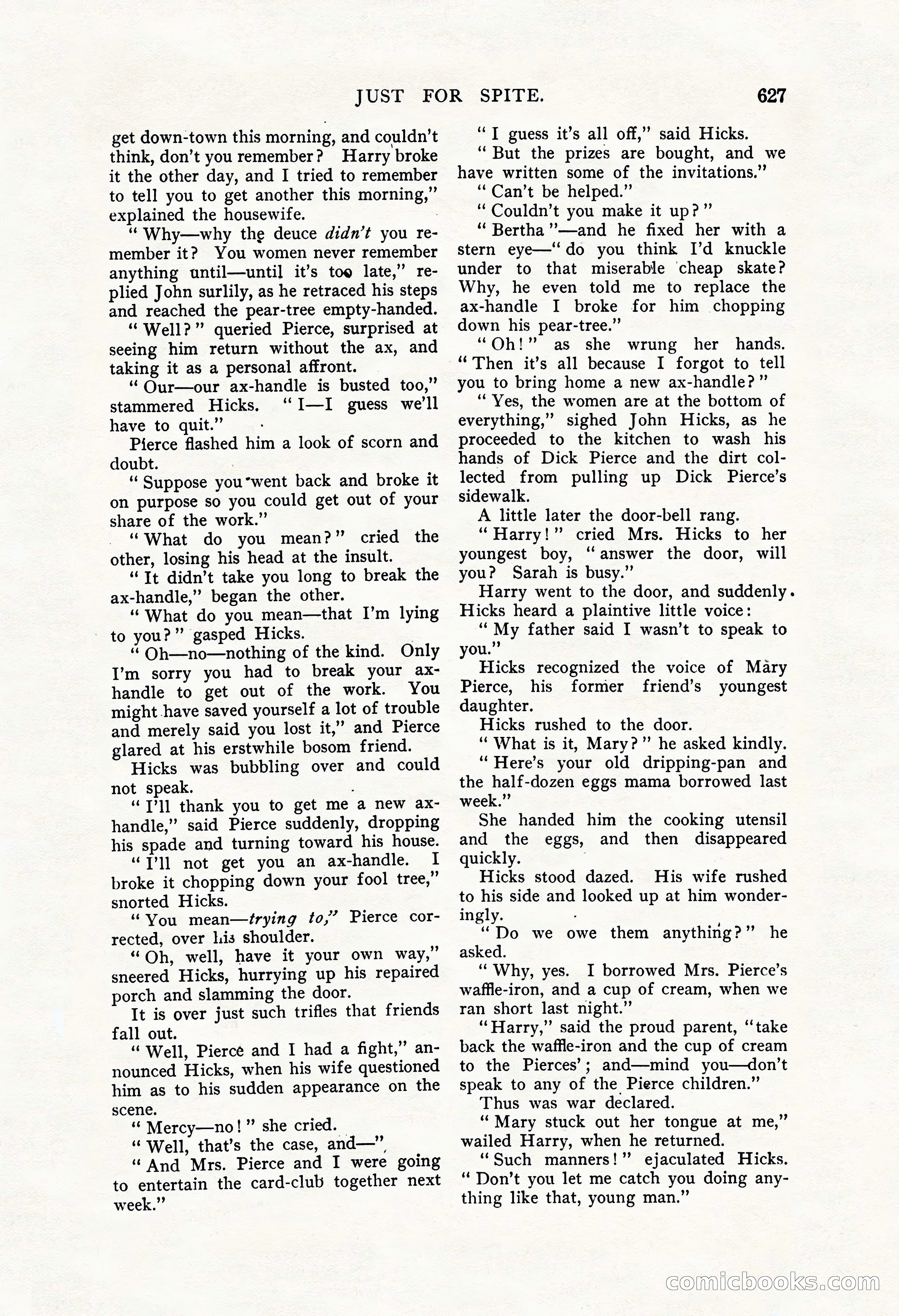
A restored page from Pulp Fiction, 1909. Page through the whole issue in the reader above.
📄 Transcribed text from this page (OCR, searchable)
Machine-transcribed from the original scan — historical spelling and the odd misread are preserved.
JUST FOR SPITE. get down-town this morning, and couldn't think, don’t you remember? Harry broke it the other day, and I tried to remember to tell you to get another this morning,” explained the housewife. : ‘“Why—why the deuce didn’t you re- member it? You women never remember anything until—until it’s toe late,” re- plied John surlily, as he retraced his steps and reached the pear-tree empty-handed. “Well?” queried Pierce, surprised at seeing him return without the ax, and taking it as a personal affront. “ Our—our ax-handle is busted too,” stammered Hicks. ‘“‘I—I guess we'll have to quit.” Pierce flashed him a look of scorn and doubt. ‘“ Suppose you’went back and broke it on purpose so you could get out of your share of the work.” “What do you mean?” cried the other, losing his head at the insult. “Tt didn’t take you long to break the ax-handle,” began the other. “What do you mean—that I’m lying to you?” gasped Hicks. 7 “ Oh—no—nothing of the kind. Only I’m sorry you had to break your ax- handle to get out of the work. You might have saved yourself a lot of trouble and merely said you lost it,” and Pierce glared at his erstwhile bosom friend. Hicks was bubbling over and could not speak. “T’ll thank you to get me a new ax- handle,” said Pierce suddenly, dropping his spade and turning toward his house. “T’l] not get you an ax-handle. 1 broke it chopping down your fool tree,” snorted Hicks. “Vou mean—frying to,’ Pierce cor- rected, over his shoulder. “Oh, well, have it your own way,” sneered Hicks, hurrying up his repaired porch and slamming the door. ; It is over just such trifles that friends fall out. “ Well, Pierce and I had a fight,” an- nounced Hicks, when his wife questioned him as to his sudden appearance on the scene. ‘““ Mercy—no!” she cried. — “Well, that’s the case, and—”, “And Mrs. Pierce and I were going to entertain the card-club together next week.” 627 ‘“T guess it’s all off,” said Hicks. ‘But the prizes are bought, and we have written some of the invitations.” ‘“Can’t be helped.” ‘““Couldn’t you make it up?” ‘“‘ Bertha ’—and he fixed her with a stern eye—‘‘ do you think I’d knuckle under to that miserable cheap skate? Why, he even told me to replace the ax-handle I broke for him chopping down his pear-tree.” “Oh!” as she wrung her hands. “Then it’s all because I forgot to tell you to bring home a new ax-handle?” ‘“‘'Yes, the women are at the bottom of everything,” sighed John Hicks, as he proceeded to the kitchen to wash his hands of Dick Pierce and the dirt col- lected from pulling up Dick Pierce’s sidewalk. A little later the door-bell rang. “Harry!” cried Mrs. Hicks to her youngest boy, ‘‘answer the door, will you? Sarah is busy.” Harry went to the door, and suddenly. Hicks heard a plaintive little voice: ‘My father said I wasn’t to speak to you.” Hicks recognized the voice of Mary Pierce, his former friend’s youngest daughter. Hicks rushed to the door. ‘What is it, Mary?” he asked kindly. ‘‘Here’s your old dripping-pan and the half-dozen eggs mama borrowed last week.” She handed him the cooking utensil and the eggs, and then disappeared quickly. Hicks stood dazed. His wife rushed to his side and looked up at him wonder- ingly. “Do we owe them anything?” he asked. ‘Why, yes. I borrowed Mrs. Pierce’s waffle-iron, and a cup of cream, when we ran short last night.” “Harry,” said the proud parent, “‘take back the waffle-iron and the cup of cream to the Pierces’; and—mind you—don’t speak to any of the Pierce children.” Thus was war declared. “Mary stuck out her tongue at me,” wailed Harry, when he returned. ‘‘Such manners!” ejaculated Hicks. ‘Don’t you let me catch you doing any- thing like that, young man.” EO OO (C (©