
Pulp Fiction, 1909 · page 51 of 266
The Argosy, Vol. 61, No. 4 — page 51: what you’re looking at
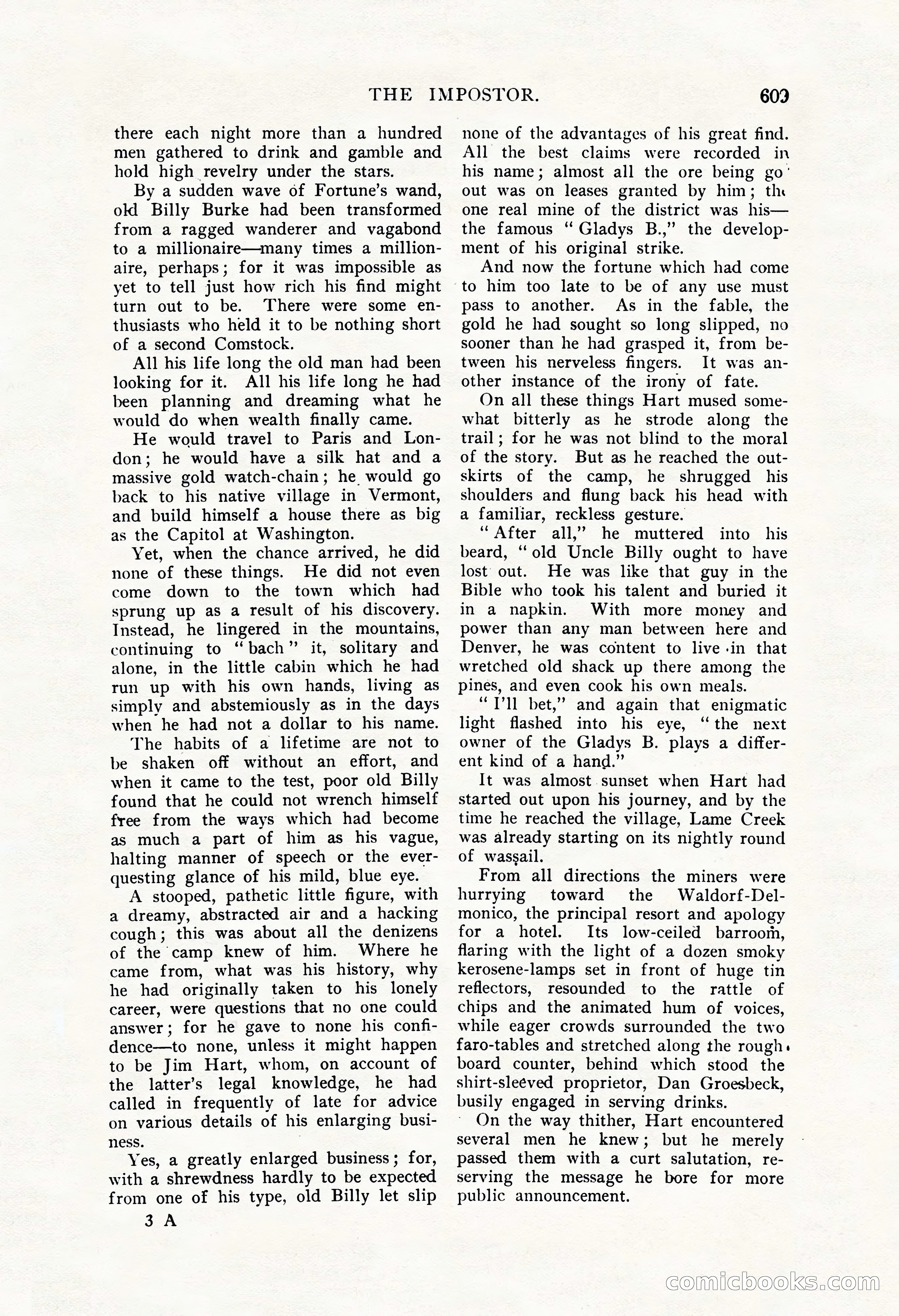
A restored page from Pulp Fiction, 1909. Page through the whole issue in the reader above.
📄 Transcribed text from this page (OCR, searchable)
Machine-transcribed from the original scan — historical spelling and the odd misread are preserved.
THE IMPOSTOR. there each night more than a hundred men gathered to drink and gamble and hold high revelry under the stars. By a sudden wave of Fortune’s wand, old Billy Burke had been transformed from a ragged wanderer and vagabond to a millionaire—many times a million- aire, perhaps; for it was impossible as yet to tell just how rich his find might turn out to be. There were some en- thusiasts who held it to be nothing short of a second Comstock. All his life long the old man had been looking for it. All his life long he had been planning and dreaming what he would do when wealth finally came. He would travel to Paris and Lon- don; he would have a silk hat and a massive gold watch-chain; he would go back to his native village in Vermont, and build himself a house there as big as the Capitol at Washington. Yet, when the chance arrived, he did none of these things. He did not even come down to the town which had sprung up as a result of his discovery. Instead, he lingered in the mountains, continuing to “bach” it, solitary and alone, in the little cabin which he had run up with his own hands, living as simply and abstemiously as in the days when he had not a dollar to his name. The habits of a lifetime are not to be shaken off without an effort, and when it came to the test, poor old Billy found that he could not wrench himself free from the ways which had become as much a part of him as his vague, halting manner of speech or the ever- questing glance of his mild, blue eye. A stooped, pathetic little figure, with a dreamy, abstracted air and a hacking cough; this was about all the denizens of the camp knew of him. Where he came from, what was his history, why he had originally taken to his lonely career, were questions that no one could answer; for he gave to none his confi- dence—to none, unless it might happen to be Jim Hart, whom, on account of the latter’s legal knowledge, he had called in frequently of late for advice on various details of his enlarging busi- ness. Yes, a greatly enlarged business; for, with a shrewdness hardly to be expected from one of his type, old Billy let slip 3 A 603 none of the advantages of his great find. All the best claims were recorded in his name; almost all the ore being go’ out was on leases granted by him; thx one real mine of the district was his— the famous “ Gladys B.,” the develop- ment of his original strike. And now the fortune which had come ‘to him too late to be of any use must pass to another. As in the fable, the gold he had sought so long slipped, no sooner than he had grasped it, from be- tween his nerveless fingers. It was an- other instance of the irony of fate. On all these things Hart mused some- what bitterly as he strode along the trail; for he was not blind to the moral of the story. But as he reached the out- skirts of the camp, he shrugged his shoulders and flung back his head with a familiar, reckless gesture. ‘After all,” he muttered into his beard, “old Uncle Billy ought to have lost out. He was like that guy in the Bible who took his talent and buried it in a napkin. With more money and power than any man between here and Denver, he was content to live-in that wretched old shack up there among the pines, and even cook his own meals. “Tl bet,” and again that enigmatic light flashed into his eye, ‘the next owner of the Gladys B. plays a differ- ent kind of a hand.” It was almost sunset when Hart had started out upon his journey, and by the time he reached the village, Lame Creek was already starting on its nightly round of wassail. From all directions the miners were hurrying toward the Waldorf-Del- monico, the principal resort and apology for a hotel. Its low-ceiled barroom, flaring with the light of a dozen smoky kerosene-lamps set in front of huge tin reflectors, resounded to the rattle of chips and the animated hum of voices, while eager crowds surrounded the two faro-tables and stretched along the rough. board counter, behind which stood the shirt-sleéved proprietor, Dan Groesbeck, busily engaged in serving drinks. On the way thither, Hart encountered several men he knew; but he merely passed them with a curt salutation, re- serving the message he bore for more public announcement. Gioo (©