
Pulp Fiction, 1909 · page 50 of 266
The Argosy, Vol. 61, No. 4 — page 50: what you’re looking at
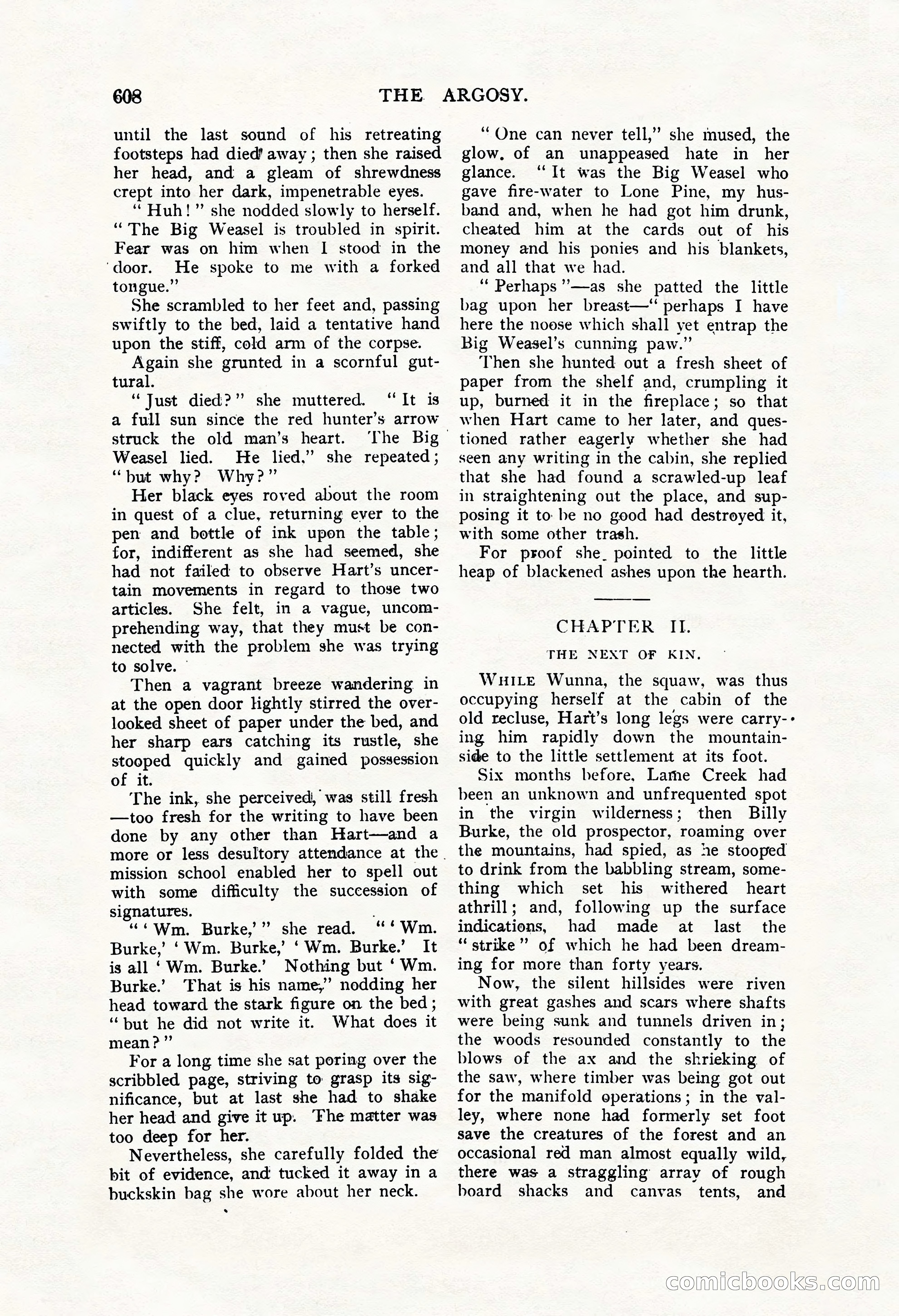
A restored page from Pulp Fiction, 1909. Page through the whole issue in the reader above.
📄 Transcribed text from this page (OCR, searchable)
Machine-transcribed from the original scan — historical spelling and the odd misread are preserved.
608 until the last sound of his retreating footsteps had died’ away ; then she raised her head, and a gleam of shrewdness crept into her dark, impenetrable eyes. “Huh!” she nodded slowly to herself. “The Big Weasel is troubled in spirit. Fear was on him when I stood in the ‘door. He spoke to me with a forked tongue.” She scrambled to her feet and, passing swiftly to the bed, laid a tentative hand upon the stiff, cold arm of the corpse. Again she grunted in a scornful gut- tural. ‘Just died?” she muttered. “It is a full sun since the red hunter’s arrow struck the old man’s heart. Weasel lied. He lied,” she repeated ; “but why? Why?” Her black eyes roved about the room in quest of a clue, returning ever to the pen and bottle of ink upon the table; for, indifferent as she had seemed, she had not failed to observe Hart’s uncer- tain movements in regard to those two articles. She felt, in a vague, uncom- prehending way, that they must be con- nected with the problem she was trying to solve. © Then a vagrant breeze wandering in at the open door lightly stirred the over- looked sheet of paper under the bed, and her sharp ears catching its rustle, she stooped quickly and gained possession of it. The ink, she perceived, was still fresh —too fresh for the writing to have been done by any other than Hart—and a more or less desultory attendance at the. mission school enabled her to spell out with some difficulty the succession of signatures. ‘““¢ Wm. Burke,’” she read. ‘‘*‘ Wm. Burke,’ ‘Wm. Burke,’ ‘Wm. Burke.’ It is all ‘Wm. Burke.’ Nothing but ‘Wm. Burke.’ ‘That is his name,’ nodding her head toward the stark figure on the bed ; “but he did not write it. What does it mean ?”’ For a long time she sat poring over the scribbled page, striving to grasp its sig- nificance, but at last she had to shake her head and give it up. The matter was too deep for her. Nevertheless, she carefully folded the bit of evidence, and tucked it away in a buckskin bag she wore about her neck. e The Big THE. ARGOSY. “One can never tell,’’ she mused, the glow, of an unappeased hate in her glance. “It was the Big Weasel who gave fire-water to Lone Pine, my hus- band and, when he had got him drunk, cheated him at the cards out of his money and his ponies and his blankets, and all that we had. ‘’ Perhaps ’’—as she patted the little bag upon her breast—‘ perhaps I have here the noose which shall yet entrap the Big Weasel’s cunning paw.” Then she hunted out a fresh sheet of paper from the shelf and, crumpling it up, burned it in the fireplace; so that when Hart came to her later, and ques- tioned rather eagerly whether she had seen any writing in the cabin, she replied that she had found a scrawled-up leaf in straightening out the place, and sup- posing it to be no good had destroyed it, with some other trash. For proof she_ pointed to the little heap of blackened ashes upon the hearth. CHAPTER II. THE NEXT OF KIN. WHILE Wunna, the squaw, was thus occupying herself at the cabin of the old recluse, Har'’s long legs were carry-:> ing him rapidly down the mountain- side to the little settlement at its foot. Six months before, Larhe Creek had been an unknown and unfrequented spot in the virgin wilderness; then Billy Burke, the old prospector, roaming over the mountains, had spied, as he stooped to drink from the babbling stream, some- thing which set his withered heart athrill; and, following up the surface indications, had made at last the ‘““ strike’ of which he had been dream- ing for more than forty years. Now, the silent hillsides were riven with great gashes and scars where shafts were being sunk and tunnels driven in; the woods resounded constantly to the blows of the ax and the shrieking of the saw, where timber was being got out for the manifold operations; in the val- ley, where none had formerly set foot save the creatures of the forest and an occasional red man almost equally wild, there was a straggling array of rough board shacks and canvas tents, and OO) (C©