
Pulp Fiction, 1909 · page 42 of 266
The Argosy, Vol. 61, No. 4 — page 42: what you’re looking at
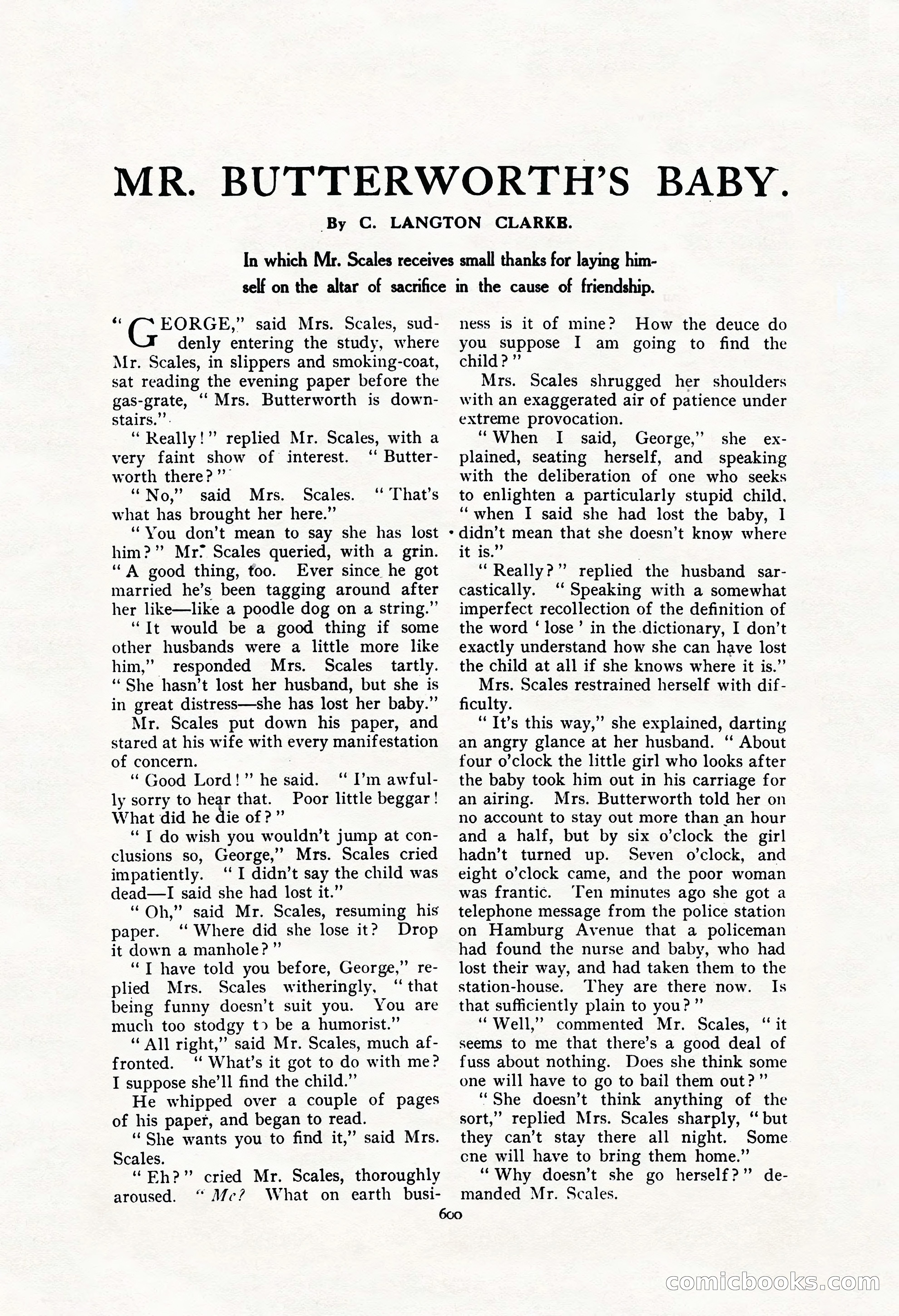
A restored page from Pulp Fiction, 1909. Page through the whole issue in the reader above.
📄 Transcribed text from this page (OCR, searchable)
Machine-transcribed from the original scan — historical spelling and the odd misread are preserved.
MR. BUTTERWORTH’S BABY. By C. LANGTON CLARKE. In which Mr. Scales receives small thanks for laying him- self on the altar of sacrifice in the cause of friendship. = EORGE,” said Mrs. Scales, sud- denly entering the study, where Mr. Scales, in slippers and smoking-coat, sat reading the evening paper before the gas-grate, ‘ Mrs. Butterworth is down- stairs.’’. ‘“ Really!” replied Mr. Scales, with a very faint show of interest. “ Butter- worth there?” “No,” said Mrs. Scales. ‘“ That’s what has brought her here.” ‘‘You don’t mean to say she has lost him?” Mr’ Scales queried, with a grin. ‘“A good thing, too. Ever since he got married he’s been tagging around after her like—like a poodle dog on a string.” “It would be a good thing if some other husbands were a little more like him,” responded Mrs. Scales tartly. ‘““She hasn’t lost her husband, but she is in great distress—she has lost her baby.” Mr. Scales put down his paper, and stared at his wife with every manifestation of concern. | “Good Lord!” he said. ‘“ I’m awful- ly sorry to sy that. Poor little beggar ! What did he die of ?” ‘I do wish you wouldn’t jump at con- clusions so, George,” Mrs. Scales cried impatiently. ‘‘ I didn’t say the child was dead—I said she had lost it.” “Oh,” said Mr. Scales, resuming his paper. ‘‘ Where did she lose it? Drop it down a manhole? ”’ ‘“T have told you before, George,” re- plied Mrs. Scales witheringly, “ that being funny doesn’t suit you. You are much too stodgy t> be a humorist.” ‘All right,” said Mr. Scales, much af- fronted. ‘‘ What’s it got to do with me? I suppose she’ll find the child.” He whipped over a couple of pages of his paper, and began to read. ‘She wants you to find it,” said Mrs. Scales. “Eh?” cried Mr. Scales, thoroughly aroused. “ Mec? What on earth busi- hess is it of mine? How the deuce do you suppose I am going to find the child?” Mrs. Scales shrugged her shoulders with an exaggerated air of patience under extreme provocation. ‘When I said, George,” she _ ex- plained, seating herself, and speaking with the deliberation of one who seeks to enlighten a particularly stupid child. “when I said she had lost the baby, 1 didn’t mean that she doesn’t know where it is.” “Really?” replied the husband sar- castically. ‘‘ Speaking with a somewhat imperfect recollection of the definition of the word ‘ lose’ in the dictionary, I don’t exactly understand how she can have lost the child at all if she knows where it is.” Mrs. Scales restrained herself with dif- ficulty. “It’s this way,” she explained, darting an angry glance at her husband. ‘‘ About four o’clock the little girl who looks after the baby took him out in his carriage for an airing. Mrs. Butterworth told her on no account to stay out more than an hour and a half, but by six o’clock the girl hadn’t turned up. Seven o’clock, and eight o’clock came, and the poor woman was frantic. ‘Ten minutes ago she got a telephone message from the police station on Hamburg Avenue that a policeman had found the nurse and baby, who had lost their way, and had taken them to the station-house. ‘They are there now. Is that sufficiently plain to you?” ‘‘ Well,’”” commented Mr. Scales, “ it seems to me that there’s a good deal of fuss about nothing. Does she think some one will have to go to bail them out?” ‘“She doesn’t think anything of the sort,” replied Mrs. Scales sharply, ‘‘ but they can’t stay there all night. Some cne will have to bring them home.” ‘“Why doesn’t she go herself?” de- manded Mr. Scales. 600 OO (©