
Pulp Fiction, 1909 · page 41 of 266
The Argosy, Vol. 61, No. 4 — page 41: what you’re looking at
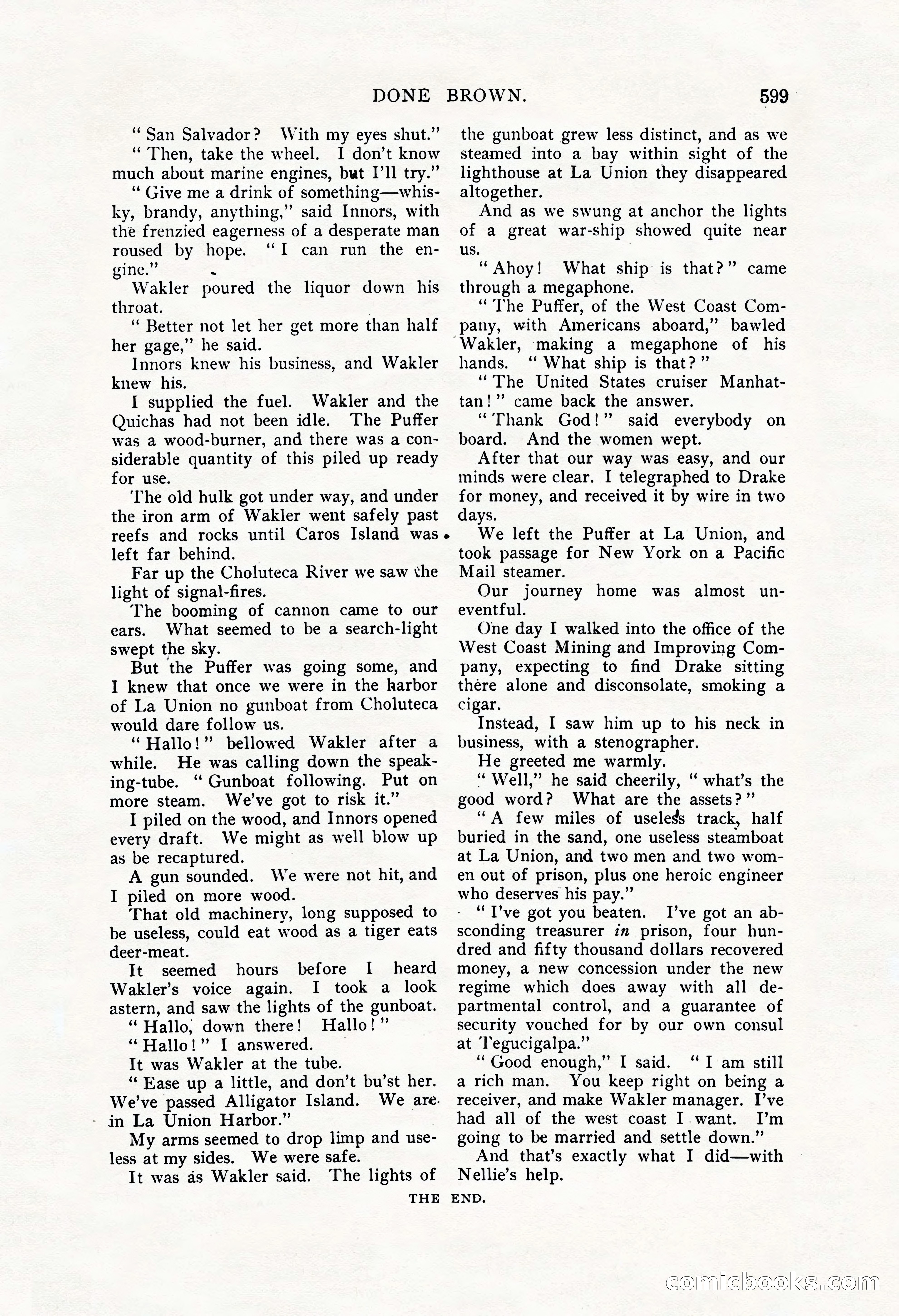
A restored page from Pulp Fiction, 1909. Page through the whole issue in the reader above.
📄 Transcribed text from this page (OCR, searchable)
Machine-transcribed from the original scan — historical spelling and the odd misread are preserved.
DONE BROWN. ‘“San Salvador? With my eyes shut.” ‘Then, take the wheel. I don’t know much about marine engines, but I’ll try.” ‘Give me a drink of something—whis- ky, brandy, anything,” said Innors, with the frenzied eagerness of a desperate man roused by hope. “I can run the en- gine.” : Wakler poured the liquor down his throat. ‘“ Better not let her get more than half her gage,” he said. Innors knew his business, and Wakler knew his. I supplied the fuel. Wakler and the Quichas had not been idle. The Puffer was a wood-burner, and there was a con- siderable quantity of this piled up ready for use. The old hulk got under way, and under the iron arm of Wakler went safely past reefs and rocks until Caros Island was left far behind. _ Far up the Choluteca River we saw the light of signal-fires. The booming of cannon came to our ears. What seemed to be a search-light swept the sky. But the Puffer was going some, and I knew that once we were in the harbor of La Union no gunboat from Choluteca would dare follow us. “Hallo!” bellowed Wakler after a while. He was calling down the speak- ing-tube. ‘‘ Gunboat following. Put on more steam. We've got to risk it.” I piled on the wood, and Innors opened every draft. We might as well blow up as be recaptured. A gun sounded. We were not hit, and I piled on more wood. That old machinery, long supposed to be useless, could eat wood as a tiger eats deer-meat. It seemed hours before I _ heard Wakler’s voice again. I took a look astern, and saw the lights of the gunboat. “ Hallo, down there! Hallo!” “Hallo!” I answered. | It was Wakler at the tube. “Ease up a little, and don’t bu’st her. We’ve passed Alligator Island. We are. - in La Union Harbor.” My arms seemed to drop limp and use- less at my sides. We were safe. It was 4s Wakler said. The lights of 599 the gunboat grew less distinct, and as we steamed into a bay within sight of the lighthouse at La Union they disappeared altogether. And as we swung at anchor the lights of a great war-ship showed quite near us. ‘“Ahoy! What ship is that?’ came through a megaphone. “The Puffer, of the West Coast Com- pany, with Americans aboard,” bawled Wakler, making a megaphone of his hands. ‘ What ship is that?” “The United States cruiser Manhat- tan!’’ came back the answer. “Thank God!” said everybody on board. And the women wept. After that our way was easy, and our minds were clear. I telegraphed to Drake for money, and received it by wire in two days. We left the Puffer at La Union, and took passage for New York on a Pacific Mail steamer. Our journey home was almost un- eventful. One day I walked into the office of the West Coast Mining and Improving Com- pany, expecting to find Drake sitting there alone and disconsolate, smoking a cigar. Instead, I saw him up to his neck in business, with a stenographer. He greeted me warmly. “ Well,” he said cheerily, ‘“ what’s the good word? What are the assets?” “A few miles of useless track, half buried in the sand, one useless steamboat at La Union, and two men and two wom- en out of prison, plus one heroic engineer who deserves his pay.” ‘“T’ve got you beaten. I’ve got an ab- sconding treasurer zm prison, four hun- dred and fifty thousand dollars recovered money, a new concession under the new regime which does away with all de- partmental control, and a guarantee of security vouched for by our own consul at Tegucigalpa.” ‘“Good enough,” I said. “I am still a rich man. You keep right on being a receiver, and make Wakler manager. I’ve had all of the west coast I want. I’m going to be married and settle down.” And that’s exactly what I did—with Nellie’s help. THE END. Gioo