
Pulp Fiction, 1909 · page 30 of 266
The Argosy, Vol. 61, No. 4 — page 30: what you’re looking at
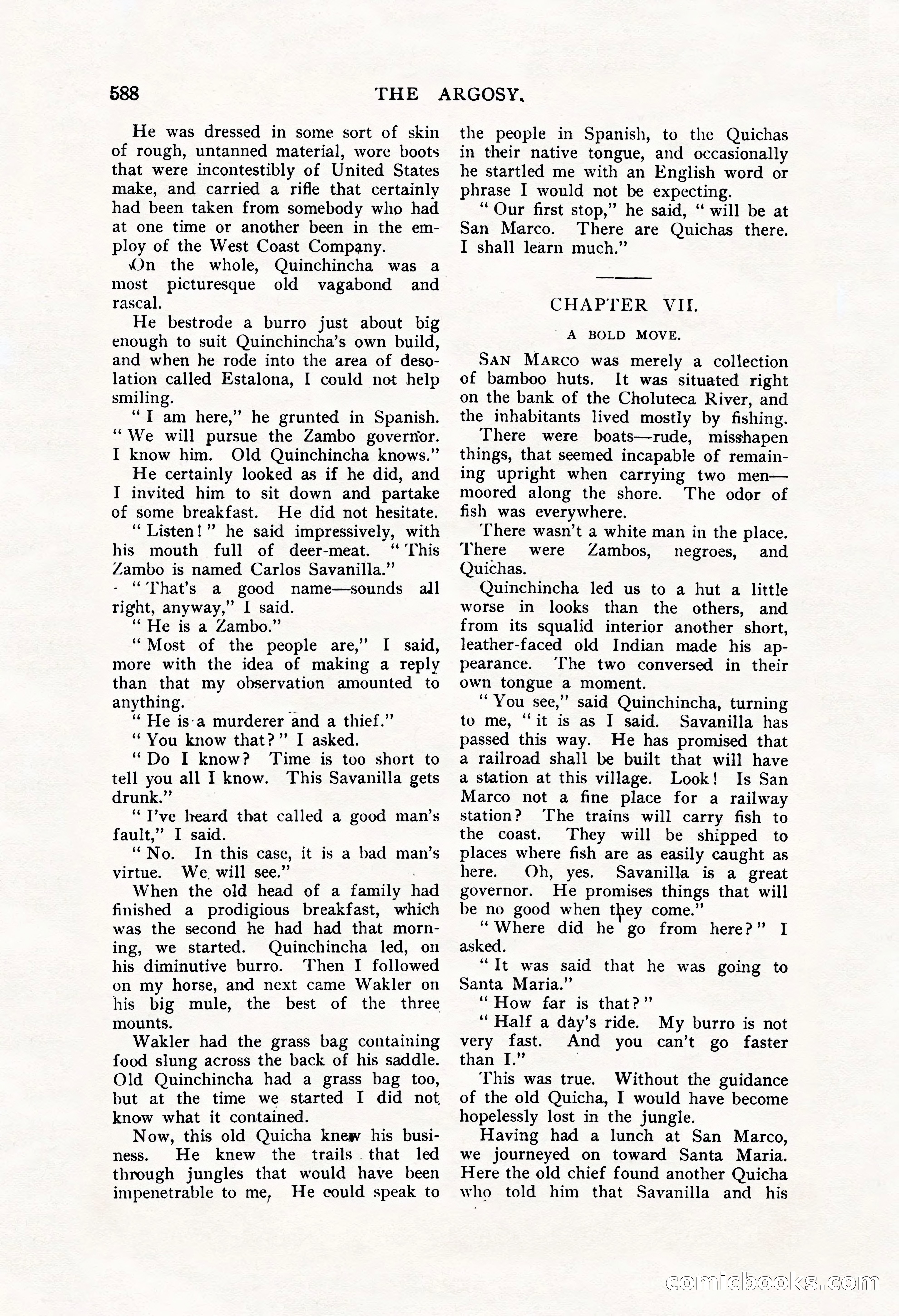
A restored page from Pulp Fiction, 1909. Page through the whole issue in the reader above.
📄 Transcribed text from this page (OCR, searchable)
Machine-transcribed from the original scan — historical spelling and the odd misread are preserved.
588 He was dressed in some sort of skin of rough, untanned material, wore boots that were incontestibly of United States make, and carried a rifle that certainly had been taken from somebody who had at one time or another been in the em- ploy of the West Coast Company. On the whole, Quinchincha was a most picturesque old vagabond and rascal. He bestrode a burro just about big enough to suit Quinchincha’s own build, and when he rode into the area of deso- lation called Estalona, I could not help smiling. ‘“T am here,” he grunted in Spanish. “We will pursue the Zambo governor. I know him. Old Quinchincha knows.” He certainly looked as if he did, and I invited him to sit down and partake of some breakfast. He did not hesitate. ‘Listen!’ he said impressively, with his mouth full of deer-meat. “ This Zambo is named Carlos Savanilla.” “That’s a good name—sounds right, anyway,” I said. “He is a Zambo.” “Most of the people are,” I said, more with the idea of making a reply than that my observation amounted to anything. . ‘He is‘a murderer and a thief.” ‘You know that?” I asked. “Do I know? Time is too short to tell you all I know. This Savanilla gets drunk.” ‘““T’ve heard that called a good man’s fault,” I said. ‘No. In this case, it is a bad man’s virtue. We. will see.” : When the old head of a family had finished a prodigious breakfast, which was the second he had had that morn- ing, we started. Quinchincha led, on his diminutive burro. Then I followed on my horse, and next came Wakler on his big mule, the best of the three mounts. Wakler had the grass bag containing food slung across the back of his saddle. Old Quinchincha had a grass bag too, but at the time we started I did not, know what it contained. : Now, this old Quicha knew his busi- ness. He knew the trails. that led through jungles that would have been impenetrable to me, He could speak to all THE ARGOSY, the people in Spanish, to the Quichas in their native tongue, and occasionally he startled me with an English word or phrase I would not be expecting. “Our first stop,” he said, ‘‘ will be at San Marco. There are Quichas there. I shall learn much.” CHAPTER VIL. A BOLD MOVE. SAN Marco was merely a collection of bamboo huts. It was situated right on the bank of the Choluteca River, and the inhabitants lived mostly by fishing. There were boats—rude, misshapen things, that seemed incapable of remain- ing upright when carrying two men— moored along the shore. The odor of fish was everywhere. ‘There wasn’t a white man in the place. There were Zambos, negroes, and Quichas. Quinchincha led us to a hut a little worse in looks than the others, and from its squalid interior another short, leather-faced old Indian made his ap- pearance. ‘The two conversed in their own tongue a moment. ‘You see,” said Quinchincha, turning to me, “it is as I said. Savanilla has passed this way. He has promised that a railroad shall be built that will have a station at this village. Look! Is San Marco not a fine place for a railway station? ‘The trains will carry fish to the coast. They will be shipped to places where fish are as easily caught as here. Oh, yes. Savanilla is a great governor. He promises things that will be no good when they come.” ‘Where did he go from here?” I asked. . “It was said that he was going to Santa Maria.” “How far is that?” “ Half a day’s ride. very fast. than I.” This was true. Without the guidance of the old Quicha, I would have become hopelessly lost in the jungle. Having had a lunch at San Marco, we journeyed on toward Santa Maria. Here the old chief found another Quicha who told him that Savanilla and _ his My burro is not And you can’t go faster CO OO) (C CO