
Pulp Fiction, 1909 · page 29 of 266
The Argosy, Vol. 61, No. 4 — page 29: what you’re looking at
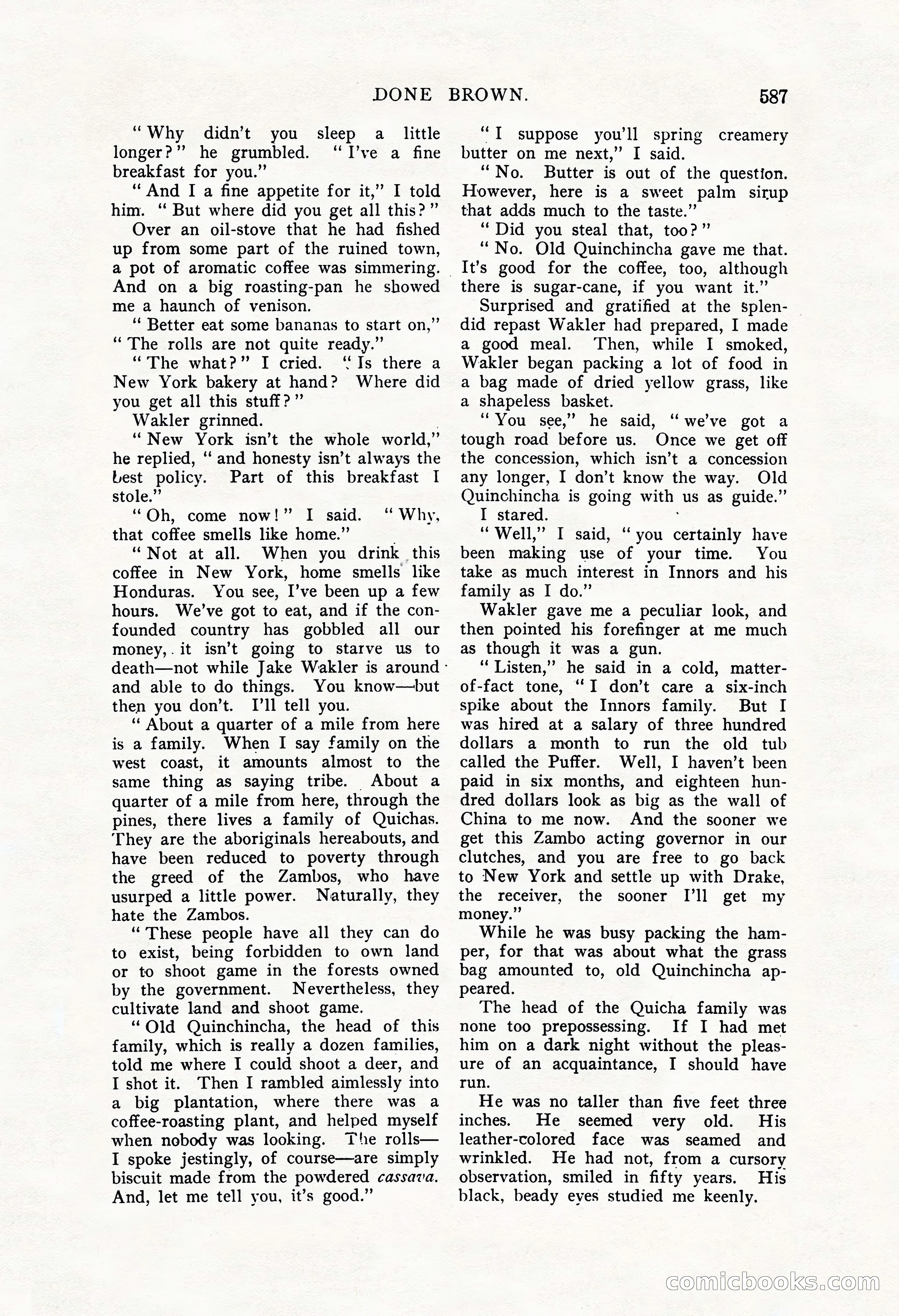
A restored page from Pulp Fiction, 1909. Page through the whole issue in the reader above.
📄 Transcribed text from this page (OCR, searchable)
Machine-transcribed from the original scan — historical spelling and the odd misread are preserved.
DONE BROWN. “Why didn’t you longer?”’ he grumbled. breakfast for you.” ‘“And I a fine appetite for it,” I told him. ‘ But where did you get all this?” Over an oil-stove that he had fished up from some part of the ruined town, sleep a little “Tve a fine a pot of aromatic coffee was simmering. — And on a big roasting-pan he showed me a haunch of venison. ‘* Better eat some bananas to start on,” “The rolls are not quite ready.” “The what?” I cried. “Is there a New York bakery at hand? Where did you get all this stuff?”’ Wakler grinned. : ‘New York isn’t the whole world,” he replied, ‘“‘ and honesty isn’t always the best policy. Part of this breakfast I stole.” “Oh, come now!” I said. “ Why, that coffee smells like home.” “ Not at all. When you drink this coffee in New York, home smells like Honduras. You see, I’ve been up a few hours. We've got to eat, and if the con- founded country has gobbled all our money,.it isn’t going to starve us to death—not while Jake Wakler is around - and able to do things. You know—but then you don’t. I'll tell you. ‘‘ About a quarter of a mile from here is a family. When I say family on the west coast, it amounts almost to the same thing as saying tribe. About a quarter of a mile from here, through the pines, there lives a family of Quichas. They are the aboriginals hereabouts, and have been reduced to poverty through the greed of the Zambos, who have usurped a little power. Naturally, they hate the Zambos. “These people have all they can do to exist, being forbidden to own land or to shoot game in the forests owned by the government. Nevertheless, they cultivate land and shoot game. “Old Quinchincha, the head of this family, which is really a dozen families, told me where I could shoot a deer, and I shot it. Then I rambled aimlessly into a big plantation, where there was a coffee-roasting plant, and helped myself when nobody was looking. The rolls— I spoke jestingly, of course—are simply biscuit made from the powdered cassava. And, let me tell you, it’s good.” 587 “I suppose you'll spring creamery butter on me next,’ I said. “No. Butter is out of the question. However, here is a sweet palm sirup that adds much to the taste.” ‘Did you steal that, too?” “No. Old Quinchincha gave me that. It’s good for the coffee, too, although there is sugar-cane, if you want it.” Surprised and gratified at the splen- did repast Wakler had prepared, I made a good meal. Then, while I smoked, Wakler began packing a lot of food in a bag made of dried yellow grass, like a shapeless basket. “You see,” he said, ‘‘we’ve got a tough road before us. Once we get off the concession, which isn’t a concession any longer, I don’t know the way. Old Quinchincha is going with us as guide.” I stared. : “Well,” I said, ‘“ you certainly have been making use of your time. You take as much interest in Innors and his family as I do.” Wakler gave me a peculiar look, and then pointed his forefinger at me much as though it was a gun. ‘Listen,’ he said in a cold, matter- of-fact tone, ‘I don’t care a six-inch spike about the Innors family. But I was hired at a salary of three hundred dollars a month to run the old tub called the Puffer. Well, I haven’t been paid in six months, and eighteen hun- dred dollars look as big as the wall of China to me now. And the sooner we get this Zambo acting governor in our clutches, and you are free to go back to New York and settle up with Drake, the receiver, the sooner I’ll get my money.” While he was busy packing the ham- per, for that was about what the grass bag amounted to, old Quinchincha ap- peared. The head of the Quicha family was none too prepossessing. If I had met him on a dark night without the pleas- ure of an acquaintance, I should have run. He was no taller than five feet three inches. He seemed very old. His leather-colored face was seamed and wrinkled. He had not, from a cursory observation, smiled in fifty years. His black, beady eves studied me keenly. EO JOO Cc