
Pulp Fiction, 1909 · page 19 of 266
The Argosy, Vol. 61, No. 4 — page 19: what you’re looking at
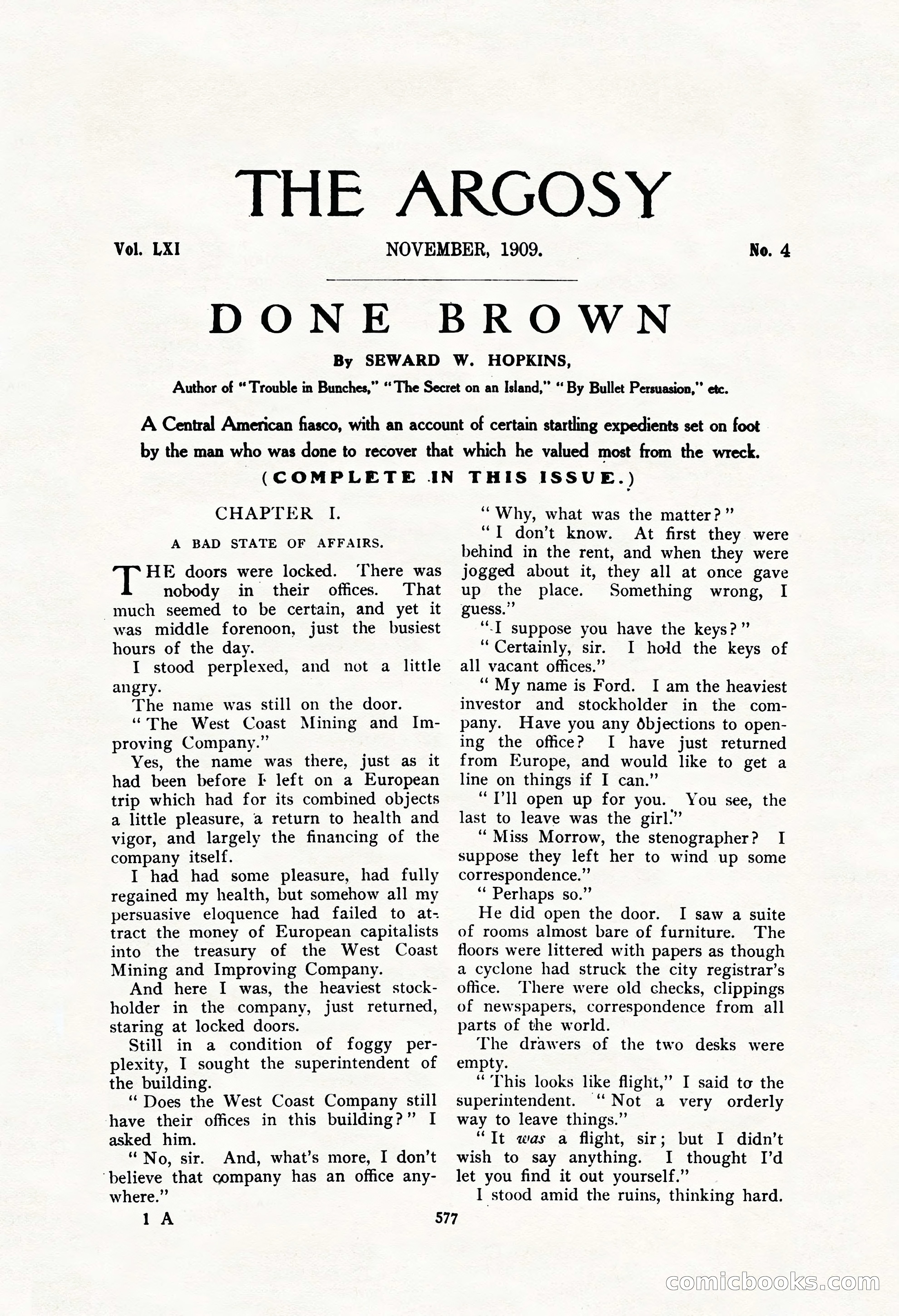
A restored page from Pulp Fiction, 1909. Page through the whole issue in the reader above.
📄 Transcribed text from this page (OCR, searchable)
Machine-transcribed from the original scan — historical spelling and the odd misread are preserved.
THE ARGOSY Vol. LXI NOVEMBER, 1909. No. 4 DONE BROWN By SEWARD W. HOPKINS, Author of “ Trouble in Bunches,” ‘ The Secret on an Island,” “ By Bullet Persuasion,” etc. A Central American fiasco, with an account of certain startling expedients set on foot by the man who was done to recover that which he valued most from the wreck. (COMPLETE IN THIS ISSUE.) CHAPTER I. A BAD STATE OF AFFAIRS. HE doors were locked. ‘There was nobody in their offices. That much seemed to be certain, and yet it was middle forenoon, just the busiest hours of the day. I stood perplexed, and not a little angry. The name was still on the door. “The West Coast Mining and Im- proving Company.” Yes, the name was there, just as it had been before I left on a European trip which had for its combined objects a little pleasure, a return to health and vigor, and largely the financing of the company itself. I had had some pleasure, had fully regained my health, but somehow all my persuasive eloquence had failed to at- tract the money of European capitalists into the treasury of the West Coast Mining and Improving Company. And here I was, the heaviest stock- holder in the company, just returned, staring at locked doors. Still in a condition of foggy per- plexity, I sought the superintendent of the building. “Does the West Coast Company still have their offices in this building?” I asked him. ‘No, sir. And, what’s more, I don’t ‘believe that company has an office any- where.” 1A ‘Why, what was the matter?” “I don’t know. At first they were behind in the rent, and when they were jogged about it, they all at once gave up the place. Something wrong, I guess.” ‘I suppose you have the keys?” ‘Certainly, sir. I hold the keys of all vacant offices.” “My name is Ford. I am the heaviest investor and stockholder in the com- pany. Have you any dbjections to open- ing the office? I have just returned from Europe, and would like to get a line on things if I can.” “T’ll open up for you. last to leave was the girl.” “Miss Morrow, the stenographer? I suppose they left her to wind up some correspondence.”’ “Perhaps so.” He did open the door. I saw a suite of rooms almost bare of furniture. The floors were littered with papers as though a cyclone had struck the city registrar’s office. There were old checks, clippings of newspapers, correspondence from all parts of the world. The drawers of the two desks were You see, the empty. “This looks like flight,” I said to the superintendent. “ Not a very orderly way to leave things.” “It was a flight, sir; but I didn’t wish to say anything. I thought I’d let you find it out yourself.” I stood amid the ruins, thinking hard. 377 OO (©