
Pulp Fiction, 1909 · page 128 of 266
The Argosy, Vol. 61, No. 4 — page 128: what you’re looking at
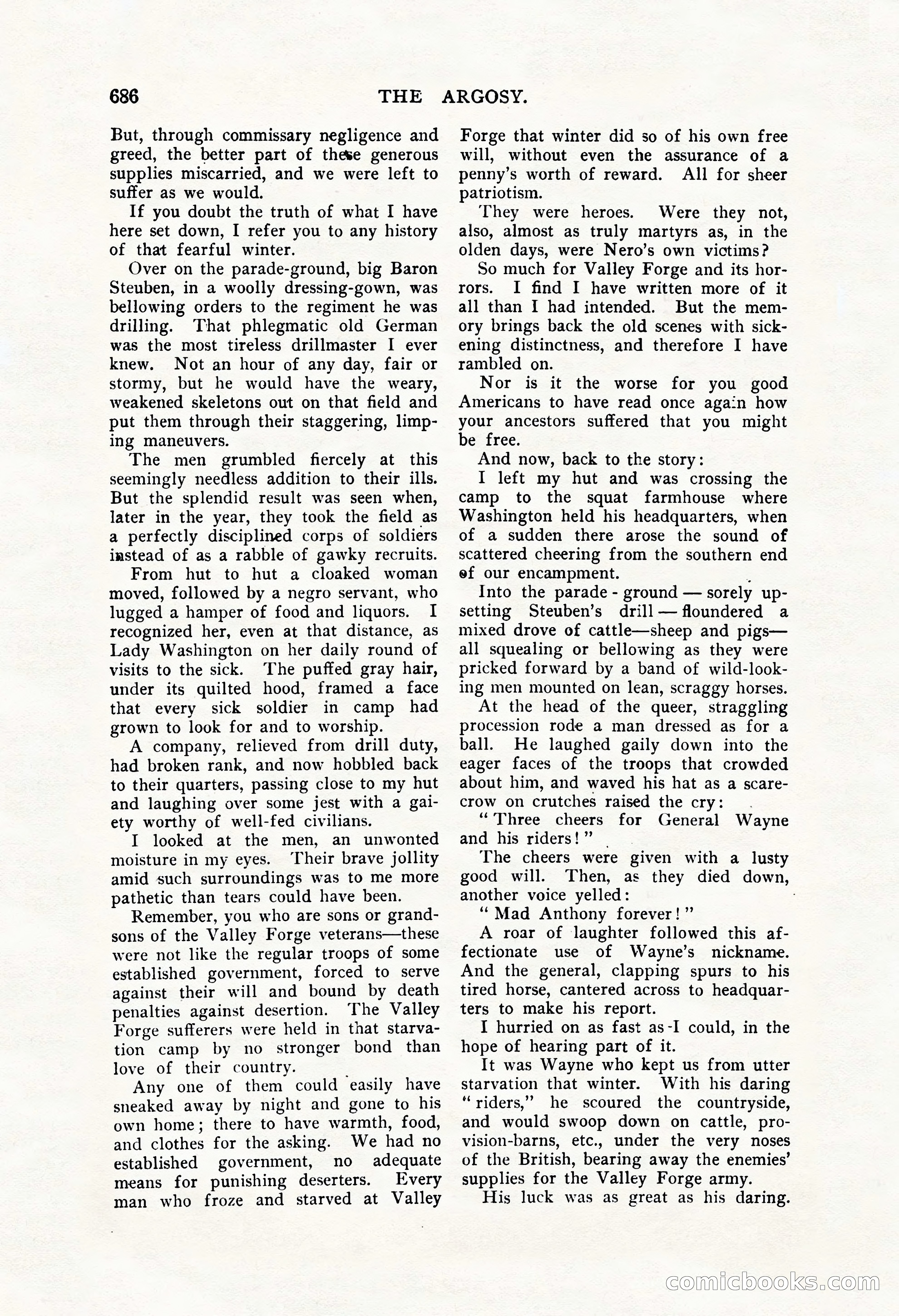
A restored page from Pulp Fiction, 1909. Page through the whole issue in the reader above.
📄 Transcribed text from this page (OCR, searchable)
Machine-transcribed from the original scan — historical spelling and the odd misread are preserved.
686 But, through commissary negligence and greed, the better part of these generous supplies miscarried, and we were left to suffer as we would. If you doubt the truth of what I have here set down, I refer you to any history of that fearful winter. Over on the parade-ground, big Baron Steuben, in a woolly dressing-gown, was bellowing orders to the regiment he was drilling. That phlegmatic old German was the most tireless drillmaster I ever knew. Not an hour of any day, fair or stormy, but he would have the weary, weakened skeletons out on that field and put them through their staggering, limp- ing maneuvers. The men grumbled fiercely at this seemingly needless addition to their ills. But the splendid result was seen when, later in the year, they took the field as a perfectly disciplined corps of soldiers instead of as a rabble of gawky recruits. From hut to hut a cloaked woman moved, followed by a negro servant, who lugged a hamper of food and liquors. I recognized her, even at that distance, as Lady Washington on her daily round of visits to the sick. The puffed gray hair, under its quilted hood, framed a face that every sick soldier in camp had grown to look for and to worship. A company, relieved from drill duty, had broken rank, and now hobbled back to their quarters, passing close to my hut and laughing over some jest with a gai- ety worthy of well-fed civilians. I looked at the men, an unwonted moisture in my eyes. ‘Their brave jollity amid such surroundings was to me more pathetic than tears could have been. Remember, you who are sons or grand- sons of the Valley Forge veterans—these were not like the regular troops of some established government, forced to serve against their will and bound by death penalties against desertion. The Valley Forge sufferers were held in that starva- tion camp by no stronger bond than love of their country. Any one of them could easily have sneaked away by night and gone to his own home; there to have warmth, food, and clothes for the asking. We had no established government, no adequate means for punishing deserters. Every man who froze and starved at Valley THE ARGOSY. Forge that winter did so of his own free will, without even the assurance of a penny’s worth of reward. All for sheer patriotism. They were heroes. Were they not, also, almost as truly martyrs as, in the olden days, were Nero’s own victims? So much for Valley Forge and its hor- rors. I find I have written more of it all than I had intended. But the mem- ory brings back the old scenes with sick- ening distinctness, and therefore I have rambled on. Nor is it the worse for you good Americans to have read once again how your ancestors suffered that you might be free. And now, back to the story: I left my hut and was crossing the camp to the squat farmhouse where Washington held his headquarters, when of a sudden there arose the sound of scattered cheering from the southern end ef our encampment. : Into the parade - ground — sorely up- setting Steuben’s drill— floundered a mixed drove of cattle—sheep and pigs— all squealing or bellowing as they were pricked forward by a band of wild-look- ing men mounted on lean, scraggy horses. At the head of the queer, straggling procession rode a man dressed as for a ball. He laughed gaily down into the eager faces of the troops that crowded about him, and waved his hat as a scare- crow on crutches raised the cry: “Three cheers for General Wayne and his riders!” | The cheers were given with a lusty good will. another voice yelled: “Mad Anthony forever!” A roar of laughter followed this af- fectionate use of Wayne’s nickname. And the general, clapping spurs to his tired horse, cantered across to headquar- ters to make his report. I hurried on as fast as-I could, in the hope of hearing part of it. It was Wayne who kept us from utter starvation that winter. With his daring “riders,” he scoured the countryside, and would swoop down on cattle, pro- vision-barns, etc., under the very noses of the British, bearing away the enemies’ supplies for the Valley Forge army. His luck was as great as his daring. Then, as they died down, OO (Cc (©