
Pulp Fiction, 1909 · page 127 of 266
The Argosy, Vol. 61, No. 4 — page 127: what you’re looking at
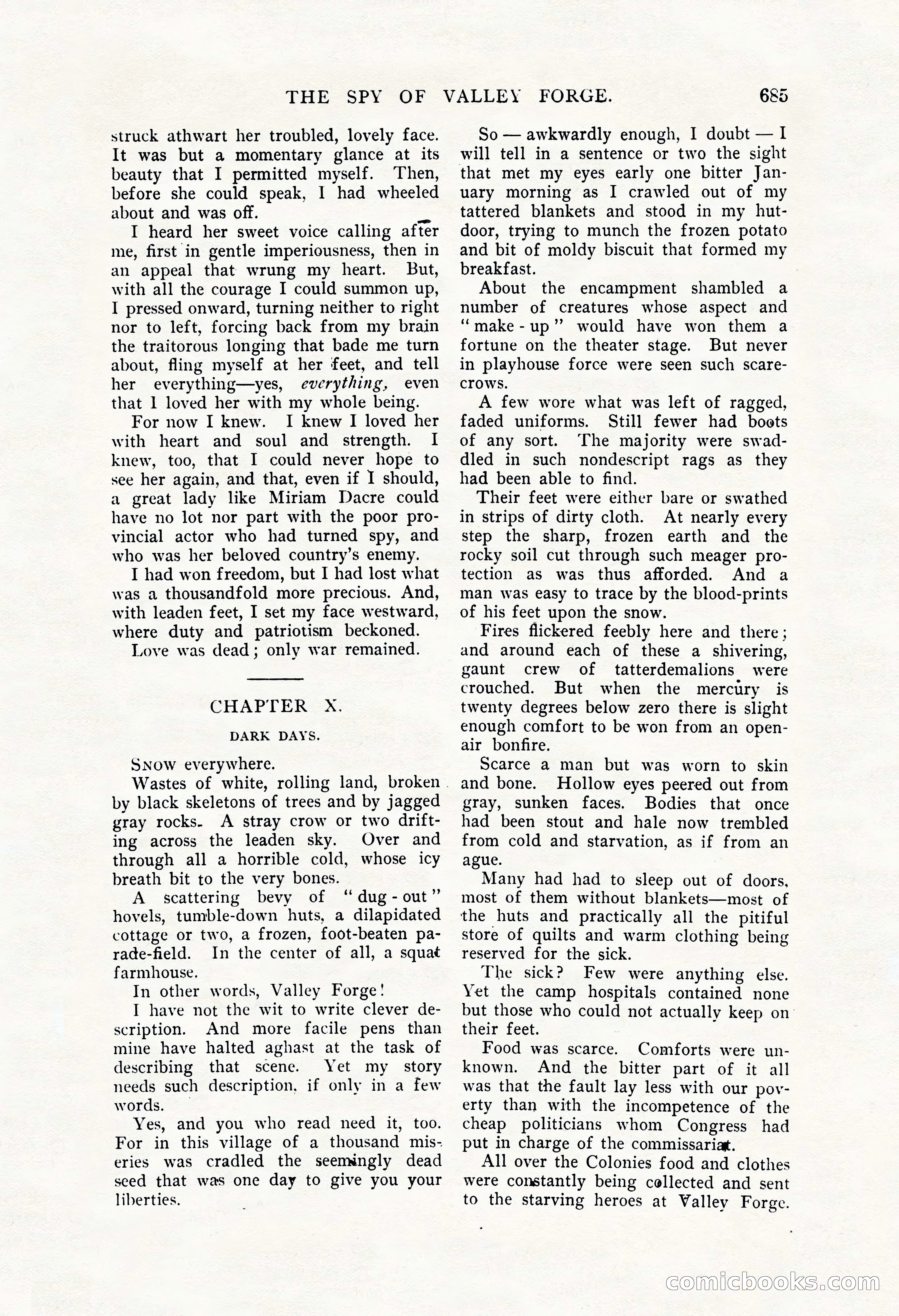
A restored page from Pulp Fiction, 1909. Page through the whole issue in the reader above.
📄 Transcribed text from this page (OCR, searchable)
Machine-transcribed from the original scan — historical spelling and the odd misread are preserved.
THE SPY OF VALLEY FORGE. struck athwart her troubled, lovely face. It was but a momentary glance at its beauty that I permitted myself. Then, before she could speak, I had wheeled about and was off. a I heard her sweet voice calling after me, first in gentle imperiousness, then in an appeal that wrung my heart. But, with all the courage I could summon up, I pressed onward, turning neither to right nor to left, forcing back from my brain the traitorous longing that bade me turn about, fling myself at her feet, and tell her everything—yes, everything, even that 1 loved her with my whole being. For now I knew. I knew I loved her with heart and soul and strength. I knew, too, that I could never hope to see her again, and that, even if I should, a great lady like Miriam Dacre could have no lot nor part with the poor pro- vincial actor who had turned spy, and who was her beloved country’s enemy. I had won freedom, but I had lost what was a thousandfold more precious. And, with leaden feet, I set my face westward, where duty and patriotism beckoned. Love was dead; only war remained. CHAPTER xX. DARK DAYS. SNow everywhere. Wastes of white, rolling land, broken . by black skeletons of trees and by jagged gray rocks. A stray crow or two drift- ing across the leaden sky. Over and through all a horrible cold, whose icy breath bit to the very bones. A scattering bevy of ‘‘dug- out” hovels, tumble-down huts, a dilapidated cottage or two, a frozen, foot-beaten pa- rade-field. In the center of all, a squat farmhouse. In other words, Valley Forge! I have not the wit to write clever de- scription. And more facile pens than mine have halted aghast at the task of describing that scene. Yet my _ story needs such description, if only in a few words. _ Yes, and you who read need it, too. For in this village of a thousand mis- eries was cradled the seemNngly dead seed that was one day to give you your liberties. 6&5 So — awkwardly enough, I doubt — I will tell in a sentence or two the sight that met my eyes early one bitter Jan- uary morning as I crawled out of my tattered blankets and stood in my hut- door, trying to munch the frozen potato and bit of moldy biscuit that formed my breakfast. About the encampment shambled a number of creatures whose aspect and ‘“make-up’’ would have won them a fortune on the theater stage. But never in playhouse force were seen such scare- crows. A few wore what was left of ragged, faded uniforms. Still fewer had boots of any sort. ‘The majority were swad- dled in such nondescript rags as they had been able to find. Their feet were either bare or swathed in strips of dirty cloth. At nearly every step the sharp, frozen earth and the rocky soil cut through such meager pro- tection as was thus afforded. And a man was easy to trace by the blood-prints of his feet upon the snow. Fires flickered feebly here and there; and around each of these a shivering, gaunt crew of tatterdemalions were crouched. But when the mercury is twenty degrees below zero there is slight enough comfort to be won from an open- air bonfire. Scarce a man but was worn to skin and bone. Hollow eyes peered out from gray, sunken faces. Bodies that once had been stout and hale now trembled from cold and starvation, as if from an ague. Many had had to sleep out of doors, most of them without blankets—most of the huts and practically all the pitiful store of quilts and warm clothing being reserved for the sick. The sick? Few were anything else. Yet the camp hospitals contained none but those who could not actually keep on their feet. Food was scarce. Comforts were un- known. And the bitter part of it all was that the fault lay less with our pov- erty than with the incompetence of the cheap politicians whom Congress had put in charge of the commissariat. All over the Colonies food and clothes were constantly being cellected and sent to the starving heroes at Walley Forge. COMmicloo ©