
Pulp Fiction, 1909 · page 122 of 266
The Argosy, Vol. 61, No. 4 — page 122: what you’re looking at
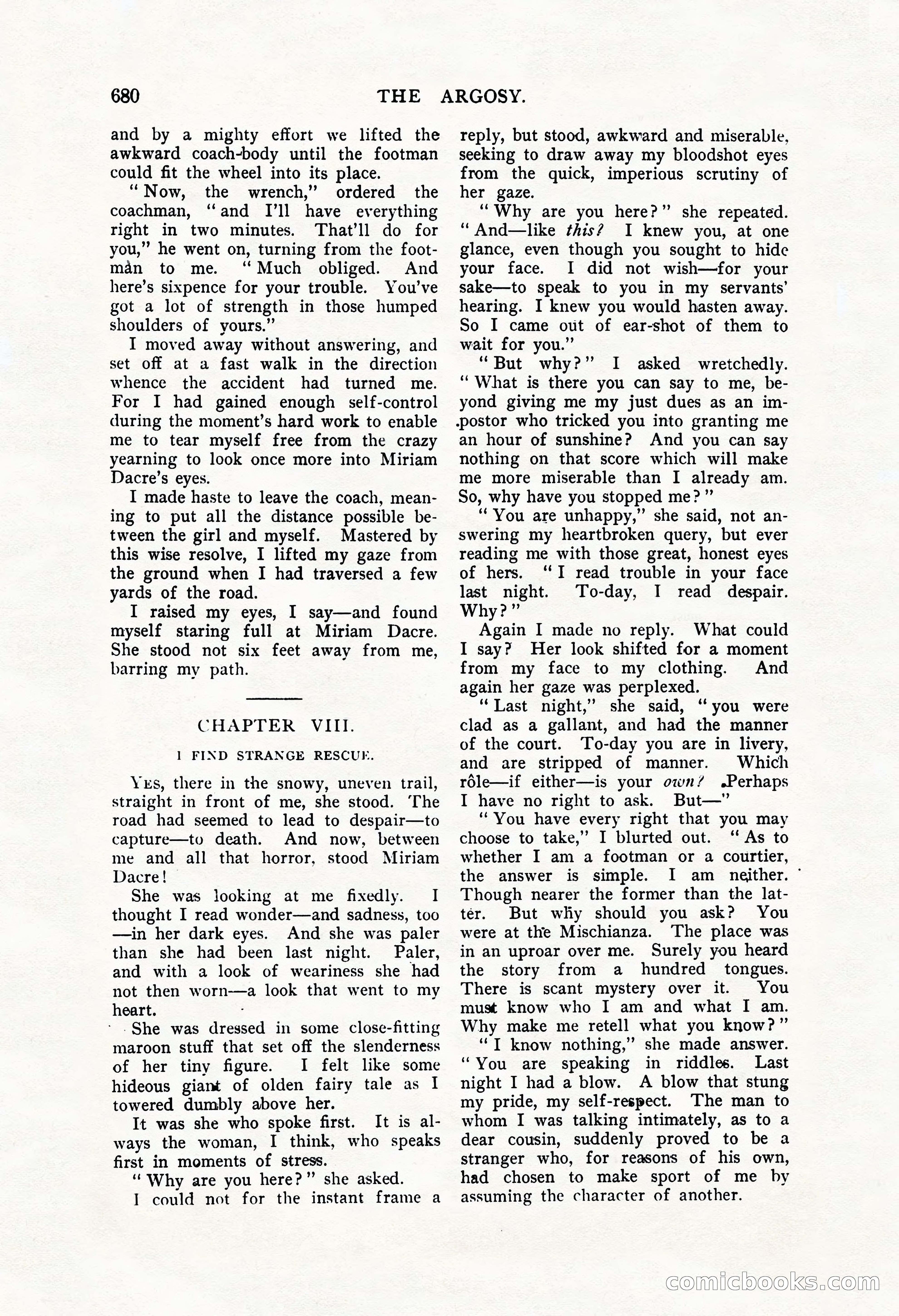
A restored page from Pulp Fiction, 1909. Page through the whole issue in the reader above.
📄 Transcribed text from this page (OCR, searchable)
Machine-transcribed from the original scan — historical spelling and the odd misread are preserved.
680 and by a mighty effort we lifted the awkward coach-body until the footman could fit the wheel into its place. “Now, the wrench,’ ordered the coachman, “and I'll have everything right in two minutes. That'll do for you,” he went on, turning from the foot- man to me. ‘Much obliged. And here’s sixpence for your trouble. You've got a lot of strength in those humped shoulders of yours.” I moved away without answering, and set off at a fast walk in the direction whence the accident had turned me. For I had gained enough self-control during the moment’s hard work to enable me to tear myself free from the crazy yearning to look once more into Miriam Dacre’s eyes. I made haste to leave the coach, mean- ing to put all the distance possible be- tween the girl and myself. Mastered by this wise resolve, I lifted my gaze from the ground when I had traversed a few yards of the road. I raised my eyes, I say—and found myself staring full at Miriam Dacre. She stood not six feet away from me, barring my path. CHAPTER VIII. 1 FIND STRANGE RESCUE. Yrs, there in the snowy, uneven trail, straight in front of me, she stood. The road had seemed to lead to despair—to capture—to death. And now, between me and all that horror, stood Miriam Dacre! | She was looking at me fixedly. I thought I read wonder—and sadness, too —in her dark eyes. And she was paler than she had been last night. Paler, and with a look of weariness she had not then worn-——a look that went to my heart. ' .She was dressed in some close-fitting maroon stuff that set off the slenderness of her tiny figure. I felt like some hideous giant of olden fairy tale as I towered dumbly above her. It was she who spoke first. It is al- ways the woman, I think, who speaks first in moments of stress. ‘Why are you here?” she asked. I could not for the instant frame a THE ARGOSY. reply, but stood, awkward and miserable, seeking to draw away my bloodshot eyes from the quick, imperious scrutiny of her gaze. “Why are you here?” she repeated. ‘“ And—like this? I knew you, at one glance, even though you sought to hide your face. I did not wish—for your sake—to speak to you in my servants’ hearing. I knew you would hasten away. So I came out of ear-shot of them to wait for you.” “But why?” I asked wretchedly. ‘What is there you can say to me, be- yond giving me my just dues as an im- -_postor who tricked you into granting me an hour of sunshine? And you can say nothing on that score which will make me more miserable than I already am. So, why have you stopped me? ” ‘You are unhappy,” she said, not an- swering my heartbroken query, but ever reading me with those great, honest eyes of hers. ‘I read trouble in your face last night. To-day, I read despair. Why?” Again I made no reply. What could I say? Her look shifted for a moment from my face to my clothing. And again her gaze was perplexed. ‘Last night,” she said, “‘ you were clad as a gallant, and had the manner of the court. ‘To-day you are in livery, and are stripped of manner. Which role—if either—is your own’ Perhaps I have no right to ask. But—” ‘You have every right that you may choose to take,’’ I blurted out. “ As to whether I am a footman or a courtier, the answer is simple. Though nearer the former than the lat- ter. But why should you ask? You were at the Mischianza. The place was in an uproar over me. Surely you heard the story from a hundred tongues. There is scant mystery over it. You must know who I am and what I am. Why make me retell what you know?” ‘TI know nothing,” she made answer. “You are speaking in riddles. Last night I had a blow. A blow that stung my pride, my self-respect. The man to whom I was talking intimately, as to a dear cousin, suddenly proved to be a stranger who, for reasons of his own, had chosen to make sport of me by assuming the character of another. EO OO Cc I am _ neither. ° (©