
Pulp Fiction, 1909 · page 121 of 266
The Argosy, Vol. 61, No. 4 — page 121: what you’re looking at
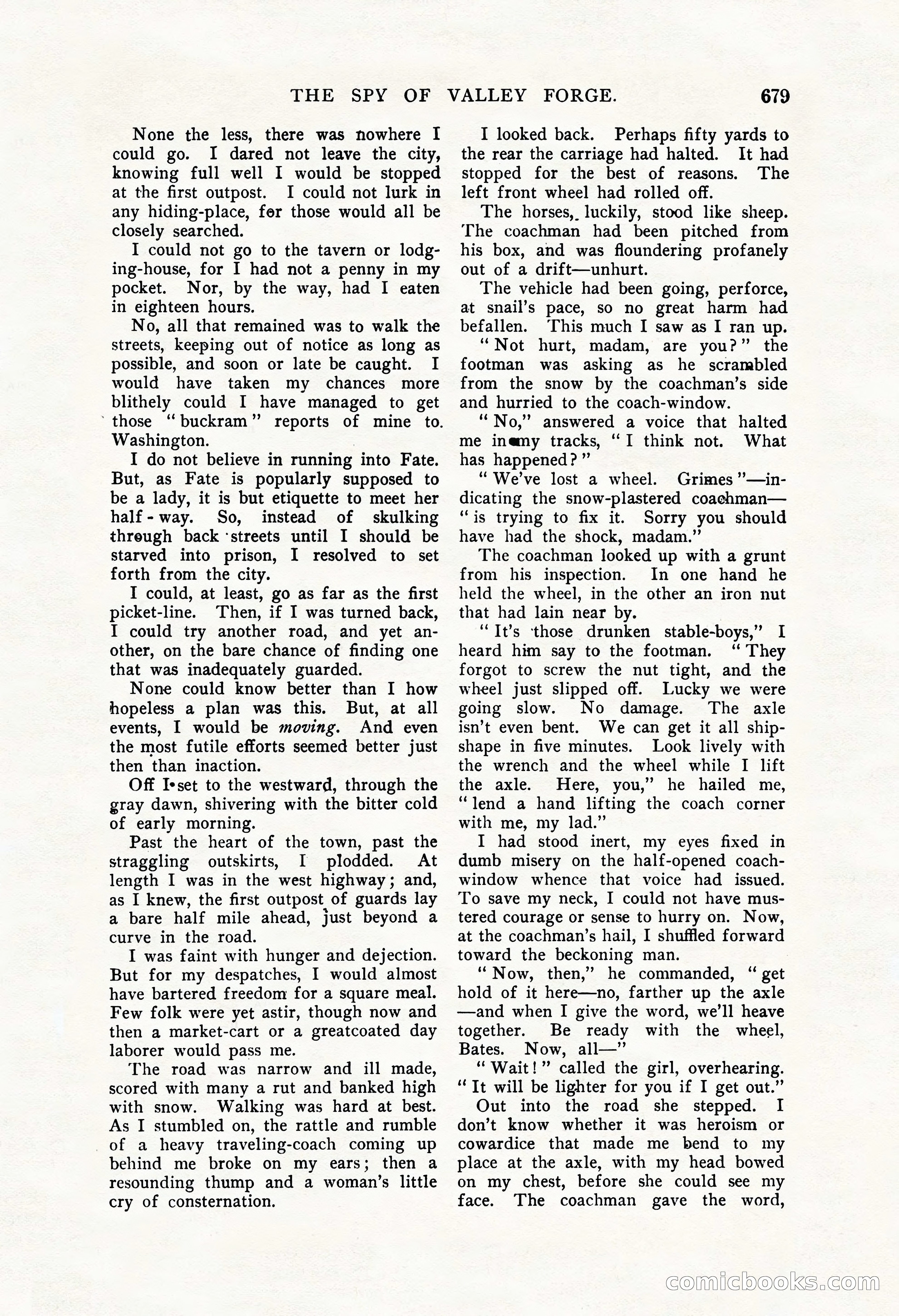
A restored page from Pulp Fiction, 1909. Page through the whole issue in the reader above.
📄 Transcribed text from this page (OCR, searchable)
Machine-transcribed from the original scan — historical spelling and the odd misread are preserved.
THE SPY OF VALLEY FORGE. None the less, there was nowhere I could go. I dared not leave the city, knowing full well I would be stopped at the first outpost. I could not lurk in any hiding-place, fer those would all be closely searched. I could not go to the tavern or lodg- ing-house, for I had not a penny in my pocket. Nor, by the way, had I eaten in eighteen hours. No, all that remained was to walk the streets, keeping out of notice as long as possible, and soon or late be caught. I would have taken my chances more blithely could I have managed to get ‘those ‘“‘buckram”’ reports of mine to. Washington. | I do not believe in running into Fate. But, as Fate is popularly supposed to be a lady, it is but etiquette to meet her half-way. So, instead of skulking threugh back ‘streets until I should be starved into prison, I resolved to set forth from the city. I could, at least, go as far as the first picket-line. Then, if 1 was turned back, I could try another road, and yet an- other, on the bare chance of finding one that was inadequately guarded. None could know better than I how hopeless a plan was this. But, at all events, I would be moving. And even the most futile efforts seemed better just then than inaction. Off Isset to the westward, through the gray dawn, shivering with the bitter cold of early morning. Past the heart of the town, past the straggling outskirts, I plodded. At length I was in the west highway; and, as I knew, the first outpost of guards lay a bare half mile ahead, just beyond a curve in the road. I was faint with hunger and dejection. But for my despatches, I would almost have bartered freedom for a square meal. Few folk were yet astir, though now and then a market-cart or a greatcoated day laborer would pass me. The road was narrow and ill made, scored with many a rut and banked high with snow. Walking was hard at best. As I stumbled on, the rattle and rumble of a heavy traveling-coach coming up behind me broke on my ears; then a resounding thump and a woman’s little cry of consternation. 679 I looked back. Perhaps fifty yards to the rear the carriage had halted. It had stopped for the best of reasons. The left front wheel had rolled off. The horses, luckily, stood like sheep. The coachman had been pitched from his box, and was floundering profanely out of a drift—unhurt. The vehicle had been going, perforce, at snail’s pace, so no great harm had befallen. This much I saw as I ran up. “Not hurt, madam, are you?” the footman was asking as he scrambled from the snow by the coachman’s side and hurried to the coach-window. ‘No,’ answered a voice that halted me inemy tracks, “I think not. What has happened? ” ‘We've lost a wheel. Grimes ’—in- dicating the snow-plastered coachman— ‘is trying to fix it. Sorry you should have had the shock, madam.” The coachman looked up with a grunt from his inspection. In one hand he held the wheel, in the other an iron nut that had lain near by. “It’s ‘those drunken stable-boys,” I heard him say to the footman. ‘“ They forgot to screw the nut tight, and the wheel just slipped off. Lucky we were going slow. No damage. The axle isn’t even bent. We can get it all ship- shape in five minutes. Look lively with the wrench and the wheel while I lift the axle. Here, you,” he hailed me, “lend a hand lifting the coach corner with me, my lad.” I had stood inert, my eyes fixed in dumb misery on the half-opened coach- window whence that voice had issued. To save my neck, I could not have mus- tered courage or sense to hurry on. Now, at the coachman’s hail, I shuffled forward toward the beckoning man. “Now, then,’ he commanded, “ get hold of it here—no, farther up the axle —and when I give the word, we’ll heave together. Be ready with the wheel, Bates. Now, all—”’ “Wait!” called the girl, overhearing. “Tt will be lighter for you if I get out.” Out into the road she stepped. I don’t know whether it was heroism or cowardice that made me bend to my place at the axle, with my head bowed on my chest, before she could see my face. The coachman gave the word, Ghboo (©