
Pulp Fiction, 1907 · page 199 of 220
The Argosy, January 1907 — page 199: what you’re looking at
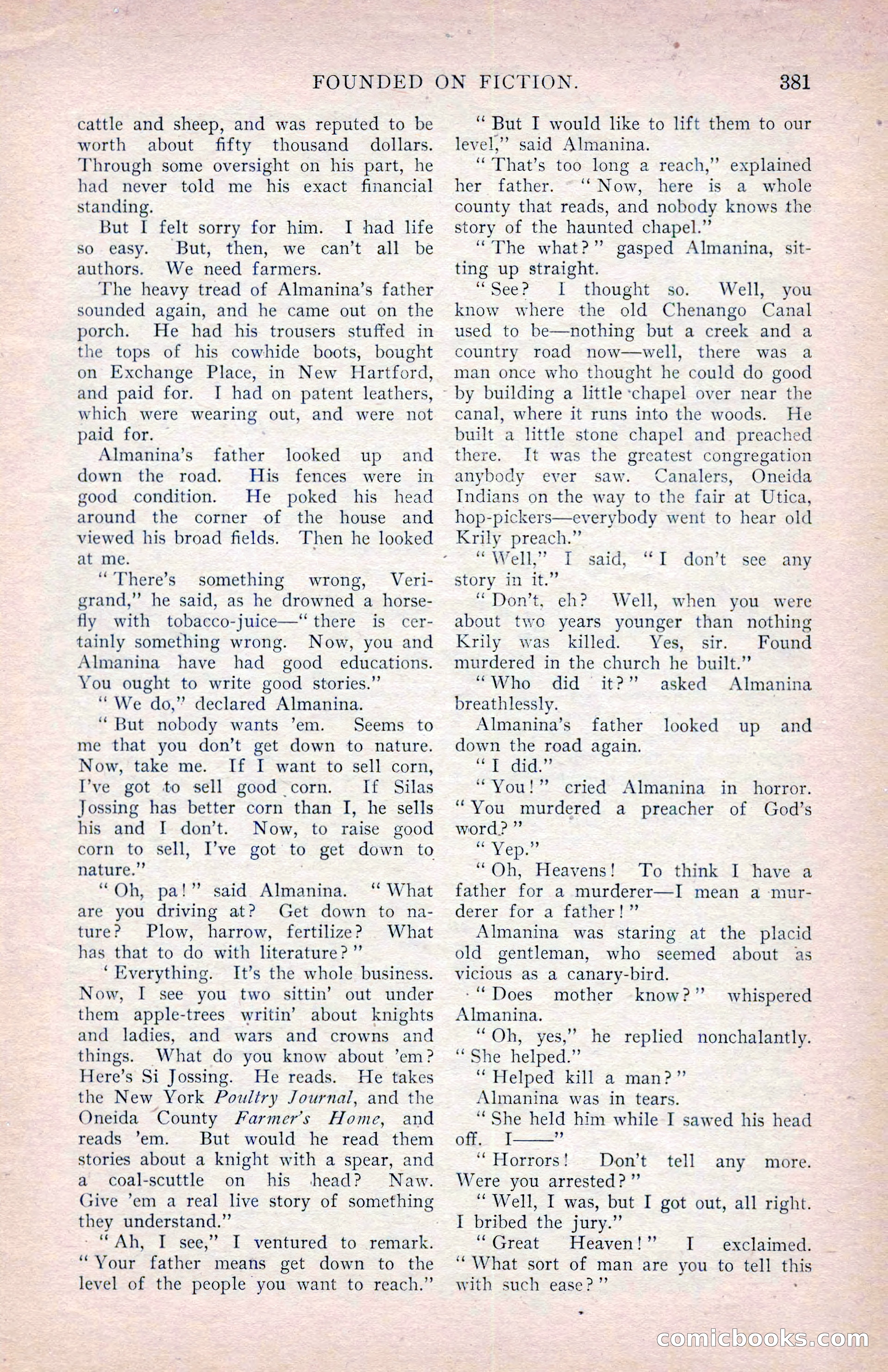
A restored page from Pulp Fiction, 1907. Page through the whole issue in the reader above.
📄 Transcribed text from this page (OCR, searchable)
Machine-transcribed from the original scan — historical spelling and the odd misread are preserved.
FOUNDED ON FICTION. cattle and sheep, and was reputed to be worth about fifty thousand dollars. Through some oversight on his part, he had never told me his exact financial standing. But I felt sorry for him. I had life so easy. But, then, we can’t all be authors. We need farmers. The heavy tread of Almanina’s father sounded again, and he came out on the porch. He had his trousers stuffed in the tops of his cowhide boots, bought on Exchange Place, in New Hartford, and paid for. I had on patent leathers, which were wearing out, and were not paid for. Almanina’s father looked up and down the road. His fences were in good condition. He poked his head around the corner of the house and viewed his broad fields. Then he looked at me. “There’s something wrong, Veri- grand,” he said, as he drowned a horse- fly with tobacco-juice—“ there is cer- tainly something wrong. Now, you and Almanina have had good _ educations. You ought to write good stories.” ‘We do,” declared Almanina. “But nobody wants ’em. Seems to me that you don’t get down to nature. Now, take me. If I want to sell corn, I’ve got to sell good corn. If Silas Jossing has better corn than I, he sells his and I don’t. Now, to raise good corn to sell, nature.” “Oh, pa!” said Almanina. ‘ What are you driving at? Get down to na- ture? Plow, harrow, fertilize? What has that to do with literature? ”’ ‘Everything. It’s the whole business. Now, I see you two sittin’ out under them apple-trees writin’ about knights and ladies, and wars and crowns aad things. What do you know about ’em? Here’s Si Jossing. He reads. He takes the New York Poultry Journal, and the Oneida County Farmer’s Home, and reads ’em. But would he read them stories about a knight with a spear, and a coal-scuttle on his head? Naw. Give ’em a real live story of something they understand.” - “Ah, I see,” I ventured to remark. “Your father means get down to the level of the people you want to reach.” I’ve got to get down to 881 ‘But I would like to lift them to our level,’ said Almanina. ‘That’s too long a reach,” explained her father. ~ ‘‘ Now, here is a whole county that reads, and nobody knows the story of the haunted chapel.” “The what?” gasped Almanina, sit- ting up straight. =peer l- thought so:-- Well; -you know where the old Chenango Canal used to be—nothing but a creek and a country road now—well, there was a man once who thought he could do good by building a little chapel over near the canal, where it runs into the woods. He built a little stone chapel and preached there. It was the greatest congregation anybody ever saw. Canalers, Oneida Indians on the way to the fair at Utica, hop-pickers—everybody went to hear old Krily preach.” — Welk” -focsaid, “I don’t “see any story in it.” “ Don’t, eh? Well, when you were about two years younger than nothing Krily was killed. Yes, sir. Found murdered in the church he built.” “Who did it?” asked Almanina breathlessly. Almanina’s father looked up and down the road again. eke adel. “You!” cried Almanina in_ horror. “You murdered a preacher of God’s word? ” ee te “Oh, Heavens! To think I have a father for a murderer—I mean a -mur- derer for a father!” Almanina was staring at the placid old gentleman, who seemed about as vicious as a canary-bird. -“ Does mother know?” whispered Almanina. “Oh, yes,” he replied nonchalantly. ‘She helped.” ‘Helped kill a man?” Almanina was in tears. ‘She held him while I sawed his head Ge = ” ‘Horrors! Don’t Were you arrested?” “ Well, I was, but I got out, all right. I bribed the jury.” ‘Great Heaven!” I exclaimed. ‘What sort of man are you to tell gee with such ease?” tell any more. > Go _OoOK (C@