
Pulp Fiction, 1907 · page 198 of 220
The Argosy, January 1907 — page 198: what you’re looking at
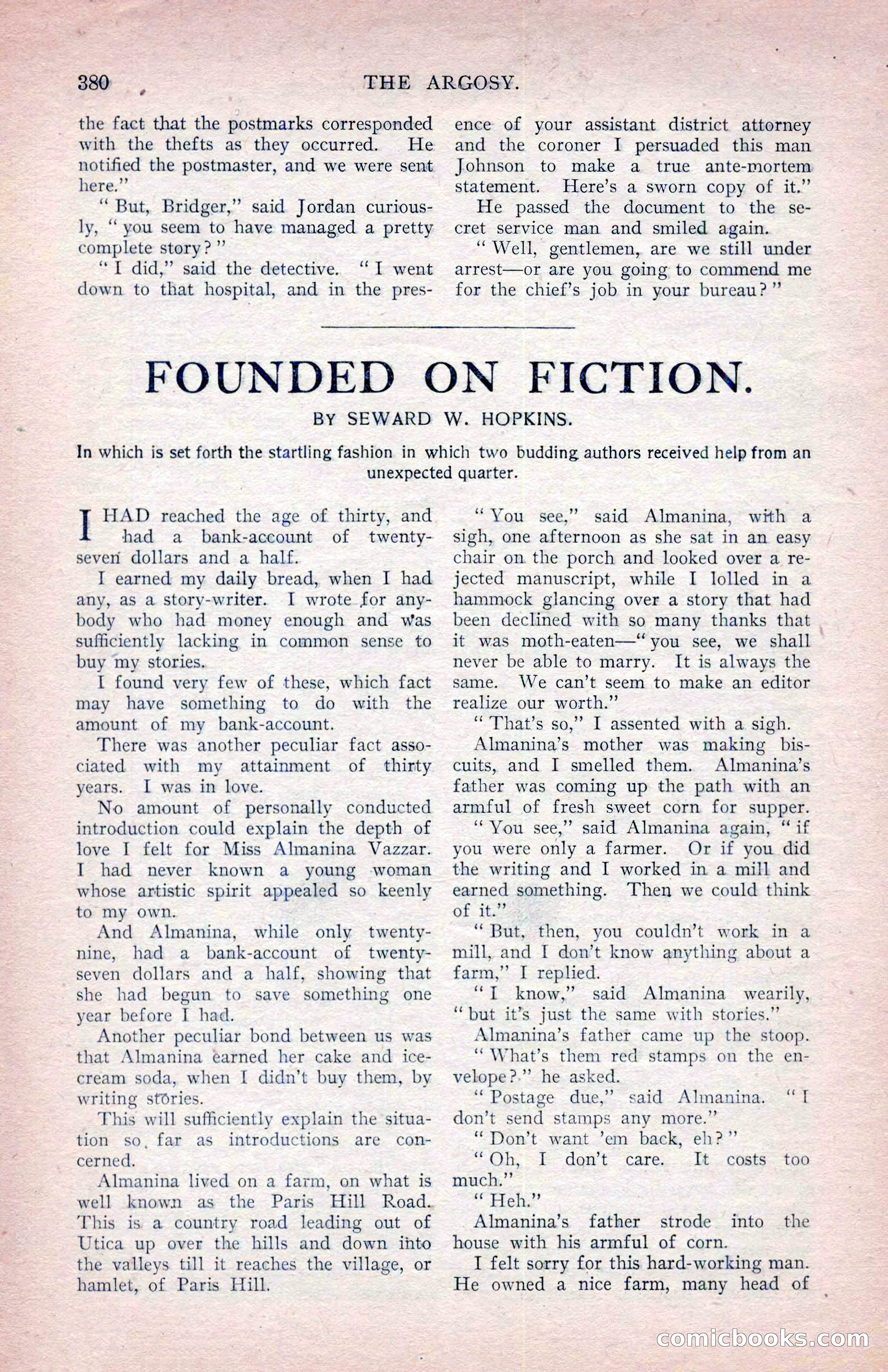
A restored page from Pulp Fiction, 1907. Page through the whole issue in the reader above.
📄 Transcribed text from this page (OCR, searchable)
Machine-transcribed from the original scan — historical spelling and the odd misread are preserved.
380 the fact that the postmarks corresponded with the thefts as they occurred. He notified the postmaster, and we were sent here.” ‘ But, Bridger,” said Jordan curious- ly, “you seem to have managed a pretty complete story? ”’ “T did,” said the detective. “ I went down to that hospital, and in the pres- ad ence of your assistant district attorney and the coroner I persuaded this man Johnson to make a true ante-mortem statement. Here’s a sworn copy of it.” He passed the document to the se- cret service man and smiled again. “Well, gentlemen, are we still under arrest—or are you going to commend me for the chief’s job in your bureau?” FOUNDED ON FICTION. BY SEWARD W. HOPKINS. In which is set forth the startling fashion in which two budding authors received help from an unexpected quarter. HAD reached the age of thirty, and had a _ bank-account of twenty- seven dollars and a half. I earned my daily bread, when I had any, as a story-writer. I wrote for any- body who had money enough and was sufficiently lacking in common sense to buy my stories. L found very few of these, which fact may have something to do with the amount of my bank-account. There was another peculiar fact asso- ciated with my attainment of thirty years. I was in love. No amount of personally conducted introduction could explain the depth of love I felt for Miss Almanina Vazzar. I had never known a young ‘woman whose artistic spirit appealed so keenly to my own. And Almanina, while only twenty- nine, had a bank-account of twenty- seven dollars and a half, showing that she had begun to save something one year before I had. Another peculiar bond between us was that Almanina earned her cake and ice- cream soda, when [ didn’t buy them, by writing stories. This will sufficiently explain the situa- tion so. far as introductions are con- cerned. Almanina lived on a farm, on what is well known as the Paris Hill Road. This is a country road leading out of Utica up over the hills and down into the valleys. till it reaches the village, or hamlet, of Paris Hill. “You see,” said Almanina, with a sigh, one afternoon as she sat in an easy chair on the porch and looked over a re- jected manuscript, while I lolled in a hammock glancing over a story that had been declined with so many thanks that it was moth-eaten—‘“ you see, we shall never be able to marry. It is always the same. We can’t seem to make an editor realize our worth.” ‘“That’s so,” I assented with a sigh. Almanina’s mother was making bis- cuits, and I smelled them. Almanina’s father was coming up the path with an armful of fresh sweet corn for supper. ‘You see,’ said Almanina again, “ if you were only a farmer. Or if you did the writing and I worked in a mill and earned something. Then we could think of it.” ‘But, then, you couldn’t work in a mill, and I don’t know anything about a farm,” I replied. “I know,” said Almanina wearily, ‘but it’s just the same with stories.” Almanina’s father came up the stoop. ‘“What’s them red stamps on the en- velope?.”’ he asked. ‘Postage due,” said Almanina. “I don’t send stamps any more.” ‘Don’t want ’em back, eh?” “Oh, I don’t care. It costs too much.”’ wees w=) 8 Almanina’s father strode into the house with his armful of corn. I felt sorry for this hard-working man. He owned a nice farm, many head of CORNICE OOOLKS (E@)