
Pulp Fiction, 1906 · page 209 of 248
The Argosy, October 1906 — page 209: what you’re looking at
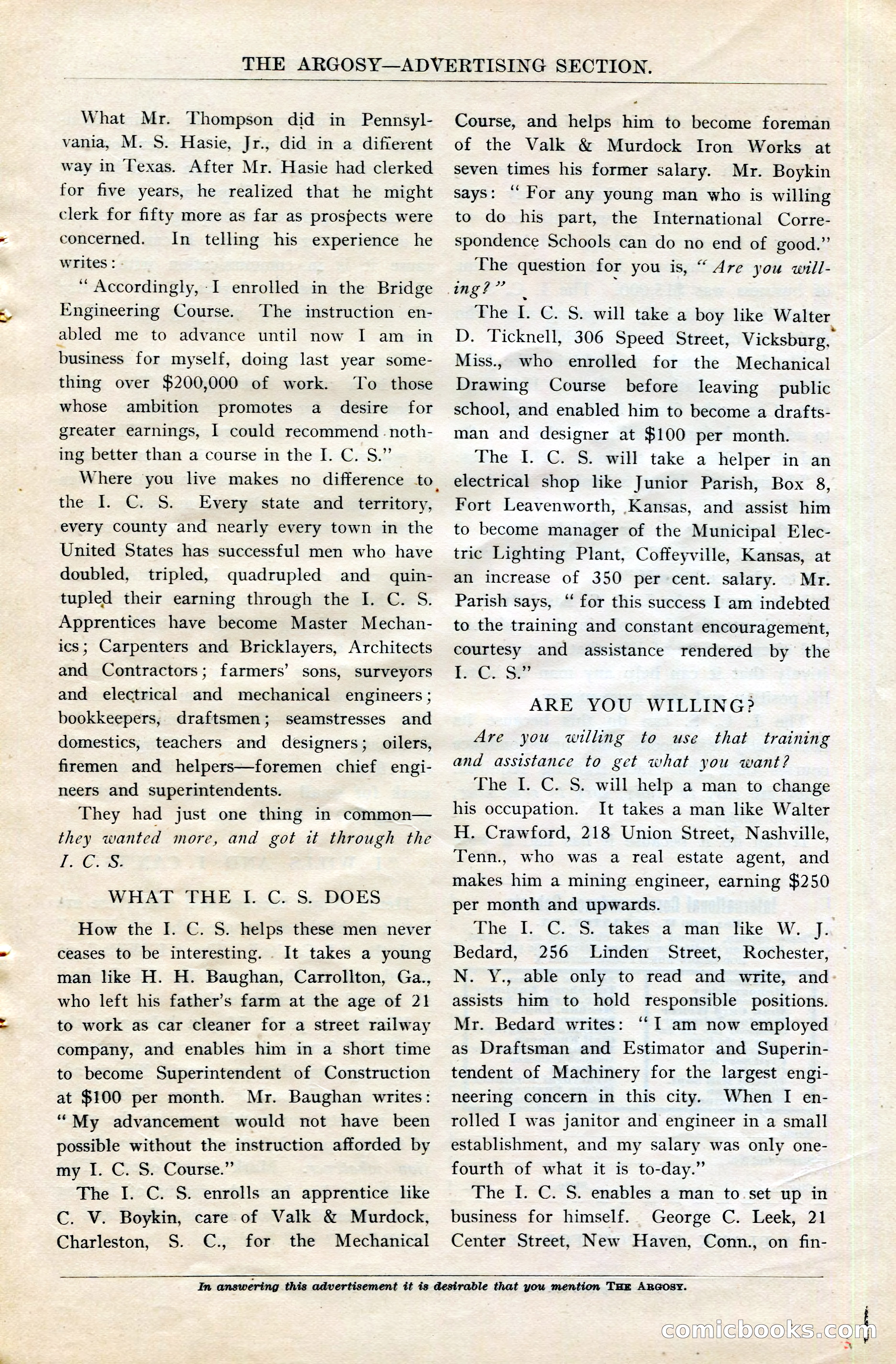
A restored page from Pulp Fiction, 1906. Page through the whole issue in the reader above.
📄 Transcribed text from this page (OCR, searchable)
Machine-transcribed from the original scan — historical spelling and the odd misread are preserved.
* THE ARGOSY—ADVERTISING SECTION. What Mr. Thompson did in Pennsyl- vania, M. S. Hasie, Jr., did in a difierent way in Texas. After Mr. Hasie had clerked for five years, he realized that he might clerk for fifty more as far as prospects were concerned. In telling his experience he writes : » ‘ Accordingly, -I enrolled in the Bridge Engineering Course. The instruction en- abled me to advance until now I am in business for myself, doing last year some- thing over $200,000 of work. To those whose ambition promotes a desire for greater earnings, I could recommend -noth- ing better than a course in the I. C. 8.” Where you live makes no difference to. the I. C. S. Every state and territory, every county and nearly every town in the United States has successful men who have doubled, tripled, quadrupled and_ quin- tupled their earning through the I. C. S. Apprentices have become Master Mechan- ics; Carpenters and Bricklayers, Architects and Contractors; farmers’ sons, surveyors and electrical and mechanical engineers ; bookkeepers, draftsmen; seamstresses and domestics, teachers and designers; oilers, firemen and helpers—foremen chief engi- neers and superintendents. They had just one thing in common— they wanted more, and got it through the 1. CG. WHAT THE I. C. S. DOES How the I. C. S. helps these men never ceases to be interesting. . It takes a young man like H. H. Baughan, Carrollton, Ga., who left his father’s farm at the age of 21 to work as car cleaner for a street railway company, and enables him in a short time to become Superintendent of Construction at $100 per month. Mr. Baughan writes: ‘“My advancement would not have been possible without the instruction afforded by my I. C. S. Course.” The I. C. S. enrolls an apprentice like C. V. Boykin, care of Valk & Murdock, Charleston, S. C., for the Mechanical Course, and helps him to become foreman of the Valk & Murdock Iron Works at seven times his former salary. Mr. Boykin says: ‘‘ For any young man who is willing to do his part, the International Corre- spondence Schools can do no end of good.” The question for you is, “ Are you will- ing?” The I. C. S. will take a boy like Walter D. Ticknell, 306 Speed Street, Vicksburg, Miss., who enrolled for the Mechanical Drawing Course before leaving public school, and enabled him to become a drafts- man and designer at $100 per month. The I. C. S. will take a helper in an electrical shop like Junior Parish, Box 8, Fort Leavenworth, Kansas, and assist him to become manager of the Municipal Elec- tric Lighting Plant, Coffeyville, Kansas, at an increase of 350 per cent. salary. Mr. Parish says, “ for this success I am indebted to the training and constant encouragement, courtesy and assistance rendered by the ti SE ARE YOU WILLING? Are you willing to use that training and assistance to get what you want? The I. C. S. will help a man to change his occupation. It takes a man like Walter H. Crawford, 218 Union Street, Nashville, Tenn., who was a real estate agent, and makes him a mining engineer, earning $250 per month and upwards. The I. C. S. takes a man like W. J. Bedard, 256 Linden Street, Rochester, N. Y., able only to read and write, and- assists him to hold responsible positions. Mr. Bedard writes: “I am now employed as Draftsman and Estimator and Superin- tendent of Machinery for the largest engi- neering concern in this city. When I en- rolled I was janitor and engineer in a small establishment, and my salary was only one- fourth of what it is to-day.” The I. C. S. enables a man to set up in business for himself. George C. Leek, 21 Center Street, New Haven, Conn., on fin- In answering this advertisement it is desirable that you mention THE ARGOSY. Gomicvookssco