
Pulp Fiction, 1906 · page 208 of 248
The Argosy, October 1906 — page 208: what you’re looking at
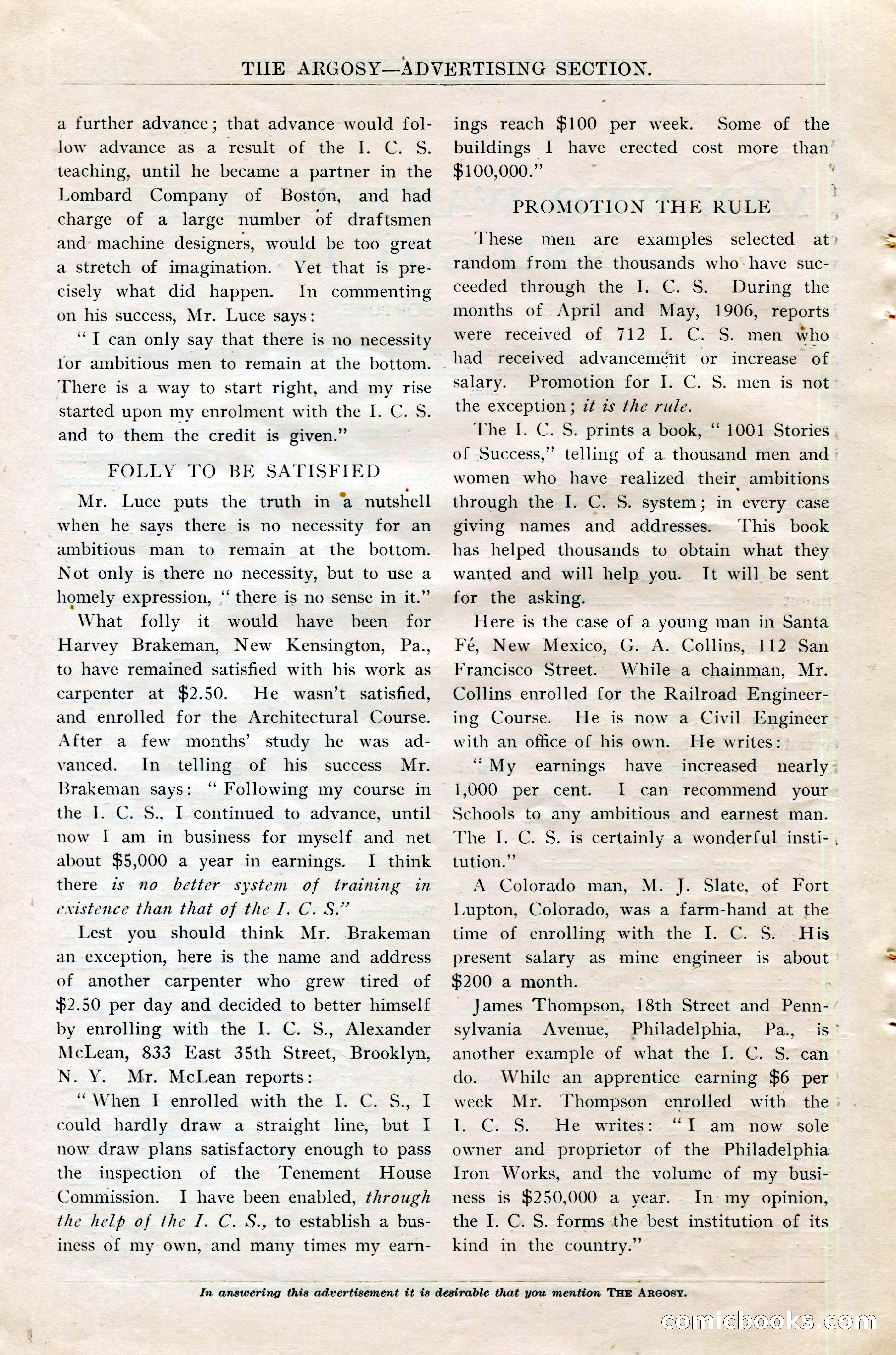
A restored page from Pulp Fiction, 1906. Page through the whole issue in the reader above.
📄 Transcribed text from this page (OCR, searchable)
Machine-transcribed from the original scan — historical spelling and the odd misread are preserved.
a further advance; that advance would fol- low advance as a result of the I. C. S. teaching, until he became a partner in the Lombard Company of Boston, and had charge of a large number of draftsmen and machine designers, would be too great a stretch of imagination. Yet that is pre- cisely what did happen. In commenting on his success, Mr. Luce says: “I can only say that there is no necessity tor ambitious men to remain at the bottom. There is a way to start right, and my rise started upon my enrolment with the I. C. S. and to them the credit is given.” | FOLLY TO BE SATISFIED Mr. Luce puts the truth in ‘a nutshell when he says there is no necessity for an ambitious man to remain at the bottom. Not only is there no necessity, but to use a homely expression, “ there is no sense in it.” What folly it would have been for Harvey Brakeman, New Kensington, Pa., to have remained satisfied with his work as carpenter at $2.50. He wasn’t satisfied, and enrolled for the Architectural Course. After a few months’ study he was _ ad- In telling of his Mr. Brakeman says: ‘ Following my course in the I. C. S., I continued to advance, until now | am in business for myself and net about $5,000 a year in earnings. I think there zs no better system of training in existence than that of the I. C. S.”’ Lest you should think Mr. an exception, here is the name and address of another carpenter who grew tired of $2.50 per day and decided to better himself by enrolling with the I. C. S., Alexander McLean, 833 East 35th Street, Brooklyn, N. Y. Mr. McLean reports: ‘When I enrolled with the I. C. S., I could hardly draw a straight line, but I now draw plans satisfactory enough to pass the inspection of the ‘Tenement House Commission. I have been enabled, through the help of the I. C. S., to establish a bus- iness of my own, and many times my earn- vanced. success Brakeman THE ARGOSY—ADVERTISING SECTION. ings reach $100 per week. Some of the buildings I have erected cost more than $100,000.” PROMOTION THE RULE ‘These men = are random from the thousands who: have suc- ceeded through the I. C. S. During the months of April and May, 1906, reports were received of 712 I. C. S. men who examples had received advanceméiit or increase of salary. Promotion for I. C. S. men is not the exception ; z¢ zs the rule. The I. C. S. prints a book, “ 1001 Stories of Success,” telling of a thousand men and : women who have realized their ambitions through the I. C. 5. system; in every case giving names and addresses. ‘This book has helped thousands to obtain what they wanted and will help you. It will be sent for the asking. Here is the case of a young man in Santa Fé, New Mexico, G. A. Collins, 112 San Francisco Street. While a chainman, Mr. Collins enrolled for the Railroad Engineer- ing Course. He is now a Civil Engineer with an office of his own. “ My 1,000 per cent. Schools to any ambitious and earnest man. He writes: earnings have _ increased I can recommend your The I. C. S. is certainly a wonderful insti- , tution.” A Colorado man, M. J. Slate, of Fort Lupton, Colorado, was a farm-hand at the time of enrolling with the I. C. SS. His present salary as mine engineer is about $200 a month. _ James Thompson, 18th Street and Penn- sylvania Avenue, Philadelphia, Pa., another example of what the I. C. S. can do. While an apprentice earning $6 per week Mr. Tx Gs sole owner and proprietor of the Philadelphia Iron Works, and the volume of my _ busi- ness is $250,000 a year. In: my opinion, the I. C. S. forms the best institution of its kind in the country.” He writes: ‘‘I am now In answering this advertisement it is desirable that you mention THE ARGOSY. selected at) nearly ; is” Thompson enrolled with the > Go =| 0(0\(6) (-) Sal ay ae