
Pulp Fiction, 1906 · page 112 of 248
The Argosy, October 1906 — page 112: what you’re looking at
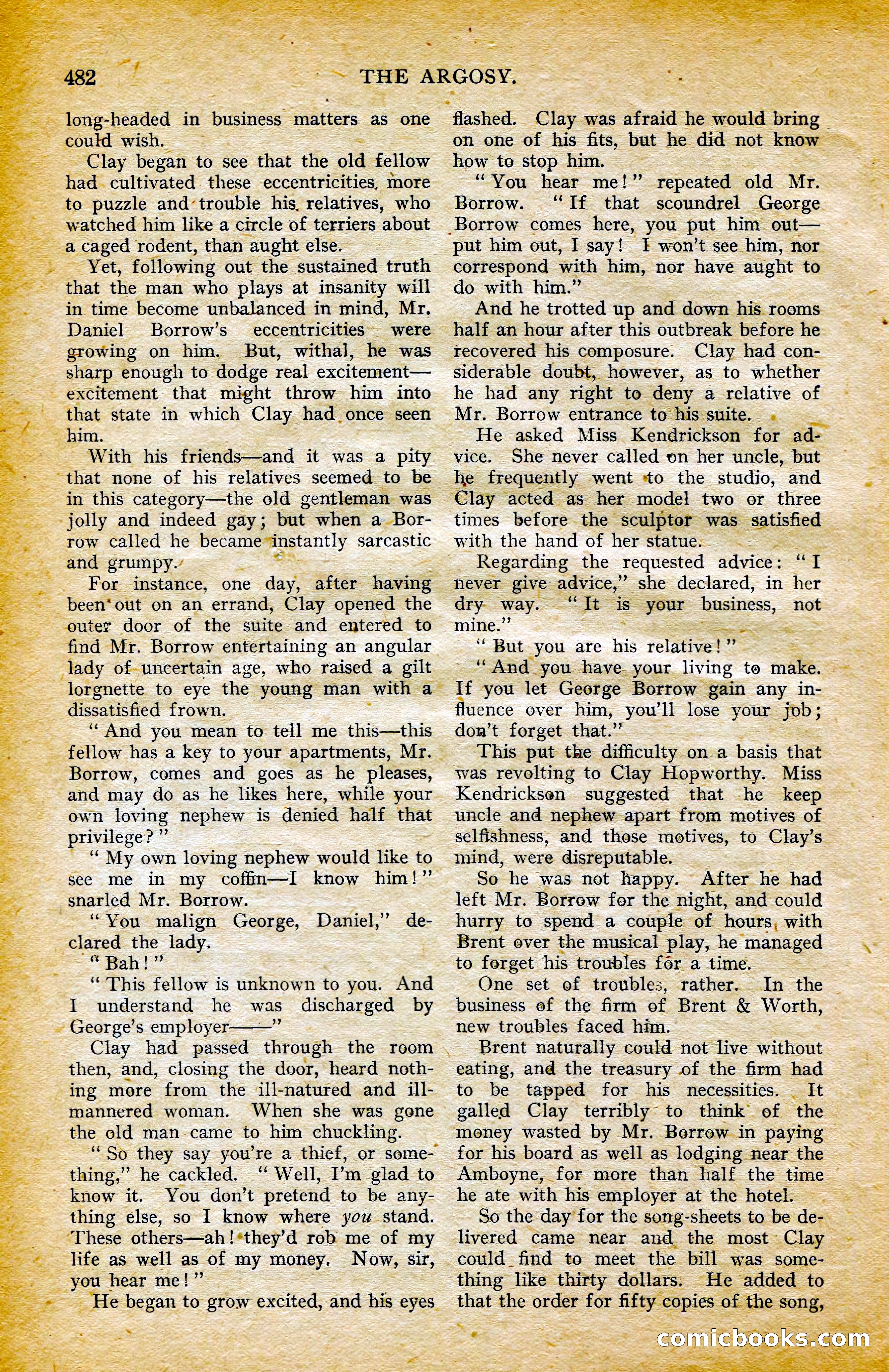
A restored page from Pulp Fiction, 1906. Page through the whole issue in the reader above.
📄 Transcribed text from this page (OCR, searchable)
Machine-transcribed from the original scan — historical spelling and the odd misread are preserved.
: Cl ren to see that the old fellow had. cultivated. these eccentricities, more s to. puzzle and’trouble his. relatives, who | = watched him like a circle of terriers ‘about oS a caged rodent, than aught else. ES. = Yet, following out the sustained truth 2 2a hat the man who plays at insanity will in time become unbalanced in mind, Mr. Daniel Borrow’s eccentricities were growing on him. But, withal, he was sharp enough to dodge real excitement— = = excitement that might throw him into _ that state in which Chay. had. once seen gS epee ~ With his friends—and it was a pity 2 “that none of his relatives seemed to be in this category—the old gentleman was jolly and indeed gay; but when a_Bor- row called he go sarcastic and grumpy. | ne For instance, one day, after Lage -been‘*out on an errand, Clay opened the outer door of the suite and entered to = = find Mr. Borrow entertaining an angular _ lady of-uncertain age, who raised a gilt _lorgnette to eye the. young man with “a-* _ dissatisfied frown. “And you mean to tell me this—this aie. comes and goes as he pleases, 2o8 -and may do as he likes here, while your own loving nephew is denied half that privilege? ”’ : __ “ My own loving nephew would like to see me in my cofin—I know him!” _ snarled Mr. Borrow. - “¥ou malign George, Daniel,” de- -clared the lady. 3 — Bah! ! 2) “This fellow is unknown to you. And I understand he was discharged by ~ George’s employer——” Clay had passed through the room , then, and, closing the door, heard noth- ing more from the ill- natured and ill- mannered woman. When she was gone the old man came to him chuckling. “So they say you’re a thief, or some- thing,” he cackled. ‘ Well, I’m glad to ~ know it. You don’t pretend to be any- thing else, so I know where you stand. = =: Sas hese others—ah!*they’d rob me of my «life as well as of my money. N ow, sir, aoe hear me!” — _ He began to grow excited, and his eyes. —— 7 a = THE ARGOSY. ed half an hour after this outbreak before he tecovered his composure. he frequently went to the studio, and | ‘Clay acted as her model two or three = = with the hand of her statue. | dry- way. - fellow has a key to your apartments, Mr. -Amboyne, for more than half the Hiies he ate with his employer at the hotel. . could. find to meet the bill. was Res SoSs flashed. Clay was afraid he Sbirtdl ag on one of his fits, but he did -hot know how to stop him. “Vou hear me!” Borrow. fehcdae ‘old Mr. “Tf that scoundrel George. y Borrow comes here, you put him out— put him out, I say! EF won't see him, nor correspond with him, nor have aught to do with him.” | And he trotted up “am down his rooms Clay had con- siderable doubt, however, as to whether he had any right to ‘deny a relative of Mr. Borrow entrance to his. Siite. 2 = He asked Miss Kendrickson for ad- vice. She never called on her uncle, but times before - the ~scul tor was: ssocsfed Ss os, Regarding the requested advice: “I never els edie ’ she declared, in her = It is” == business, not mine.’ Se ‘* But you % are his relates see “And you have your. living to mnie = If you let George Borrow gain any in- uence over him, you’ ‘1 lose —— 30D 5 don’t forget that.” This put the difficulty on a basis that was revolting to Clay Hopworthy. Miss" Kendrickson suggested that he keep uncle and nephew apart from motives of selfishness, and those metives, to Sace Ss mind, were disreputable. __ So he was not happy. ~ After he had left Mr. Borrow for the night, and could hurry to spend a couple of hours, with Brent over the musical play, he ‘managed to ferget his troubles fora time. One set of troubles, rather. In the business ef the firm of Brent & Worth, new troubles faced him. Brent naturally could not live without eating, and the treasury of the firm eee = to be tapped for his necessities. It galled Clay terribly to think” of ‘the ae money wasted by Mr. Borrow in paying — for his board as well as lodging near the Ade So the day for the song-sheets to be dee livered came near and the most “Clay — cee ry