
Pulp Fiction, 1906 · page 111 of 248
The Argosy, October 1906 — page 111: what you’re looking at
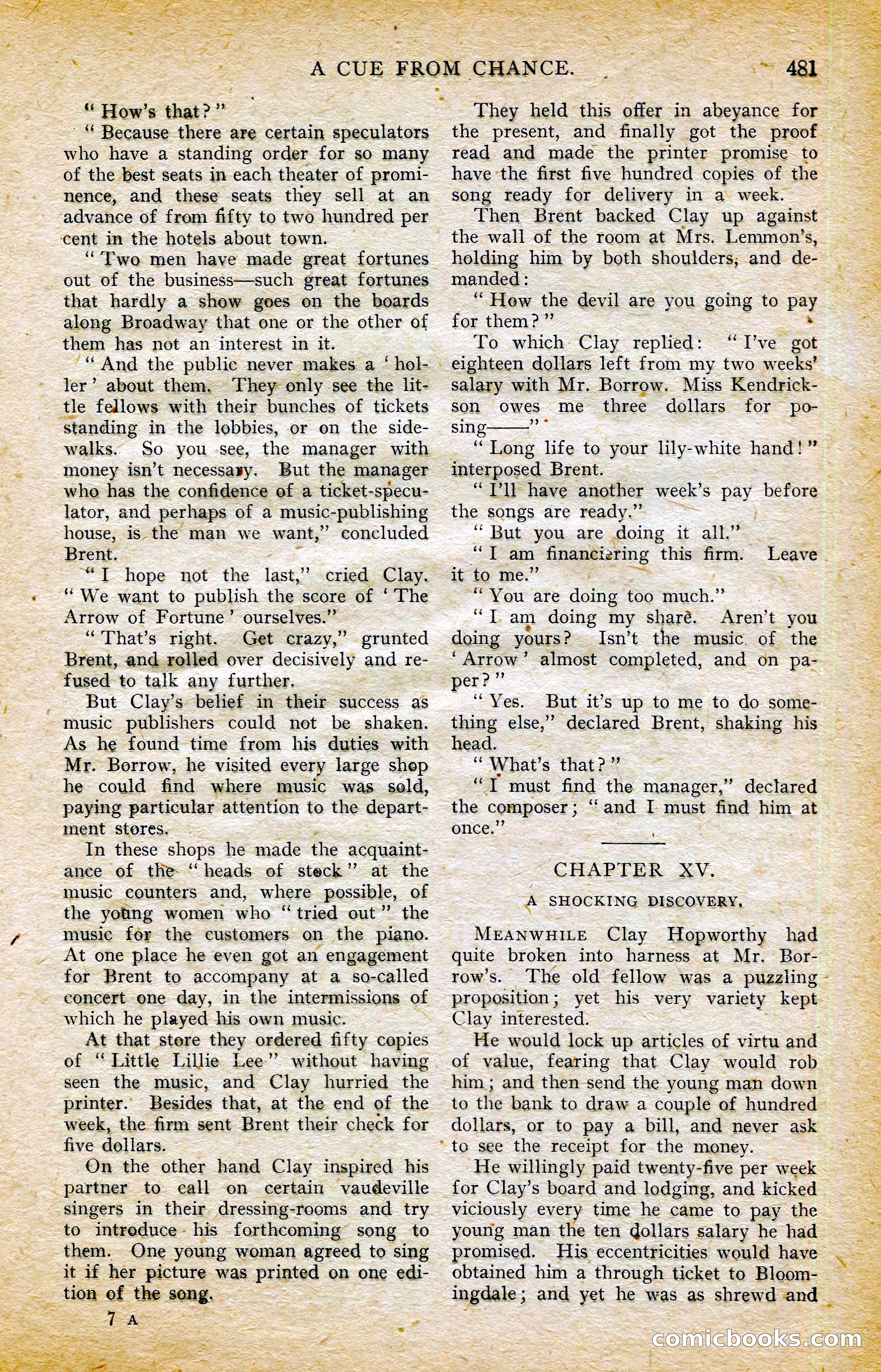
A restored page from Pulp Fiction, 1906. Page through the whole issue in the reader above.
📄 Transcribed text from this page (OCR, searchable)
Machine-transcribed from the original scan — historical spelling and the odd misread are preserved.
“ How’ s that? = -“ Because there are certain speculators who have a standing order for so many of the best seats in each theater of promi- nence, and these seats they sell at an ‘advance of from fifty to two hundred per ‘cent in the hotels about town. “Two men have made great fortunes out of the business—such great fortunes that hardly a show goes on the boards along Broadway that one or the other of them has not an interest in it. A CUE FROM CHANCE. ‘“ And the public never makes a ‘ hol- — ler’ about them. They only see the lit- tle fellows with their bunches of tickets standing in the lobbies, or on the side- walks. money isn’t necessary. But the manager who has the confidence of a ticket-specu- lator, and perhaps of a music- publishing house, is the man we want,’ ’ concluded Brent. “T hope not the last,” cried Clay. “ We want to publish the score of ‘ The Arrow of Fortune’ ourselves.” “That’s right. Get crazy,” grunted Brent, and rolled over decisively and re- fused to talk any further. But Clay’s belief in their success as ~music publishers could not be shaken. As he found time from his duties with Mr. Borrow, he visited every large shep he could find where music was sold, paying particular attention to the depart- ment stores. In these shops he made the acquaint- ance of the ‘heads of steck” at the music eounters and, where possible, of the young women who “ tried out” the music fer the customers on the piano. At one place he even got an engagement for Brent to accompany at a so-called eoncert one day, in the intermissions of which he played his own music. At that stere they ordered fifty copies of “Little Lillie Lee’ without having . seen the music, and Clay hurried the printer. Besides that, at the end of the week, the firm sent Brent their check for five dellars. On the other hand Clay inspired his partner to call on certain vaudeville singers in their dressing-rooms and try to intreduce- his forthcoming song to them. One young woman agreed to sing it if her picture was printed on one edi- AS tion of ‘the Seng. | So you see, the manager with ” They held this offer in ere for the present, and finally got the proof — read and made the printer promise - to have ‘the first five hundred copies of the song ready for delivery in a week. Then Brent backed Clay up against - the wall of the room at Mrs. Lemmon’ S, holding him by both shoulders; and de- manded : ‘Hew the devil are you going to pay for them?” To which Clay replied: “I’ve got eighteen dollars left from my two weeks’ salary with Mr. Borrow. Miss Kendrick- son owes me three dollars for po- sing a8 ‘Long life to your lily-white hand!” — interposed Brent. “T’ll have another week’s pay before the songs are ready.” “ But you are doing it all.” =f am finaneiering this firm. Leave - it to me.’ : “You are doing too Sock. = “Lam doing my sharé. Aren’t you doing yours? Isn’t the music of the ‘Arrow’ almost completed, and on pa- per?” 3 “Yes. But it’s up to me to do some- thing else,’ declared Brent, shaking his head. ‘ What’s that?” “I must find the manager,” the composer ; once.” declared ‘ CHAPTER XV. A SHOCKING DISCOVERY, MEANWHILE Clay Hopworthy had quite broken into harness at Mr. Bor- row’s. The old fellow was a puzzling - proposition; yet his very variety kept Clay interested. 7 He would lock up articles of virtu and of value, fearing that Clay would rob him; and then send the young man down to the bank to draw a couple of hundred — dollars, or to pay a bill, and never ask to see the receipt for the money. ‘He willingly paid twenty-five per week _for Clay’s board and lodging, and kicked - viciously every young man the ten dollars salary he had promised. His eccentricities would have obtained him a through ticket to Bloom- - ingdale ; and yet he was as shrewd and _ ‘and I- must find him at > time he came to pay the — CORMEOIOO<S: