
Pulp Fiction, 1906 · page 128 of 230
The Argosy, January 1906 — page 128: what you’re looking at
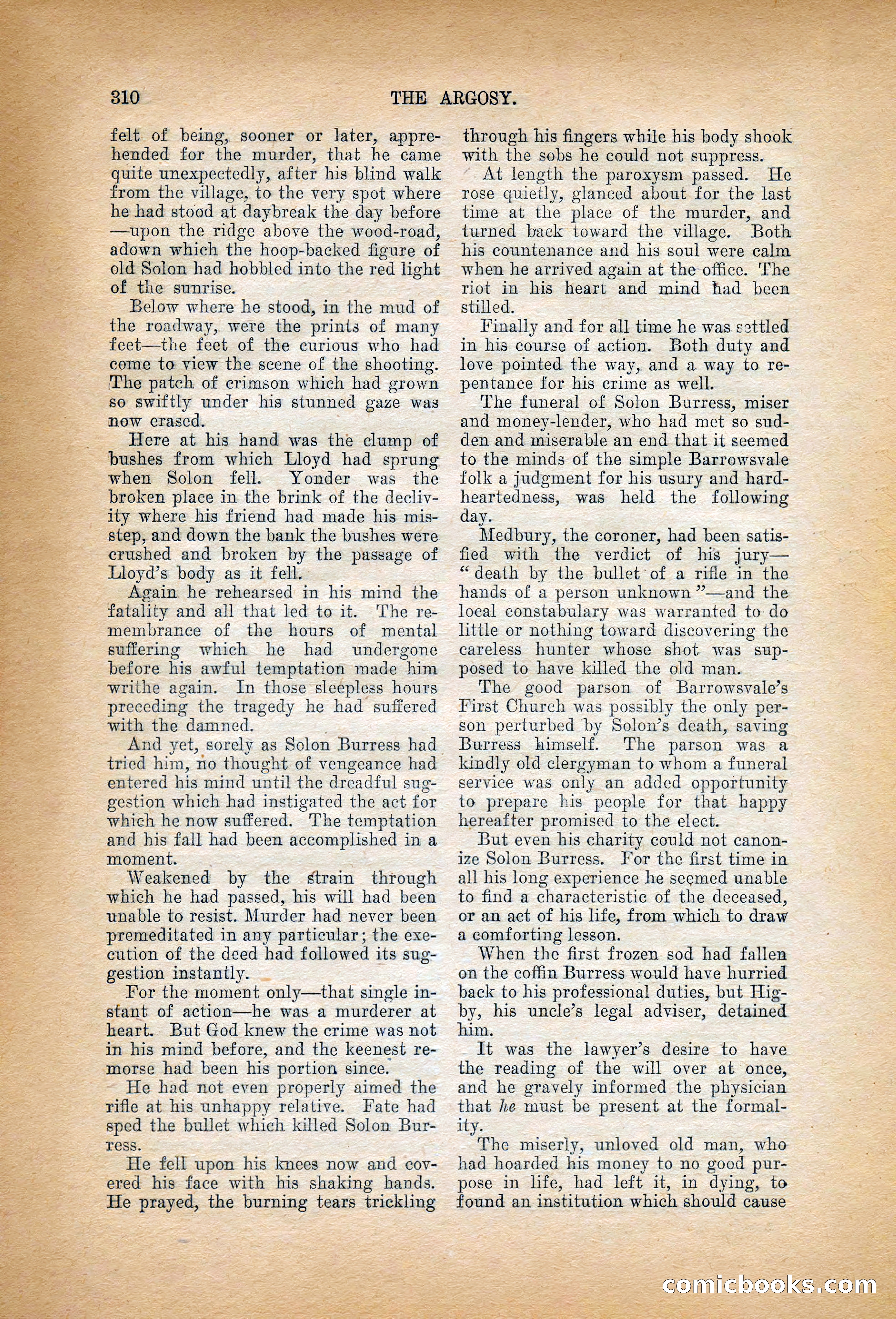
A restored page from Pulp Fiction, 1906. Page through the whole issue in the reader above.
📄 Transcribed text from this page (OCR, searchable)
Machine-transcribed from the original scan — historical spelling and the odd misread are preserved.
310 felt of being, sooner or later, appre- hended for the murder, that he came quite unexpectedly, after his blind walk trom the village, to the very spot where he had stood at daybreak the day before —upon the ridge above the wood-road, adown which the hoop-backed figure of old Solon had hobbled into the red light of the sunrise. Below where he stood, in the mud of the roadway, were the prinis of many feet—the feet of the curious who had come to view the scene of the shooting. The patch of crimson which had grown so swiftly under his stunned gaze was now erased. Here at his hand was the clump of bushes from which Lloyd had sprung when Solon fell. Yonder was the broken place in the brink of the decliv- ity where his friend had made his mis- step, and down the bank the bushes were crushed and broken by the passage of Lloyd’s body as it fell. Again he rehearsed in his mind the fatality and all that led to it. The re- membrance of the hours of mental suffering which he had undergone before his awful temptation made him writhe again. In those sleepless hours preceding the tragedy he had suffered with the damned. And yet, sorely as Solon Burress had tried him, no thought of vengeance had entered his mind until the dreadful sug- gestion which had instigated the act for which he now suffered. The temptation and his fall had been accomplished in a moment. Weakened by the strain through which he had passed, his will had been unable to resist. Murder had never been premeditated in any particular; the exe- cution of the deed had followed its sug- gestion instantly. For the moment only—that single in- stant of action—he was a murderer at heart. But God knew the crime was not in his mind before, and the keenest re- morse had been his portion since. He had not even properly aimed the rifle at his unhappy relative. Fate had sped the bullet which killed Solon Bur- ress. He fell upon his knees now and cov- ered his face with his shaking hands. He prayed, the burning tears trickling THE ARGOSY. through his fingers while his body shook with the sobs he could not suppress. At length the paroxysm passed. He rose quictly, glanced about for the last time at the place of the murder, and turned back toward the village. Both his countenance and his soul were calm when he arrived again at the office. The riot in his heart and mind had been stilled. Finally and for all time he was settled in his course of action. Both duty and love pointed the way, and a way to re- pentance for his crime as well. The funeral of Solon Burress, miser and money-lender, who had met so sud- den and miserable an end that it seemed to the minds of the simple Barrowsvale folk a judgment for his usury and hard- heartedness, was held the following day. Medbury, the coroner, had been satis- fied with the verdict of his jury— “death by the bullet of a rifle in the hands of a person unknown ”—and the loeal constabulary was warranted to do little or nothing toward discovering the careless hunter whose shot was sup- posed to have killed the old man. The good parson of Barrowsvale’s First Church was possibly the only per- son perturbed by Solon’s death, saving Burress himself. The parson was a kindly old clergyman to whom a funeral service was only an added opportunity to prepare his people for that happy hereafter promised to the elect. But even his charity could not canon- ize Solon Burress. For the first time in all his long experience he seemed unable to find a characteristic of the deceased, or an act of his life, from which to draw a comforting lesson. When the first frozen sod had fallen on the coffin Burress would have hurried back to his professional duties, but Hig- by, his uncle’s legal adviser, detained him. It was the lawyer’s desire to have the reading of the will over at once, and he gravely informed the physician that he must be present at the formal- ity. The miserly, unloved old man, who had hoarded his money to no good pur- pose in life, had left it, in dying, to found an institution which should cause comichook (E(0) im