
Pulp Fiction, 1906 · page 127 of 230
The Argosy, January 1906 — page 127: what you’re looking at
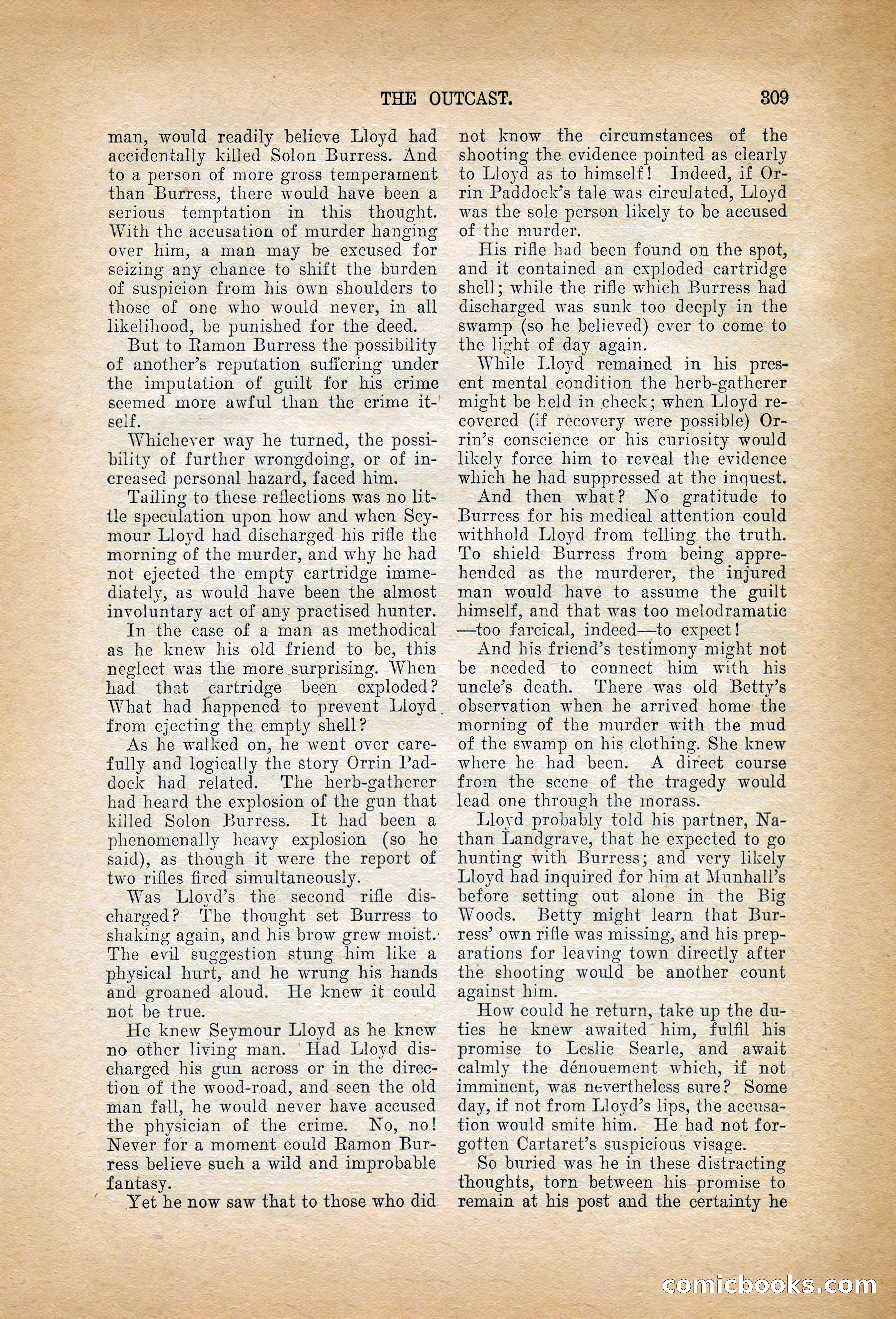
A restored page from Pulp Fiction, 1906. Page through the whole issue in the reader above.
📄 Transcribed text from this page (OCR, searchable)
Machine-transcribed from the original scan — historical spelling and the odd misread are preserved.
THE OUTCAST. man, would readily believe Lloyd had accidentally killed Solon Burress. And to a person of more gross temperament than Burress, there would have been a serious temptation in this thought. With the accusation of murder hanging over him, a man may be excused for seizing any chance to shift the burden of suspicion from his own shoulders to those of one who would never, in all likelihood, be punished for the deed. But to Ramon Burress the possibility of another’s reputation suffering under the imputation of guilt for his crime seemed more awful than the crime it-' self. Whichever way he turned, the possi- bility of further wrongdoing, or of in- ereased personal hazard, faced him. Tailing to these reilections was no lit- tle speculation upon how and when Sey- mour Lloyd had discharged his rifle the morning of the murder, and why he had not ejected the empty cartridge imme- diately, as would have been the almost involuntary act of any practised hunter. In the case of a man as methodical as he knew his old friend to be, this neglect was the more surprising. When had that cartridge been exploded? What had happened to prevent Lloyd. from ejecting the empty shell? As he walked on, he went over care- fully and logically the story Orrin Pad- dock had related. ‘The herb-gatherer had heard the explosion of the gun that killed Solon Burress. It had been a phenomenally heavy explosion (so he said), as though it were the report of two rifles fired simultaneously. Was Lloyd’s the second rifle dis- charged? The thought set Burress to shaking again, and his brow grew moist.: The evil suggestion stung him lke a physical hurt, and he wrung his hands and groaned aloud. He knew it could not be true. : He knew Seymour Lloyd as he knew no other living man. Had Lloyd dis- charged his gun across or in the direc- tion of the wood-road, and seen the old man fall, he would never have accused the physician of the crime. No, no! Never for a moment could Ramon Bur- ress believe such a wild and improbable fantasy. ' Yet he now saw that to those who did 809 not know the circumstances of the shooting the evidence pointed as clearly to Lloyd as to himself! Indeed, if Or- rin Paddock’s tale was circulated, Lloyd was the sole person likely to be accused of the murder. His rifle had been found on the spot, and it contained an exploded cartridge shell; while the rifle which Burress had discharged was sunk too deeply in the swamp (so he believed) ever to come to the light of day again. While Lloyd remained in his pres- ent mental condition the herb-gatherer might be keld in check; when Lloyd re- covered (f recovery were possible) Or- rin’s conscience or his curiosity would likely force him to reveal the evidence which he had suppressed at the inquest. And then what? No gratitude to Burress for his medical attention could withhold Lloyd from telling the truth. To shield Burress from being appre- hended as the murderer, the injured man would have to assume the guilt himself, and that was too melodramatic —too farcical, indeed—to expect! And his friend’s testimony might not be needed to connect him with his uncle’s death. ‘There was old Betty’s observation when he arrived home the morning of the murder with the mud of the swamp on his clothing. She knew where he had been. A direct course from the scene of the tragedy would lead one through the morass. Lloyd probably told his partner, Na- than Landgrave, that he expected to go hunting with Burress; and very likely Lloyd had inquired for him at Munhall’s before setting out alone in the Big Woods. Betty might learn that Bur- ress’ own rifle was missing, and his prep- arations for leaving town directly after the shooting would be another count against him. How could he return, take up the du- ties he knew awaited him, fulfil his promise to Leslie Searle, and await calmly the dénouement which, if not imminent, was nevertheless sure? Some day, if not from Lloyd’s lips, the accusa- tion would smite him. He had not for- gotten Cartaret’s suspicious visage. So buried was he in these distracting thoughts, torn between his promise to remain at his post and the certainty he ecom chook (E(@)