
Pulp Fiction, 1906 · page 109 of 230
The Argosy, January 1906 — page 109: what you’re looking at
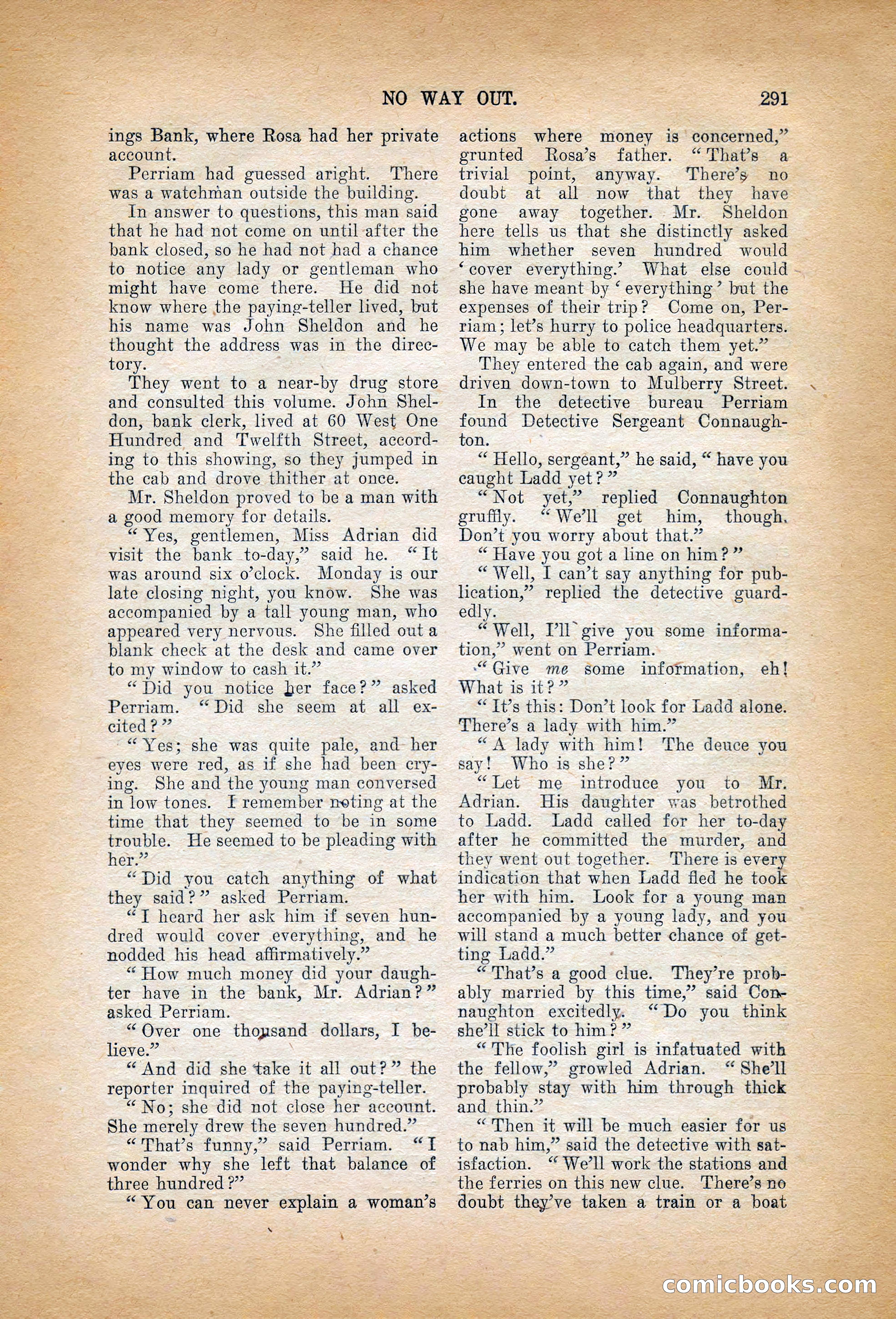
A restored page from Pulp Fiction, 1906. Page through the whole issue in the reader above.
📄 Transcribed text from this page (OCR, searchable)
Machine-transcribed from the original scan — historical spelling and the odd misread are preserved.
NO WAY OUT. ings Bank, where Rosa had her private account, Perriam had guessed aright. There was a watchman outside the building. In answer to questions, this man said that he had not come on until after the bank closed, so he had not had a chance to notice any lady or gentleman who might have come there. He did not know where the paying-teller lived, but his name was John Sheldon and he thought the address was in the direc- tory. They went to a near-by drug store and consulted this volume. John Shel- don, bank clerk, lived at 60 West One Hundred and Twelfth Street, accord- ing to this showing, so they jumped in the cab and drove thither at once. Mr. Sheldon proved to be a man with a good memory for details. “Yes, gentlemen, Miss Adrian did visit the bank to-day,” said he. “It was around six o'clock. Monday is our late closing night, you know. She was accompanied by a tall young man, who appeared very nervous. She filled out a blank check at the desk and came over to my window to cash it.” “Did you notice Der face?” asked Perriam. “Did she seem at all ex- cited ? ” “Yes; she was quite pale, and- her eyes were red, as if she had been cry- ing. She and the young man conversed in low tones. [remember neting at the time that they seemed to be in some trouble. He seemed to be pleading with her.” “Did you catch anything of what they said?” asked Perriam. “J heard her ask him if seven hun- dred would cover everything, and he nodded his head affirmatively.” “ How much money did your daugh- ter have in the bank, Mr. Adrian?” asked Perriam. “Over one thoysand dollars, heve.” “And did she take it all out?” the reporter inquired of the paying-teller. “No; she did not close her account. She merely drew the seven hundred.” “That's funny,” said Perriam. “f wonder why she left that balance of three hundred ?”’ “You can never explain a woman’s 1 be- \ 291 actions where money is concerned,” grunted MRosa’s father. “That's a trivial point, anyway. ‘There’s no doubt at all now that they have gone away together. Mr. Sheldon here tells us that she distinctly asked him whether seven hundred would “cover everything.’ she have meant by ‘ everything’ but the expenses of their trip? Come on, Per- riam; let’s hurry to police headquarters. We may be able to catch them yet.” They entered the cab again, and were driven down-town to Mulberry Street. In the detective bureau Perriam found Detective Sergeant Connaugh- ton. “ Hello, sergeant,” he said, “ have you eaught Ladd yet?” “Not yet, ” replied Connaughton oruffly. “We'll get him, though, Don’t you worry about that.” “Have you got a line on him? ” “Well, I can’t say anything for pub- lication,” rephed the detective guard- edly. “Well, T’ll give you some informa- tion,” went on Perriam. “Give me some information, What is it?” | “ It’s this: Don’t look for Ladd alone. There’s a lady with him.” “A lady with him! The deuce you eh! say! Who is she?” “Let me introduce you to Mr. Adrian. His daughter was betrothed to Ladd. Ladd called for her to-day after he committed the murder, and they went out together. There is every indication that when Ladd fled he took her with him. Look for a young man accompanied by a young lady, and you will stand a much Deuter chance of get- ting Ladd.” : “That's a good clue. They’re prob- ably married by this time,” said Con naughton excitedly. ‘“‘Do you think she’ll stick to him?” “The foolish girl is infatuated with the fellow,” growled Adrian. “ She'll probably stay with him through thick and thin.” “Then it will be much easier for us to nab him,” said the detective with sat- isfaction. “ We’ll work the stations and the ferries on this new clue. There’s no doubt they’ve taken a train or a boat cComichoo What else could - 1E(0)