
Pulp Fiction, 1906 · page 108 of 230
The Argosy, January 1906 — page 108: what you’re looking at
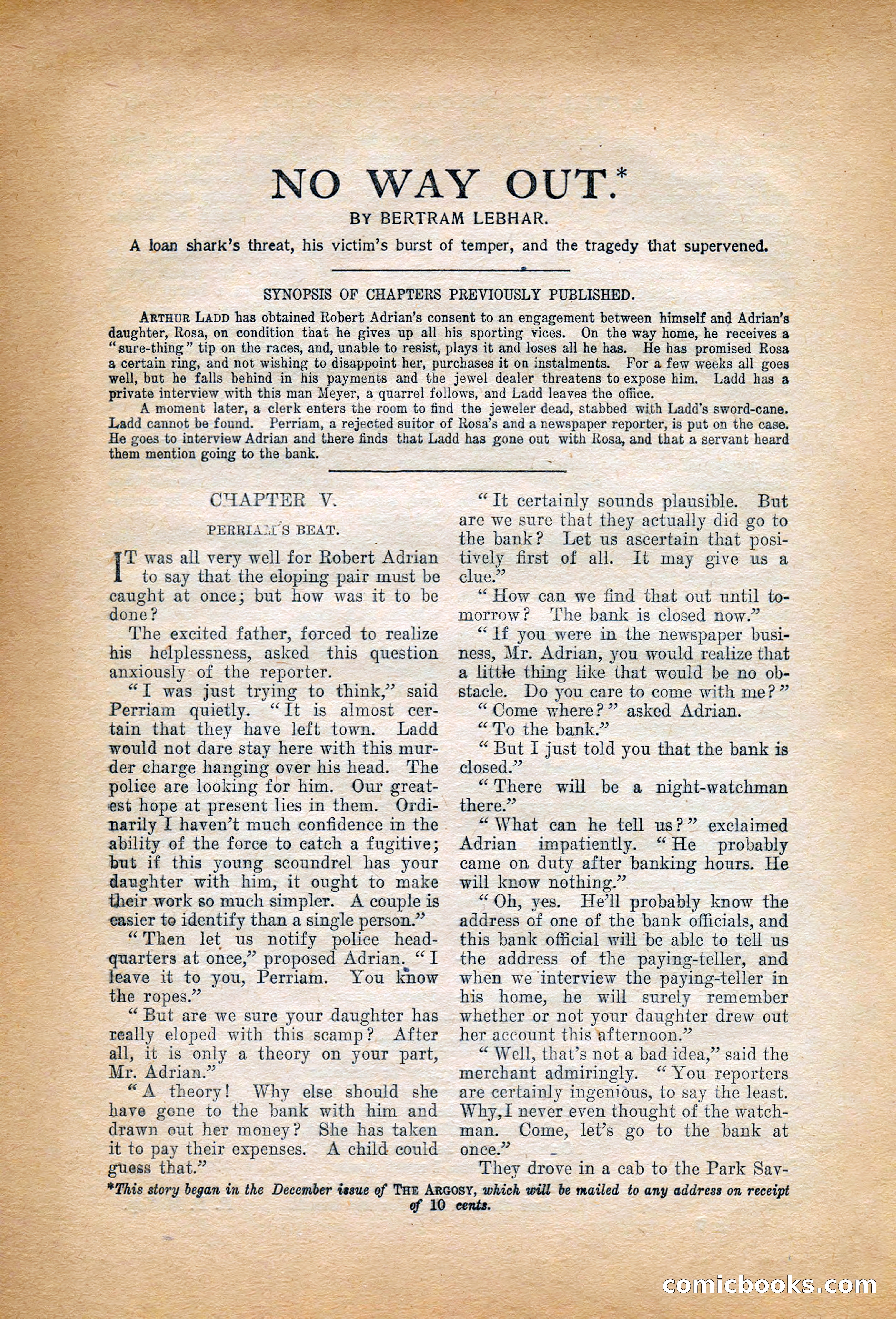
A restored page from Pulp Fiction, 1906. Page through the whole issue in the reader above.
📄 Transcribed text from this page (OCR, searchable)
Machine-transcribed from the original scan — historical spelling and the odd misread are preserved.
NO WAY OUT. BY BERTRAM LEBHAR, A loan shark’s threat, his victim’s burst of temper, and the tragedy that supervened. SYNOPSIS OF CHAPTERS PREVIOUSLY PUBLISHED. ArtTHUR LADD has obtained Robert Adrian’s consent to an engagement between himself and Adrian’s daughter, Rosa, on condition that he gives up all his sporting vices. “sure-thing” tip on the races, and, unable to resist, plays it and loses all he has. a certain ring, and not wishing to disappoint her, purchases it on instalments. On the way home, he receives a He has promised Rosa For a few weeks all goes well, but he falls behind in his payments and the jewel dealer threatens to expose him. Ladd has a private interview with this man Meyer, a quarrel follows, and Ladd leaves the office. A moment later, a clerk enters the room to find the jeweler dead, stabbed with Ladd’s sword-cane. Ladd cannot be found. Perriam, a rejected suitor of Rosa’s and a newspaper reporter, is put on the case. He goes to interview Adrian and there finds that Ladd has gone out with Rosa, and that a servant heard them mention going to the bank. CHAPTER V. PERRIAI 8S BEAT. Eg was all very well for Robert Adrian to say that the eloping pair must be caught at once; but how was it to be done? The excited father, forced to realize his helplessness, asked this question anxiously of the reporter. “ft was just trying to think,’ said Perriam quietly. “It is almost cer- tain that they have left town. Ladd would not dare stay here with this mur- der charge hanging over his head. The police are looking for him. Our great- est hope at present les in them. Ordi- narily I haven’t much confidence m the ability of the force to catch a fugitive; but if this young scoundrel has your daughter with him, it ought to make their work so much simpler. A couple is easier to identify than a single person.” “Then let us notify police head- quarters at once,” proposed Adrian. “I leave it to you, Perriam. You know the ropes.” “But are we sure your daughter has really eloped with this scamp? After all, it is only a theory on your part, Mr. Adrian.” “A theory! Why else should she have gone to the bank with him and drawn out her money? She has taken it to pay their expenses. A child could guess that.” “It certainly sounds plausible. But are we sure that they actually did go to the bank? Let us ascertain that posi- tively first of all. It may give us a clue.” “How can we find that out until to- morrow? ‘he bank is closed now.” ““ {i you were in the newspaper busi- ness, Mr. Adrian, you would realize that a littte thing like that would be no ob- stacle. Do you care to come with me?” “Come where?” asked Adrian. “To the bank.” “ But I just told you that the bank is closed.” “There will be a night-watchman there.” “What can he tell us?” exclaimed Adrian impatiently. “He probably came on duty after banking hours. He will know nothing.” “Oh, yes. He'll probably know the address of one of the bank officials, and this bank official will be able to tell us the address of the paying-teller, and when we interview the paying-teller in his home, he will surely remember whether or not your daughter drew out her account this afternoon.” “Well, that’s not a bad idea,” said the merchant admiringly. “ You reporters are certainly ingenious, to say the least. Why,f never even thought of the watch- man. , Lome, let’s go to the bank at once.’ They drove in a cab to the Park Sav- *This story began in the December tesue of THE ARGOSY, which will be matied to any address on receipt o 10 cents. (elo) a qilicel oYexe) .< (Ee)