
Pulp Fiction, 1891 · page 10 of 20
The Argosy, Vol. XI, No. 21 — page 10: what you’re looking at
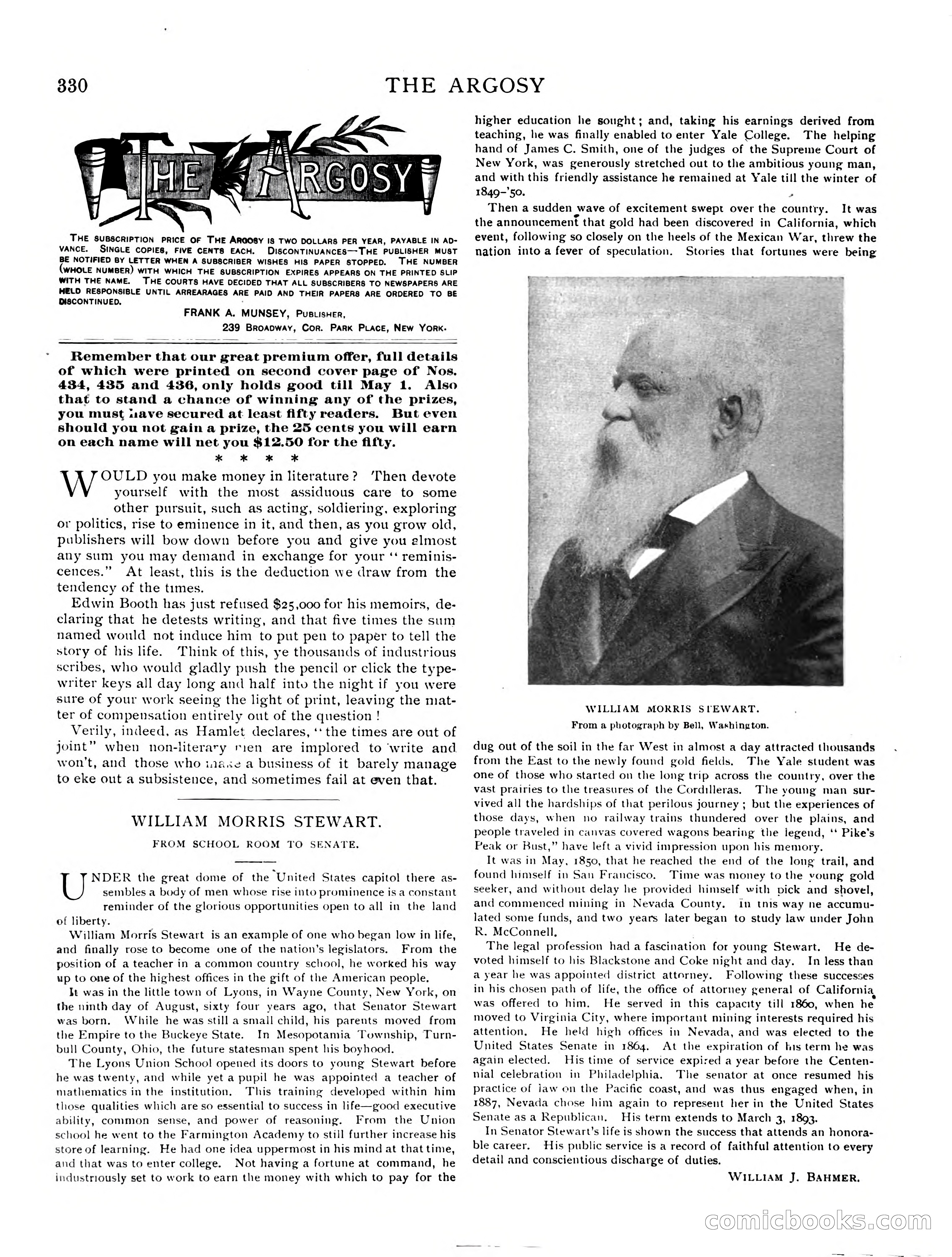
A restored page from Pulp Fiction, 1891. Page through the whole issue in the reader above.
📄 Transcribed text from this page (OCR, searchable)
Machine-transcribed from the original scan — historical spelling and the odd misread are preserved.
330 THE SUBSCRIPTION PRICE OF THE ARGOSY IS TWO DOLLARS PER YEAR, PAYABLE IN AD- VANCE. SINGLE COPIES, FIVE CENTS EACH. DISCONTINUANCES—THE PUBLISHER MUST BE NOTIFIED BY LETTER WHEN A SUBSCRIBER WISHES HIS PAPER STOPPED. THE NUMBER WHOLE NUMBER) WITH WHICH THE SUBSCRIPTION EXPIRES APPEARS ON THE PRINTED SLIP WITH THE NAME. THE COURTS HAVE DECIDED THAT ALL SUBSCRIBERS TO NEWSPAPERS ARE HELD RESPONSIBLE UNTIL ARREARAGES ARE PAID AND THEIR PAPERS ARE ORDERED TO BE DISCONTINUED. FRANK A. MUNSEY, PusisHer, 239 BroaowaAy, Cor. PARK PLACE, NEw YORK. Remember that our great premium offer, full details of which were printed on second cover page of Nos. 434, 435 and 436, only holds good till May 1. Also that to stand a chance of winning any of the prizes, you must uave secured at least fifty readers. But even should you not gain a prize, the 25 cents you will earn on each name will net you $12.50 for the fifty. * * #e * OULD you make money in literature? ‘Then devote yourself with the most assiduous care to some other pursuit, such as acting, soldiering, exploring or politics, rise to eminence in it, and then, as you grow old, publishers will bow down before you and give you elmost any sum you may demand in exchange for your ‘‘ reminis- cences.” At least, this is the deduction we draw from the tendency of the times. Edwin Booth has just refused $25,000 for his memoirs, de- claring that he detests writing, and that five times the sum named would not induce him to put pen to paper to tell the story of his life. Think of this, ye thousands of industrious scribes, who would gladly push the pencil or click the type- writer keys all day long and half into the night if you were sure of your work seeing the light of print, leaving the mat- ter of compensation entirely out of the question ! Verily, indeed, as Hamlet declares, ‘‘ the times are out of joint” when non-literary mien are implored to ‘write and won't, and those who inase a business of it barely manage to eke out a subsistence, and sometimes fail at even that. WILLIAM MORRIS STEWART. FROM SCHOOL ROOM TO SENATE, NDER the great dome of the United States capitol there as- sembles a body of men whose rise into prominence is a constant reminder of the glorious opportunities open to all in the land of liberty. William Morris Stewart is an example of one who began low in life, and finally rose to become one of the nation’s legislators. From the position of a teacher in a common country school, he worked his way up to one of the highest offices in the gift of the American people. bt was in the little town of Lyons, in Wayne County, New York, on the ninth day of August, sixty four years ago, that Senator Stewart was born. While he was still a small child, his parents moved from the Empire to the Buckeye State. In Mesopotamia Township, Turn- bull County, Ohio, the future statesman spent his boyhood. The Lyons Union School opened its doors to young Stewart before he was twenty, and while yet a pupil he was appointed a teacher of mathematics in the institution, This training developed within him those qualities which are so essential to success in life—good executive ability, common sense, and power of reasoning. From the Union school he went to the Farmington Academy to still further increase his store of learning. He had one idea uppermost in his mind at that time, aid that was to enter college. Not having a fortune at command, he industriously set to work to earn the money with which to pay for the THE ARGOSY higher education he sought; and, taking his earnings derived from teaching, he was finally enabled to enter Yale College. The helping hand of James C. Smith, one of the judges of the Supreme Court of New York, was generously stretched out to the ambitious young man, and with this friendly assistance he remained at Yale till the winter of 1849-’50. ‘i Then a sudden wave of excitement swept over the country. It was the announcement that gold had been discovered in California, which event, following so closely on the heels of the Mexican War, threw the Nation into a fever of speculation. Stories that fortunes were being 5 “ ee . ——— WILLIAM MORRIS SVEWART. From a photograph by Bell, Washington. dug out of the soil in the far West in almost a day attracted thousands from the East to the newly found gold fields. The Yale student was one of those who started on the long trip across the country, over the vast prairies to the treasures of the Cordilleras. The voung man sur- vived all the hardships of that perilous journey ; but the experiences of those days, when no railway trains thundered over the plains, and people traveled in canvas covered wagons bearing the iegend, ‘* Pike's Peak or Bust,” have left a vivid impression upon his memory. It was in May, 1850, that he reached the end of the long trail, and found himself in San Francisco, Time was money to the voung gold seeker, and without delay he provided himself with pick and shovel, and commenced mining in Nevada County, in tnis way ne accumu- lated some funds, and two years later began to study law under John R. McConnell. The legal profession had a fascination for young Stewart. He de- voted himself to his Blackstone and Coke night and day. In less ds a year he was appointed district attorney. Following these successe in his chosen path of life, the office of attorney general of California was offered to him. moved to Virginia City, where important mining interests required his attention. He held high offices in Nevada, and was elected to the United States Senate in 1864. At the expiration of his term he was again elected. His time of service expired a year before the Centen- nial celebration in Philadelphia. The senator at once resumed his practice of jaw on the Pacific coast, and was thus engaged when, in 1887, Nevada chose him again to represent her in the United States Senate as a Republican, His term extends to March 3, 1893. In Senator Stewart’s life is shown the success that attends an honora- ble career. His public service is a record of faithful attention to every detail and conscientious discharge of duties. WILLIAM J. BAHMER, He served in this capacity till 1860, when he CORnNICLOOlKS (C@)