
Pulp Fiction, 1905 · page 153 of 224
The Argosy, August 1905 — page 153: what you’re looking at
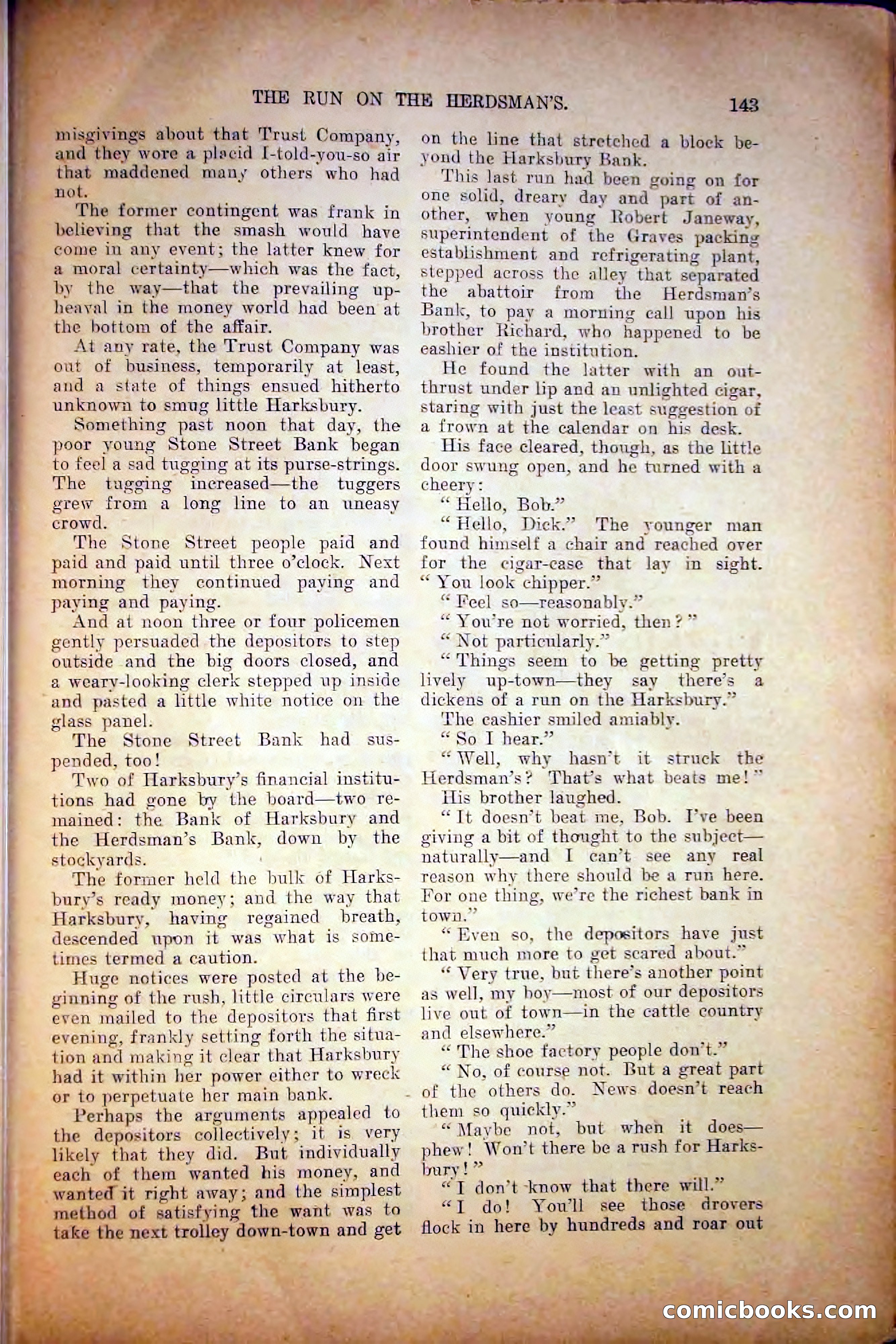
A restored page from Pulp Fiction, 1905. Page through the whole issue in the reader above.
📄 Transcribed text from this page (OCR, searchable)
Machine-transcribed from the original scan — historical spelling and the odd misread are preserved.
SI ee = — a i ~ about ‘that Trust. Company, wore a placid I-told-you-so air and that maddened many others who had ' mot. The former contingent was frank in believing that the smash would have come in any event; the latter knew for a moral certainty—which was the fact, by the way—that the prevailing up- heayal in the money world had been at the bottom of the affair. At any rate, the Trust Company was out of business, temporarily at least, and a state of things ensued hitherto unknown to smug little Harksbury. Something past noon that day, the poor young Stone Street Bank began to feel a sad tugging at its purse-strings. The tugging increased—the tuggers grew from a long line to an wneasy crowd. The Stone Street people paid and paid and paid until three o’clock. Next morning they continued paying and paying and paying. And at noon three or four policemen gently persuaded the depositors to step outside and the big doors closed, and a weary-looking clerk stepped up inside and pasted a little white notice on the glass panel. The Stone pended, too! Two of Harksbury’s financial institu- tions had gone by the board—two re- mained: the Bank of Harksbury and the Herdsman’s Bank, down by the stockyards. The former held the bulk of Harks- bury’s ready money; and the way that Harksbury, having regained breath, descended upon it was what is some- times termed a caution. Huge notices were posted at the be- ginning of the rush, little circulars were even mailed to the depositors that first evening, frankly setting forth the situa- tion and making it clear that Harksbury had it within her power either to wreck or to perpetuate her main bank. Perhaps the arguments appealed to the depositors collectively; it is very likely that they did. But individually each of them wanted his money, and Street Bank had sus- wanted it right away; and the simplest method of satisfying the want was ta take the next trolley down-town and get ’ , - (" , - 1 eB Ss e RUN ON THE HERDSMAN’S. _ of the others do. «~F . RAL So ips on the line that stretched a block be- yond the Harksbury Bank. This last run had been going on for one solid, dreary day and part of an- other, when young Robert Janeway, superintendent of the Graves packing establishment and refrigerating plant, stepped across the alley that separated the abattoir from the Herdsman’s Bank, to pay a moruing eal] upon his brother Richard, who happened to be eashier of the institution. He found the latter with an out- thrust under lip and an unlighted cigar, staring with just the least suggestion of a frown at the calendar on his desk. His face cleared, though, as the little door swung open, and he turned with a cheery: “ Hello, Bob.” “Hello, Dick.’ The younger man found himself a chair and reached over for the cigar-case that lay in sight. “You look chipper.” “ Feel so—reasonably.” “ You're not worried, then ? “ Not particnlarly.” “Things seem to be getting pretty lively up-town—they say there’s a dickens of a run on the Harksbury.” The eashier smiled amiably. “pos .k Bear “Well, why hasn*t it struck the Herdsman’s? That’s what beats me!” ilis brother laughed. “Tt doesn’t beat me, Bob. I’ve been giving a bit of thought to the subjeet— naturally—and I can’t see any real reason why there should be a run here. For one thing, we’re the richest bank in town.” * Even so, the depositors have just that much more to get scared about.” “‘ Very true, but there’s another point as well, my boy—most of our depositors live out of town—in the cattle country and elsewhere.” “The shoe factory people don’t.” “No, of course not. But a great part News doesn’t reach 33 them so quickly.” “Mavbe not, but when it does— phew! Won’t there be a rush for Harks- bury!” “T don’t know that there will.” “7 dot — ae ~ ‘ +e wig. aa . ¢ wy ees AS a = «s You'll see those drovers flock in here by hundreds and roar out — > ate as >" cComicbooks.com