
Pulp Fiction, 1905 · page 152 of 224
The Argosy, August 1905 — page 152: what you’re looking at
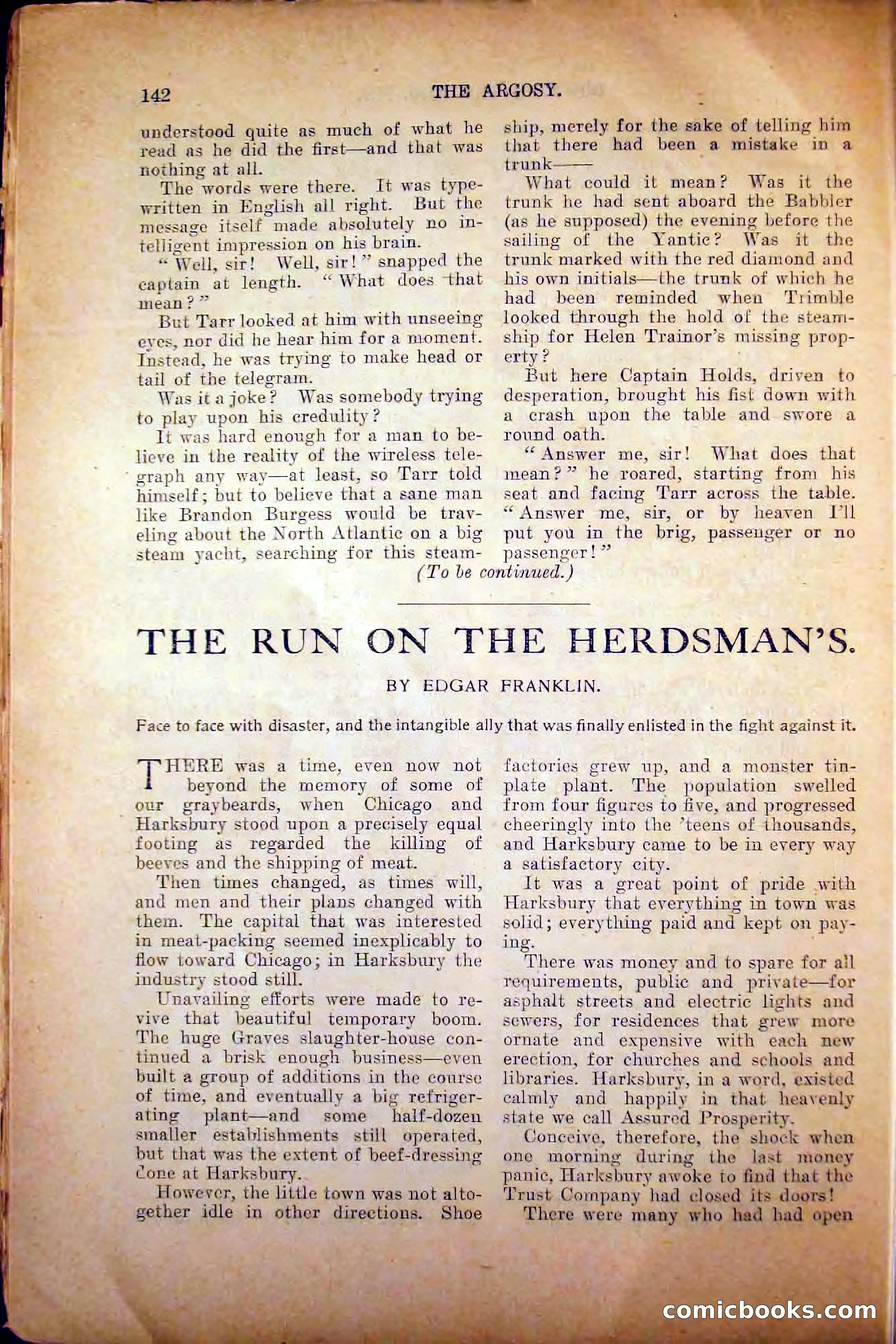
A restored page from Pulp Fiction, 1905. Page through the whole issue in the reader above.
📄 Transcribed text from this page (OCR, searchable)
Machine-transcribed from the original scan — historical spelling and the odd misread are preserved.
142 THE ARGOSY. ie understood quite as much of what he read as he did the first—and that was nothing at all. The words were there. It was type- written in English all right. But the message itself “made absolutely no in- ielligent impression on his brain. . Well, sir! Well, sir!” snapped the captain at length. “ What does that mean ?* But Tarr looked at him with unseeing eyes, nor did he hear him fora aie Instead, he was trying to make head or tail of the telegram. Was ita joke? Was somebody trying to play upon his credulity? Tt was hard enough for a man to be- lieve in the reality a the wireless tele- ‘graph any way—at least, so Tarr told himself ; but to believe that a sane man like Brandon Burgess would be trav- eling about the North Atlantic on a big steam yacht, searching for this steam- ship, merely for the sik of telling him that there had been a mistake in a trunk What could it mean? Was it the trunk he had sent aboard the Babbler (as he supposed) the evening before the sailing of the Yantic? Was it the trunk marked with the red diamond and his own initials—the trunk of which he had been reminded when Trimble looked through the hold of the steam- ship for Helen Trainor’s missing prop- erty ? But here Captain Holds, driven to desperation, brought his fist down with a crash upon the table and swore a round oath. * Answer me, sir! What does that mean?” he roared, starting from his seat and facing Tarr across the table. “Answer me, sir, or by heaven I'll put you in the brig, passenger or no 23 passenger ! (To be continued.) THE RUN ON THE HERDSMAN’S. BY EDGAR FRANKLIN. Face to face with disaster, and the intangible ally that was finally enlisted in the fight against it. HERE was a time, even now not beyond the memory of some of our gpraybeards, when Chicago and _ Harksbury stood upon a precisely equal footing as regarded the killing of beeves and the shipping of meat. Then times changed, as times will, and men and their plans changed with them. The capital that was interested in meat-packing seemed inexplicably to flow toward Chicago; in Harksbury the industry stood still. Unavailing efforts were made to re- vive that beautiful temporary boom. The huge Graves slaughter-house con- tinued a brisk enough business—even built a group of additions in the course of time, and eventually a big refriger- ating plant—and some half-dozen smaller establishments still operated, but that was the extent of beef-dressing Cone at Harksbury.. »» ,Mowever de ae town was not alto- factories grew up, and a monster tin- plate plant. The population swelled from four figures to five, and progressed cheeringly into the *teens of thousands, and Harksbury came to be in every way a satisfactory city. It was a great point of pride with Harksbury that everything in town was solid; everything paid and. kept on pay- ing. There was money and to spare for ail requirements, public and private—for asphalt streets and electric lights and sewers, for residences that grew more ornate and expensive with each new erection, for churches and schools and mee shes Sap in a word, existed calmly and happily in that heaw state we call pre Pr id Conceive, therefore, the shock one mor during the , ace ed awoke = | comicbooks.com