
Pulp Fiction, 1905 · page 135 of 224
The Argosy, August 1905 — page 135: what you’re looking at
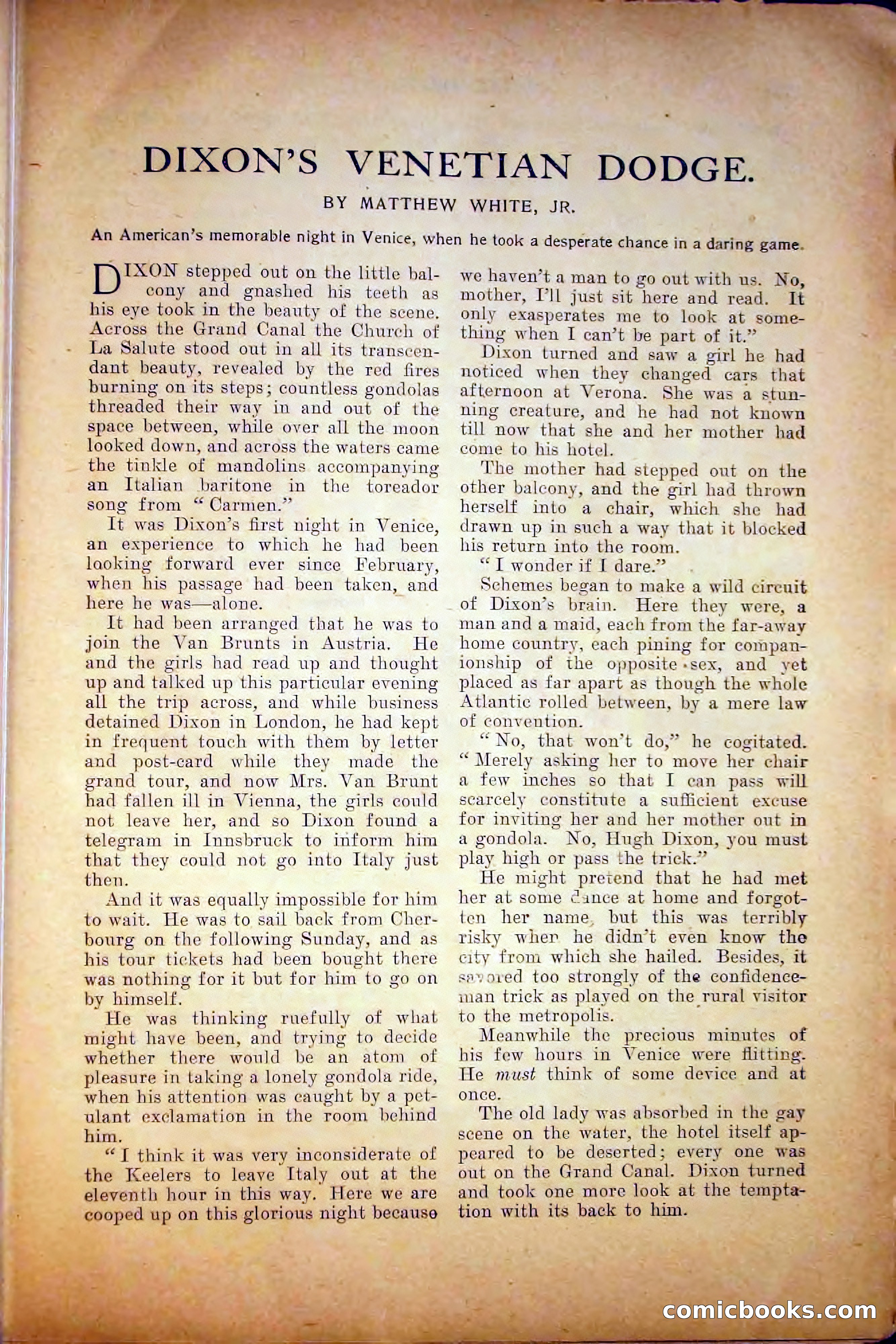
A restored page from Pulp Fiction, 1905. Page through the whole issue in the reader above.
📄 Transcribed text from this page (OCR, searchable)
Machine-transcribed from the original scan — historical spelling and the odd misread are preserved.
r ° i. s * - DIXON’S VENETIAN DODGE. BY MATTHEW WHITE, JR. 0 An American’s memorable night in Venice, when he took a desperate chance in a daring game. : saad stepped out on the little hal- cony and gnashed his teeth as his eye took in the beauty of the scene, Across the Grand Canal the Church of La Salute stood out in all its transeen- dant beauty, revealed by the red fires burning on its steps; countless gondolas threaded their way in and out of the space between, while over all the moon looked down, and across the waters came the tinkle of mandolins accompanying an Itahan baritone in the toreador song from “ Carmen.” It was Dixon’s first night in Venice, an experience to which he had been laoking forward ever since February, when his passage had been taken, and here he was—alone. It had been arranged that he was to join the Van Brunts in Austria. He and the girls had read up and thought up and talked up this particular evening all the trip across, and while business detained Dixon in London, he had kept in frequent touch with them by letter and post-card while they made the grand tour, and now Mrs. Van Brunt had fallen ill in Vienna, the girls could not leave her, and so Dixon found a telegram in Innsbruck to inform him that they could not go into Italy just then. And it was equally impossible for him to wait. He was to sail back from Cher- bourg on the following Sunday, and as his tour tickets had been bought there was nothing for it but for him to go on by himself. He was thinking ruefully of what might have been, and trying to decide whether there would be an atom of pleasure in taking a lonely gondola ride, when his attention was eaught by a pet- ulant exclamation in the room behind him. “T think it was very inconsiderate of the Keelers to leaye [taly out at the eleventh hour in this way. Here we are cooped up on this glorious night because we haven’t a man to go out with us. No, mother, I'll just sit here and read. It only exasperates me to look at some- thing when I can’t be part of it.” Dixon turned and saw a girl he had noticed when they changed cars that afternoon at Verona. She was a stun- ning creature, and he had not known till now that she and her mother had come to his hotel. The mother had siepped out on the other balcony, and the girl had thrown herself into a chair, which she had drawn up in such a way that it blocked his return into the room. “IT wonder if I dare.” Schemes began to make a wild cirenit of Dixon’s brain. Here they were, a man and a maid, each from the far-away home country, each pining for ecompan- ionship of the opposite-sex, and yet placed as far apart as though the whole Atlantic rolled between, by a mere law of convention. “No, that won’t do,” he cogitated. “Merely asking her to move her chair a few inches so that I ean pass will scarcely constitute a sufficient excuse for inviting her and her mother out in a gondola. No, Hugh Dixon, you must play high or pass the triek.” He might pretend that he had met her at some Cance at home and forgot- ten her name, but this was terribly risky wher he didn’t even know the city from which she hailed. Besides, it savoved too strongly of the confidence- man trick as played on the rural visitor to the metropolis. Meanwhile the precious minutes of his few hours in Venice were flitting. He must think of some device and at once. ; The old lady was absorbed in the gay scene on the water, the hotel itself ap- peared to be deserted; every one was out on the Grand Canal. Dixon turned and took one more look at the tempta-_ tion with its back to him. ss i * ~ an . 2 P £ <t i 7 Y .