
Pulp Fiction, 1905 · page 134 of 224
The Argosy, August 1905 — page 134: what you’re looking at
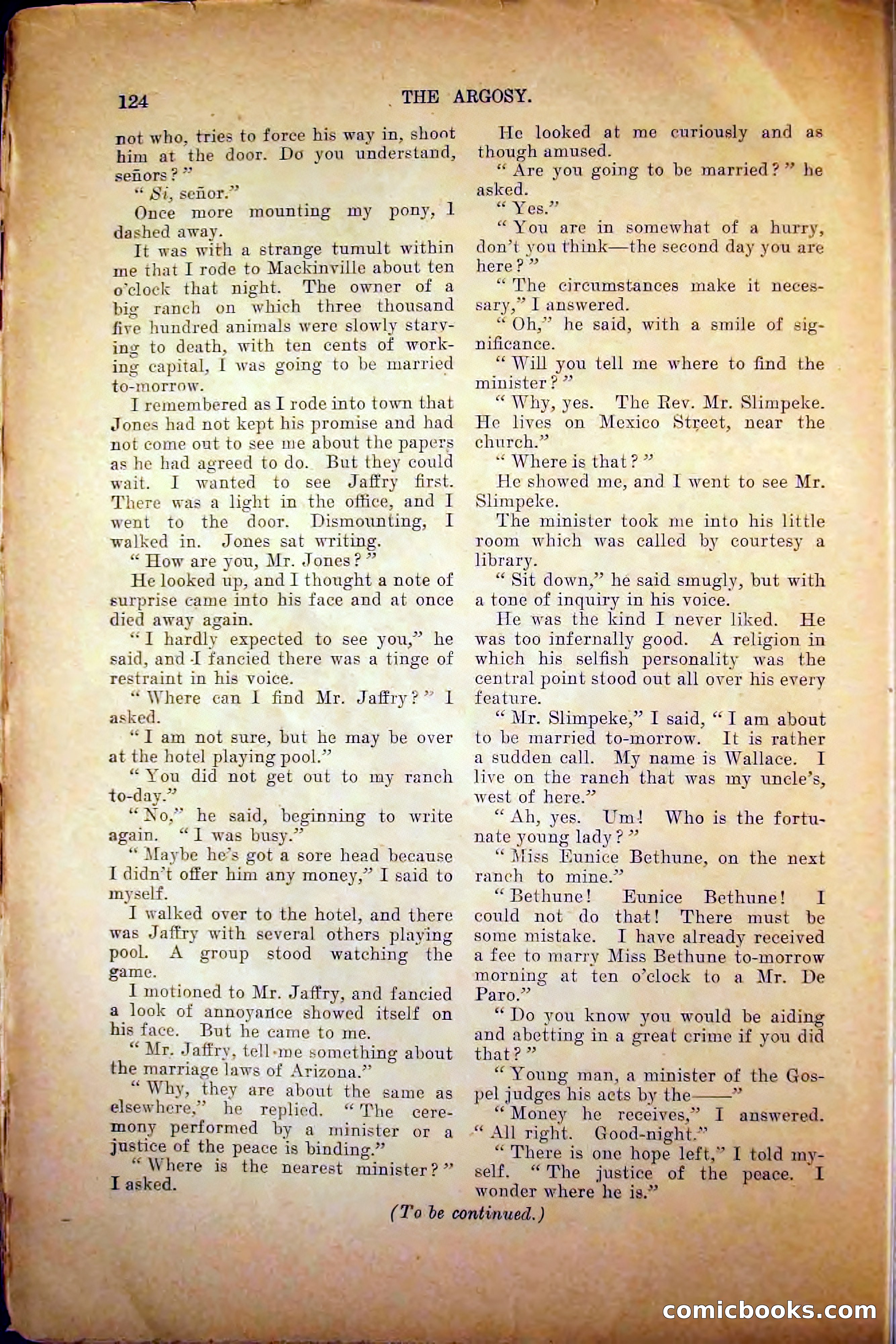
A restored page from Pulp Fiction, 1905. Page through the whole issue in the reader above.
📄 Transcribed text from this page (OCR, searchable)
Machine-transcribed from the original scan — historical spelling and the odd misread are preserved.
124 _ THE ARGOSY. not who, tries to force his way in, shoot him at the door. Do you understand, senors ? ” * Si, senor.” Once more mounting my pony, Il dashed away. It was with a strange tumult within me that I rode to Mackinville about ten o'clock that night. The owner of a bie ranch on which three thousand five hundred animals were slowly stary- ins to death, with ten cents of work- ing capital, | was going to be married to-morrow. I remembered as I rode into town that Jones had not kept his promise and had not come out to see me about the papers as he had agreed to do. But they could wait. I wanted to see Jaffry first. There was a light in the office, and I went to the door. Dismounting, I walked in. Jones sat writing. “ How are you, Mr. Jones?” He looked up, and I thought a note of surprise came into his face and at once died away again. “IT hardly expected to see you,” he said, and -I fancied there was a tinge of restraint in his voice. “Where can I find Mr. Jaffry?” I asked. *T am not sure, but he may be over at the hotel playing pool.” “You did not get out to my ranch to-day.” “No,” he said, beginning to write again. “IJ was busy.” “Maybe he’s got a sore head because I didn’t offer him any money,” I said to myself. I walked over to the hotel, and there was Jaffry with several others playing pool. A group stood watching the game. I motioned to Mr. Jaffry, and fancied a look of annoyarice showed itself on his face. But he came to me. “ Mr. Jaffry, tell-me something about the marriage laws of Arizona.” “Why, they are about the same ag elsewhere,’ he replied. “The cere- mony performed by a minister or a justice of the peace is binding.” “Where is the nearest minister?” ~ Lasked. He looked at me curiously and as though amused. “Are you going to be married?” he asked. * Yes,” “You are in somewhat of a hurry, don’t you think—the second day you are here? ” “The circumstances make it neces- sary,” I answered. “ Oh,” he said, with a smile of sig- nificance. “Will you tell me where to find the minister ? ” “Why, yes. The Rev. Mr. Slimpeke. He lives on Mexico Street, near the church.” “ Where is that? ” He showed me, and I went to see Mr. Shmpeke. The minister took me into his little room which was called by courtesy a library. “Sit down,” he said smugly, but with a tone of inquiry in his voice. He was the kind I never liked. He was too infernally good. A religion in which his selfish personality was the central point stood out all over his every feature. “Mr. Shimpeke,” I said, “I am about to be married to-morrow. It is rather a sudden call. My name is Wallace. I live on the ranch that was my unele’s, west of here.” “Ah, yes. Um! Who is the fortu- nate young lady? ” “Miss Eunice Bethune, on the next ranch to mine.” “Bethune! Eunice Bethune! I could not do that! There must be some mistake. I have already received a fee to marry Miss Bethune to-morrow morning at ten o'clock to a Mr. De Pare.” “Do you know you would be aiding and abetting in a great crime if you did thate * “Young man, a minister of the Gos- pel judges his acts by the * ‘““Money he receives,’ I answered. “All right. Good-night-” “There is one hope left,” I told my- self. “The justice of the peace. I wonder where he is.” | (To be continued.)