
Pulp Fiction, 1920 · page 196 of 200
Argosy All-Story Weekly, Vol. 123, No. 4 — page 196: what you’re looking at
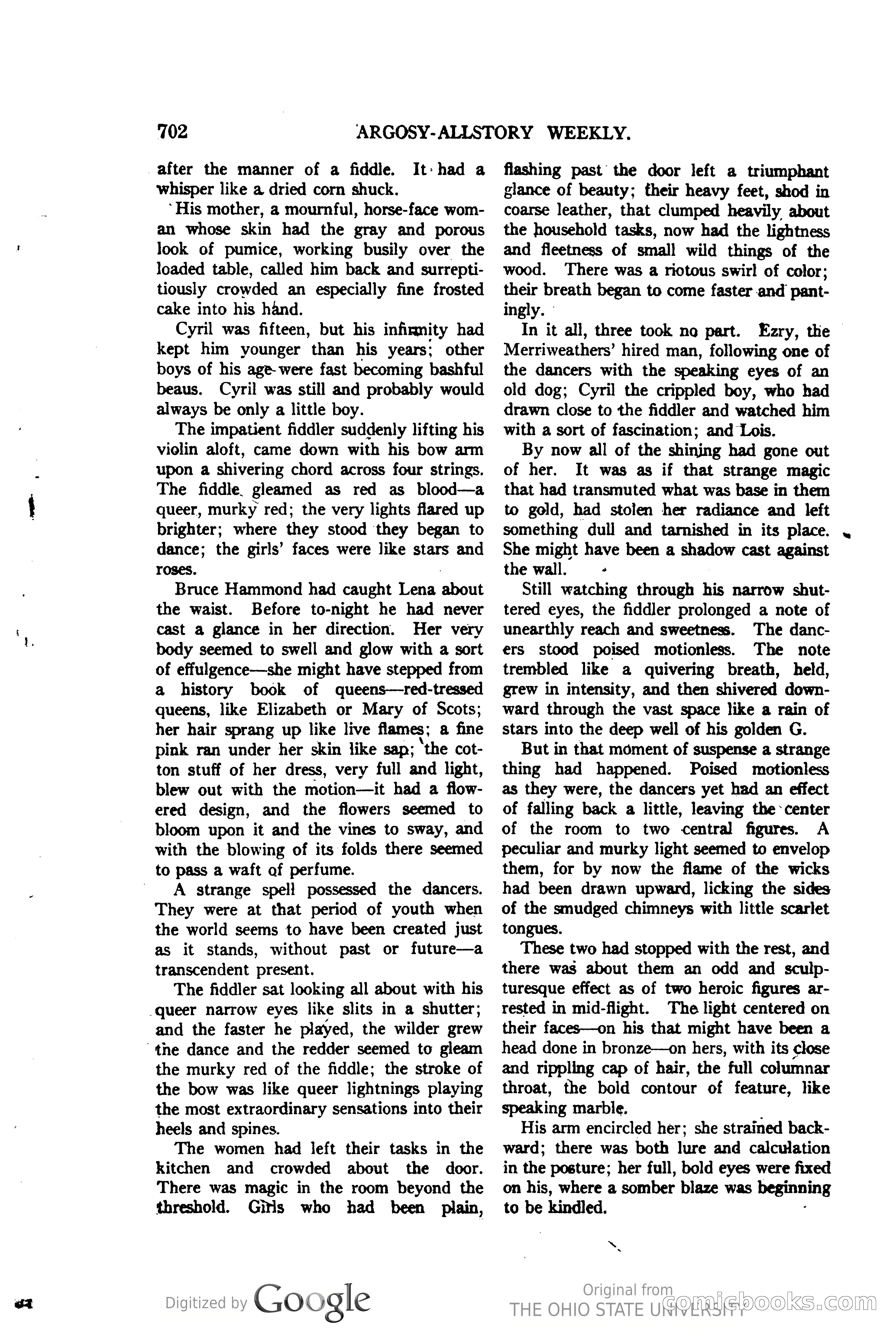
A restored page from Pulp Fiction, 1920. Page through the whole issue in the reader above.
📄 Transcribed text from this page (OCR, searchable)
Machine-transcribed from the original scan — historical spelling and the odd misread are preserved.
102 after the manner of a fiddle. It: had a whisper like a dried corn shuck. ‘His mother, a mournful, horse-face wom- an whose skin had the gray and porous look of pumice, working busily over the loaded table, called him back and surrepti- tiously crowded an especially fine frosted cake into his hand. Cyril was fifteen, but his infirmity had kept him vounger than his years; other boys of his age were fast becoming bashful beaus. Cyril was still and probably would always be only a little boy. The impatient fiddler suddenly lifting his violin aloft, came down with his bow arm upon a shivering chord across four strings. The fiddle. gleamed as red as blood—a queer, murky red; the very lights flared up brighter; where they stood they began to dance; the girls’ faces were like stars and roses. Bruce Hammond had caught Lena about the waist. Before to-night he had never cast a glance in her direction. Her very body seemed to swell and glow with a sort of effulgence—she might have stepped from a history book of queens—red-tressed queens, like Elizabeth or Mary of Scots; her hair sprang up like live flames; a fine pink ran under her skin like sap; ‘the cot- ton stuff of her dress, very full and light, blew out with the motion—it had a flow- ered design, and the flowers seemed to bloom upon it and the vines to sway, and with the blowing of its folds there seemed to pass a waft of perfume. A strange spell possessed the dancers. They were at that period of youth when the world seems to have been created just as it stands, without past or future—a transcendent present. The fiddler sat looking all about with his queer narrow eyes like slits in a shutter; and the faster he played, the wilder grew “tne dance and the redder seemed to gleam the murky red of the fiddle; the stroke of the bow was like queer lightnings playing the most extraordinary sensations into their heels and spines. The women had left their tasks in the kitchen and crowded about the door. There was magic in the room beyond the threshold. Gitis who had been plain, ARGOSY-ALLSTORY WEEKLY. flashing past the door left a triumphant glance of beauty; their heavy feet, shod in coarse leather, that clumped heavily about the household tasks, now had the lightness and fleetness of small wild things of the wood. There was a riotous swirl of color; their breath began to come faster and pant- ingly. — In it all, three took no part. Merriweathers’ hired man, following one of the dancers with the speaking eyes of an old dog; Cyril the crippled boy, who had drawn close to the fiddler and watched him with a sort of fascination; and Lois. By now all of the shining had gone out of her. It was as if that strange magic that had transmuted what was base in them to gold, had stolen her radiance and left something dull and tarnished in its place. She might have been a shadow cast against the wall. . Still watching through his narrow shut- tered eyes, the fiddler prolonged a note of unearthly reach and sweetness. The danc- ers stood poised motionless. The note trembled like a quivering breath, held, grew in intensity, and then shivered down- ward through the vast space like a rain of stars into the deep well of his golden G. But in that moment of suspense a strange thing had happened. Poised motionless as they were, the dancers yet had an effect of falling back a little, leaving the ‘center of the room to two central figures. A peculiar and murky light seemed to envelop them, for by now the flame of the wicks had been drawn upward, licking the sides of the smudged chimneys with little scarlet tongues. These two had stopped with the rest, and there was about them an odd and sculp- turesque effect as of two heroic figures ar- rested in mid-flight. The light centered on their faces—on his that might have been a head done in bronze—on hers, with its close and rippling cap of hair, the full columnar throat, the bold contour of feature, like speaking marble. ; His arm encircled her; she strained back- ward; there was both lure and calculation in the posture; her full, bold eyes were fixed on his, where a somber blaze was beginning to be kindled. Ezry, the E (SOME DOOKS.CO