
Pulp Fiction, 1920 · page 195 of 200
Argosy All-Story Weekly, Vol. 123, No. 4 — page 195: what you’re looking at
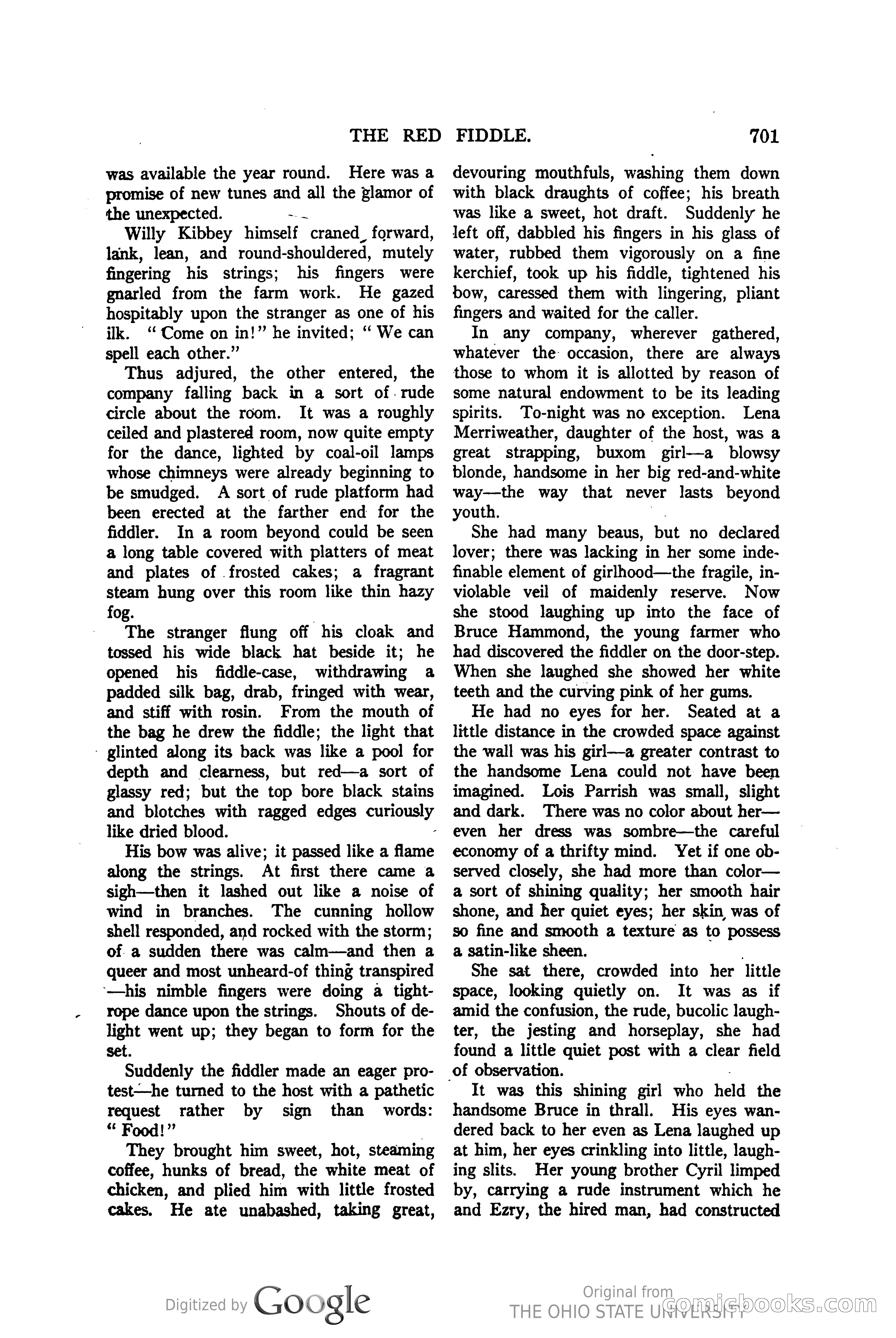
A restored page from Pulp Fiction, 1920. Page through the whole issue in the reader above.
📄 Transcribed text from this page (OCR, searchable)
Machine-transcribed from the original scan — historical spelling and the odd misread are preserved.
THE RED FIDDLE. was available the year round. Here wasa promise of new tunes and all the glamor of the unexpected. ~ Willy Kibbey himself “craned. forward, lank, lean, and round-shouldered, mutely fingering his strings; his fingers were gnarled from the farm work. He gazed hospitably upon the stranger as one of his ilk. ‘‘ Come on in!” he invited; ‘‘ We can spell each other.” Thus adjured, the other entered, the company falling back in a sort of. rude circle about the room. It was a roughly ceiled and plastered room, now quite empty for the dance, lighted by coal-oil lamps whose chimneys were already beginning to be smudged. A sort of rude platform had been erected at the farther end for the fiddler. In a room beyond could be seen a long table covered with platters of meat and plates of frosted cakes; a fragrant steam hung over this room like thin hazy fog. | The stranger flung off his cloak and tossed his wide black hat beside it; he opened his fiddle-case, withdrawing a padded silk bag, drab, fringed with wear, and stiff with rosin. From the mouth of the bag he drew the fiddle; the light that - glinted along its back was like a pool for depth and clearness, but red—a sort of glassy red; but the top bore black stains and blotches with ragged edges curiously like dried blood. His bow was alive; it passed like a flame along the strings. At first there came a sigh—then it lashed out like a noise of wind in branches. The cunning hollow shell responded, and rocked with the storm; of. a sudden there was calm—and then a queer and most unheard-of thing transpired ‘—his nimble fingers were doing a tight- rope dance upon the strings. Shouts of de- light went up; they began to form for the Set. Suddenly the fiddler made an eager pro- test—he turned to the host with a pathetic request rather by sign than words: ce Food! ? They brought him sweet, hot, steaming coffee, hunks of bread, the white meat of chicken, and plied him with little frosted cakes. He ate unabashed, taking great, 701 devouring mouthfuls, washing them down with black draughts of coffee; his breath was like a sweet, hot draft. Suddenly he left off, dabbled his fingers in his glass of water, rubbed them vigorously on a fine kerchief, took up his fiddle, tightened his bow, caressed them with lingering, pliant fingers and waited for the caller. In any company, wherever gathered, whatever the occasion, there are always those to whom it is allotted by reason of some natural endowment to be its leading spirits. To-night was no exception. Lena Merriweather, daughter of the host, was a great strapping, buxom girl—a _ blowsy blonde, handsome in her big red-and-white way—the way that never lasts beyond youth. She had many beaus, but no declared lover; there was lacking in her some inde- finable element of girlhood—the fragile, in- violable veil of maidenly reserve. Now she stood laughing up into the face of Bruce Hammond, the young farmer who had discovered the fiddler on the door-step. When she laughed she showed her white teeth and the curving pink of her gums. He had no eyes for her. Seated at a little distance in the crowded space against the wall was his girl—a greater contrast to the handsome Lena could not have been imagined. Lois Parrish was small, slight and dark. There was no color about her— even her dress was sombre—the careful economy of a thrifty mind. Yet if one ob- served closely, she had more than color— a sort of shining quality; her smooth hair shone, and her quiet eyes; her skin was of so fine and smooth a texture as to possess a satin-like sheen. . She sat there, crowded into her little space, looking quietly on. It was as if amid the confusion, the rude, bucolic laugh- ter, the jesting and horseplay, she had found a little quiet post with a clear field of observation. It was this shining girl who held the handsome Bruce in thrall. His eyes wan- dered back to her even as Lena laughed up at him, her eyes crinkling into little, laugh- ing slits. Her young brother Cyril limped by, carrying a rude instrument which he and Ezry, the hired man, had constructed leboo