
Pulp Fiction, 1920 · page 137 of 200
Argosy All-Story Weekly, Vol. 123, No. 4 — page 137: what you’re looking at
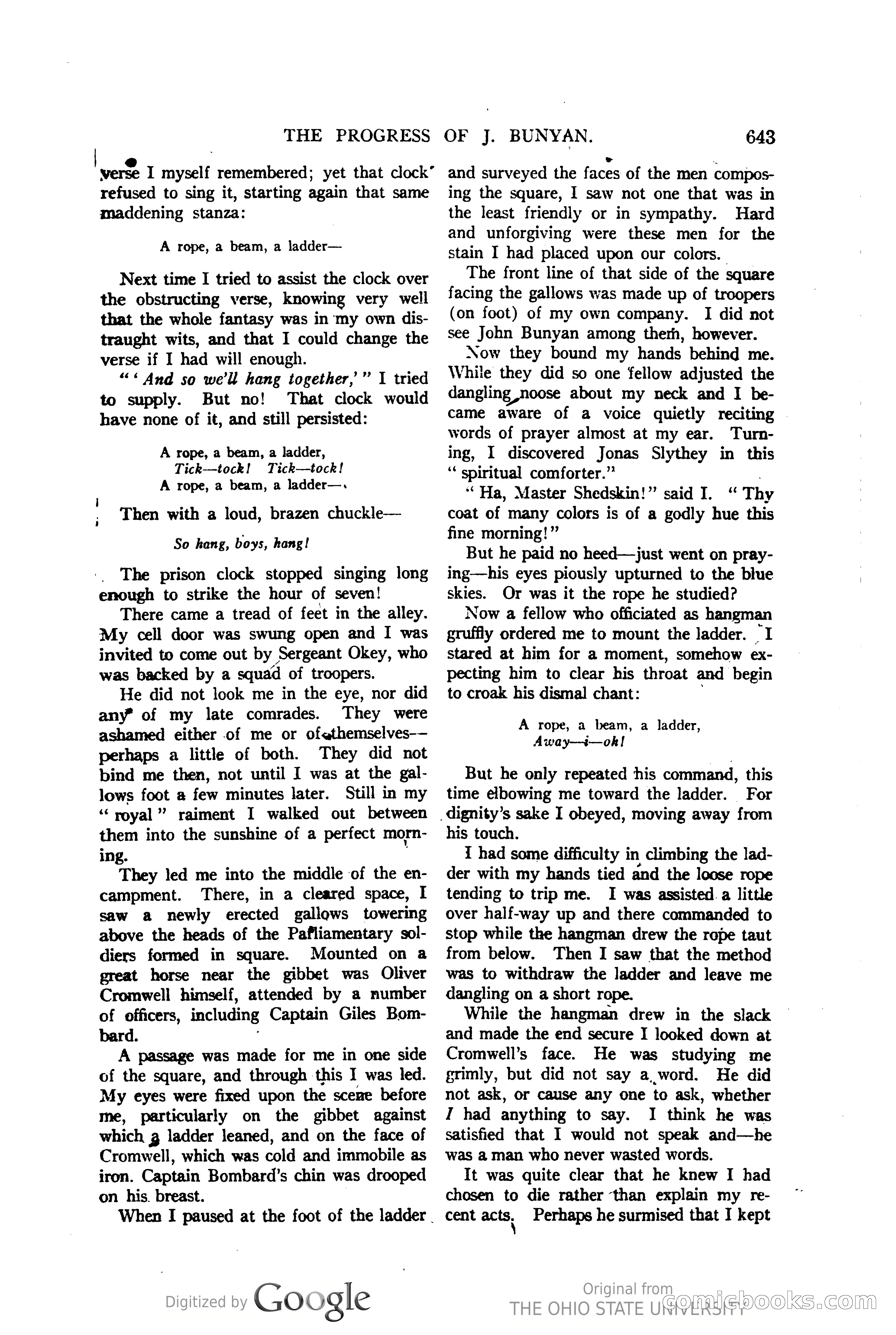
A restored page from Pulp Fiction, 1920. Page through the whole issue in the reader above.
📄 Transcribed text from this page (OCR, searchable)
Machine-transcribed from the original scan — historical spelling and the odd misread are preserved.
| THE PROGRESS verse I myself remembered; yet that clock’ refused to sing it, starting again that same maddening stanza: A rope, a beam, a ladder— Next time I tried to assist the clock over the obstructing verse, knowing very well that the whole fantasy was in ‘my own dis- traught wits, and that I could change the verse if I had will enough. “““ And so we'll hang together,” | tried to supply. But no! That clock would have none of it, and still persisted: A rope, a beam, a ladder, Tick—tock! Tick—tock! A rope, a beam, a ladder—. Then with a loud, brazen chuckle— So hang, boys, hang! The prison clock stopped singing long enough to strike the hour of seven! There came a tread of feet in the alley. My cell door was swung open and I was invited to come out by Sergeant Okey, who was backed by a squad of troopers. He did not look me in the eye, nor did any’ of my late comrades. They were ashamed either of me or ofethemselves-— perhaps a little of both. They did not bind me then, not until I was at the gal- lows foot a few minutes later. Still in my ‘royal’ raiment I walked out between them into the sunshine of a perfect morn- ing. They led me into the middle of the en- campment. There, in a cleared space, | saw a newly erected gallows towering above the heads of the Pafliamentary sol- diers formed in square. Mounted on a great horse near the gibbet was Oliver Cromwell himself, attended by a number of officers, including Captain Giles Bom- bard. A passage was made for me in one side of the square, and through this I was led. My eyes were fixed upon the scene before me, particularly on the gibbet against which g ladder leaned, and on the face of Cromwell, which was cold and immobile as iron. Captain Bombard’s chin was drooped on his. breast. | When I paused at the foot of the ladder . gi ti Z ry Go ogle OF J. BUNYAN. 643 and surveyed the faces of the men compos- ing the square, I saw not one that was in the least friendly or in sympathy. Hard and unforgiving were these men for the stain I had placed upon our colors. The front line of that side of the square facing the gallows was made up of troopers (on foot) of my own company. I did not see John Bunyan among therh, however. Now they bound my hands behind me. While they did so one fellow adjusted the dangling noose about my neck and I be- came aware of a voice quietly reciting | words of prayer almost at my ear. Turn- ing, I discovered Jonas Slythey in this ‘* spiritual comforter.” . “Ha, Master Shedskin!” said I. “ Thy coat of many colors is of a godly hue this fine morning!” But he paid no heed—just went on pray- ing—his eyes piously upturned to the blue skies. Or was it the rope he studied? Now a fellow who officiated as hangman gruffly ordered me to mount the ladder. I Stared at him for a moment, somehow ex- pecting him to clear his throat and begin to croak his dismal chant: A rope, a beam, a ladder, Away—i—ok]! But he only repeated his command, this time elbowing me toward the ladder. For _dignity’s sake I obeyed, moving away from his touch. { had some difficulty i in climbing the lad- der with my hands tied and the loose rope tending to trip me. I was assisted. a little over half-way up and there commanded to stop while the hangman drew the rope taut from below. Then I saw that the method was to withdraw the ladder and leave me dangling on a short rope. While the hangman drew in the slack and made the end secure I looked down at Cromwell’s face. He was studying me grimly, but did not say a_word. He did not ask, or cause any one to ask, whether I had anything to say. I think he was satisfied that I would not speak and—he was & man who never wasted words. It was quite clear that he knew I had chosen to die rather than explain my re- cent acts, Perhaps he surmised that I kept Origin HUE DOOLK (A)