
Pulp Fiction, 1920 · page 136 of 200
Argosy All-Story Weekly, Vol. 123, No. 4 — page 136: what you’re looking at
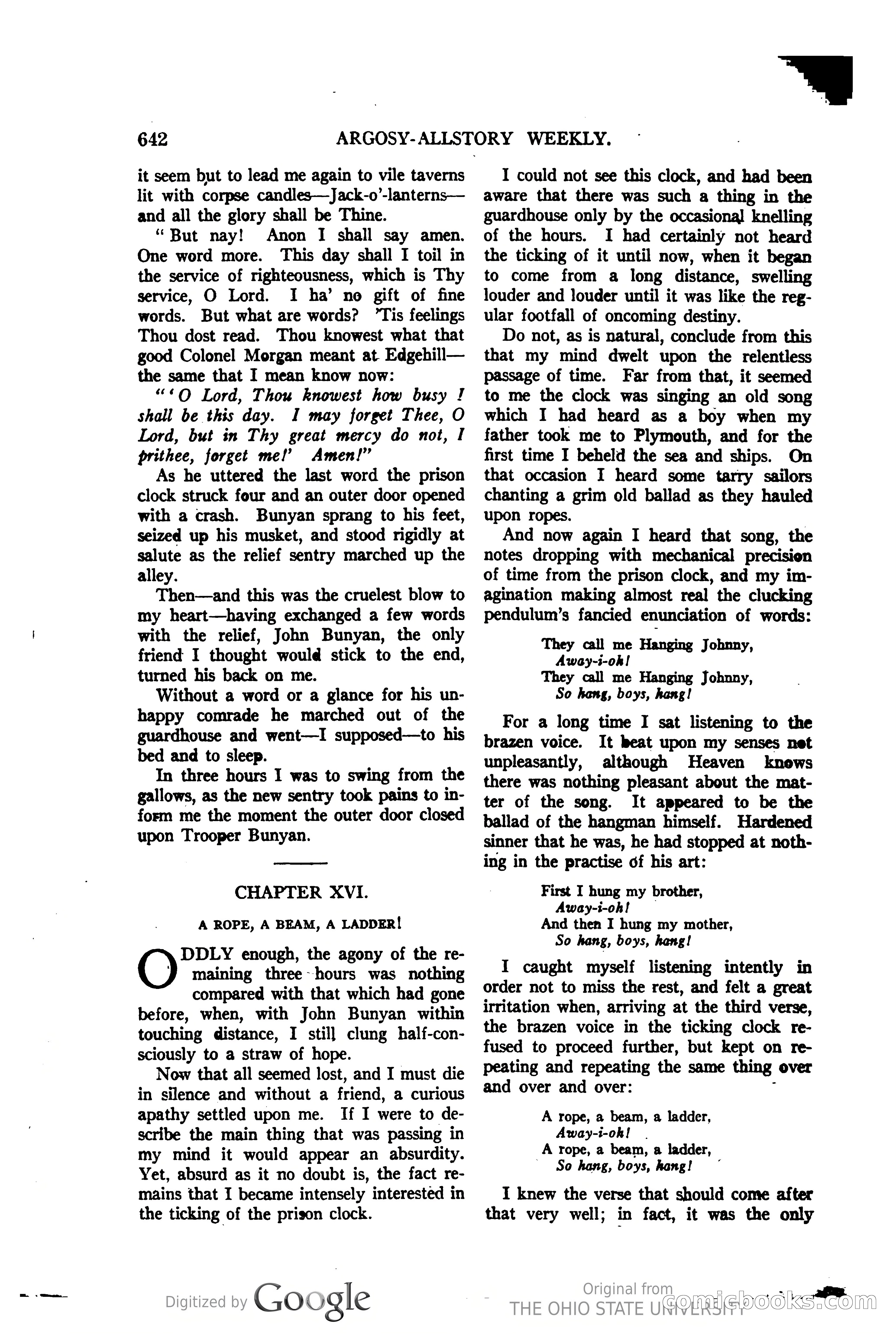
A restored page from Pulp Fiction, 1920. Page through the whole issue in the reader above.
📄 Transcribed text from this page (OCR, searchable)
Machine-transcribed from the original scan — historical spelling and the odd misread are preserved.
642 it seem but to lead me again to vile taverns lit with corpse candles—Jack-o’-lanterns— and all the glory shall be Thine. “But nay! Anon I shall say amen. One word more. This day shall I toil in the service of righteousness, which is Thy service, O Lord. I ha’ no gift of fine words. But what are words? “Tis feelings Thou dost read. Thou knowest what that good Colonel Morgan meant at Edgehill— the same that I mean know now: “¢*O Lord, Thou knowest how busy ! shall be this day. I may forget Thee, O Lord, but in Thy great mercy do not, I prithee, forget mel’ Amen!” As he uttered the last word the prison clock struck four and an outer door opened with a crash. Bunyan sprang to his feet, seized up his musket, and stood rigidly at salute as the relief sentry marched up the alley. Then—and this was the cruelest blow to my heart—having exchanged a few words with the relief, John Bunyan, the only friend I thought would stick to the end, turned his back on me. Without a word or a glance for his un- happy comrade he marched out of the guardhouse and went—I supposed—to his bed and to sleep. In three hours I was to swing from the gallows, as the new sentry took pains to in- form me the moment the outer door closed upon Trooper Bunyan. CHAPTER XVI. A ROPE, A BEAM, A LADDER! DDLY enough, the agony of the re- maining three hours was nothing compared with that which had gone before, when, with John Bunyan within touching distance, I stil] clung half-con- sciously to a straw of hope. Now that all seemed lost, and I must die in silence and without a friend, a curious apathy settled upon me. If I were to de- scribe the main thing that was passing in my mind it would appear an absurdity. Yet, absurd as it no doubt is, the fact re- mains that I became intensely interested in the ticking of the prison clock. ARGOSY-ALLSTORY WEEKLY. I could not see this clock, and had been aware that there was such a thing in the guardhouse only by the occasional knelling of the hours. I had certainly not heard the ticking of it until now, when it began to come from a long distance, swelling louder and louder until it was like the reg- ular footfall of oncoming destiny. Do not, as is natural, conclude from this that my mind dwelt upon the relentless passage of time. Far from that, it seemed to me the clock was singing an old song which I had heard as a boy when my father took me to Plymouth, and for the first time I beheld the sea and ships. On that occasion I heard some tarry sailors chanting a grim old ballad as they hauled upon ropes. And now again I heard that song, the notes dropping with mechanical precision of time from the prison clock, and my im- agination making almost real the clucking pendulum’s fancied enunciation of words: They call me Hanging Johnny, Away-i-oh! They call me Hanging Johnny, So hang, boys, hang! For a long time I sat listening to the brazen voice. It beat upon my senses net unpleasantly, although Heaven knews there was nothing pleasant about the mat- ter of the song. It appeared to be the ballad of the hangman himself. Hardened sinner that he was, he had stopped at noth- ing in the practise of his art: First I hung my brother, Away-i-oh! And then I hung my mother, So hang, boys, hang! I caught myself listening intently in order not to miss the rest, and felt a great irritation when, arriving at the third verse, the brazen voice in the ticking clock re- fused to proceed further, but kept on re- peating and repeating the same thing over and over and over: A rope, a beam, a ladder, Away-i-oh! . A rope, a beam, a ladder, ' So hang, boys, hang! I knew the verse that should come after that very well; in fact, it was the only