
Pulp Fiction, 1920 · page 179 of 232
Argosy All-Story Weekly, Vol. 123, No. 3 — page 179: what you’re looking at
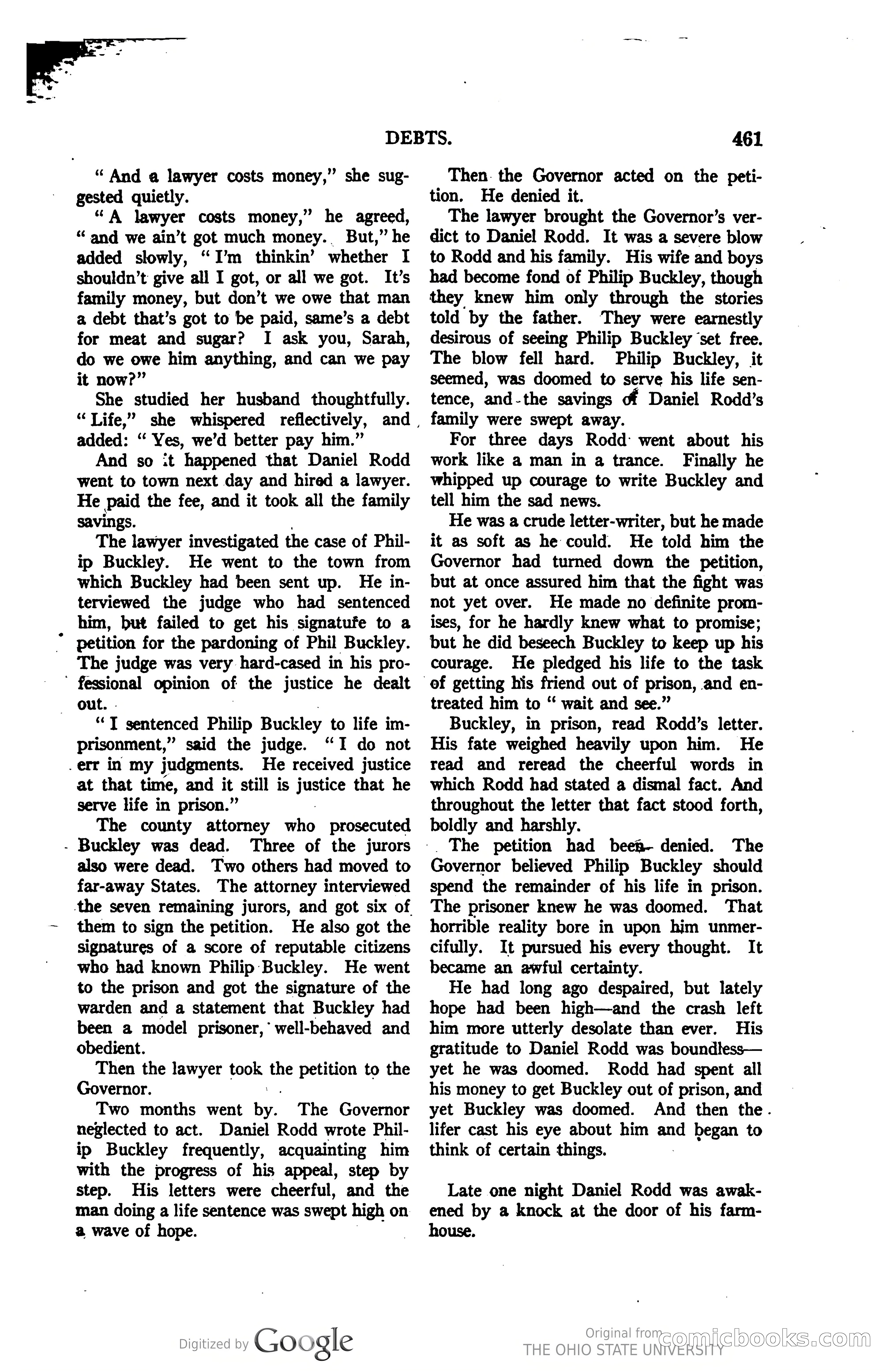
A restored page from Pulp Fiction, 1920. Page through the whole issue in the reader above.
📄 Transcribed text from this page (OCR, searchable)
Machine-transcribed from the original scan — historical spelling and the odd misread are preserved.
DEBTS. “ And a lawyer costs money,” she sug- gested quietly. “A lawyer costs money,” he agreed, “and we ain’t got much money. But,” he added slowly, “I’m thinkin’ whether I shouldn’t give all I got, or all we got. It’s family money, but don’t we owe that man a debt that’s got to be paid, same’s a debt for meat and sugar? I ask you, Sarah, do we owe him anything, and can we pay it now?” She studied her husband thoughtfully. “Life,” she whispered reflectively, and , added: “ Yes, we’d better pay him.” And so it happened that Daniel Rodd went to town next day and hired a lawyer. He paid the fee, and it took all the family savings. The lawyer investigated the case of Phil- ip Buckley. He went to the town from which Buckley had been sent up. He in- terviewed the judge who had sentenced him, but failed to get his signatufe to a petition for the pardoning of Phil Buckley. The judge was very hard-cased in his pro- ’ fessional opinion of the justice he dealt out. “e I sentenced Philip Buckley to life im- prisonment,” said the judge. “I do not .err in my judgments. He received justice at that time, and it still is justice that he serve life in prison.” The county attorney who prosecuted - Buckley was dead. Three of the jurors also were dead. Two others had moved to far-away States. The attorney interviewed the seven remaining jurors, and got six of them to sign the petition. He also got the signatures of a score of reputable citizens who had known Philip Buckley. He went to the prison and got the signature of the warden and a statement that Buckley had been a model prisoner,’ well-behaved and obedient. Then the lawyer took the petition to the Governor. Two months went by. The Governor neglected to act. Daniel Rodd wrote Phil- ip Buckley frequently, acquainting him with the progress of his appeal, step by step. His letters were cheerful, and the man doing a life sentence was swept high on. a wave of hope. Digitized by Go ogle 461 Then. the Governor acted on the peti- tion. He denied it. The lawyer brought the Governor’s ver- dict to Daniel Rodd. It was a severe blow to Rodd and his family. His wife and boys had become fond of Philip Buckley, though they knew him only through the stories told by the father. They were earnestly desirous of seeing Philip Buckley ‘set free. The blow fell hard. Philip Buckley, it seemed, was doomed to serve his life sen- tence, and-the savings of Daniel Rodd’s family were swept away. For three days Rodd: went about his work like a man in a trance. Finally he whipped up courage to write Buckley and tell him the sad news. He was a crude letter-writer, but he made it as soft as he could. He told him the Governor had turned down the petition, but at once assured him that the fight was not yet over. He made no definite prom- ises, for he hardly knew what to promise; but he did beseech Buckley to keep up his courage. He pledged his life to the task of getting his friend out of prison, and en- treated him to “ wait and see.” Buckley, in prison, read Rodd’s letter. His fate weighed heavily upon him. He read and reread the cheerful words in which Rodd had stated a dismal fact. And throughout the letter that fact stood forth, boldly and harshly. '. The petition had bees- denied. The Governor believed Philip Buckley should spend the remainder of his life in prison. The prisoner knew he was doomed. That horrible reality bore in upon him unmer- cifully. It pursued his every thought. It became an awful certainty. He had long ago despaired, but lately hope had been high—and the crash left him more utterly desolate than ever. His gratitude to Daniel Rodd was boundless— yet he was doomed. Rodd had spent all his money to get Buckley out of prison, and yet Buckley was doomed. And then the. lifer cast his eye about him and began to think of certain things. Late one night Daniel Rodd was awak- ened by a knock at the door of his farm- house. 0 rigi } a fi | ; Ke OMNKE = S) NOOK CO