
Pulp Fiction, 1920 · page 178 of 232
Argosy All-Story Weekly, Vol. 123, No. 3 — page 178: what you’re looking at
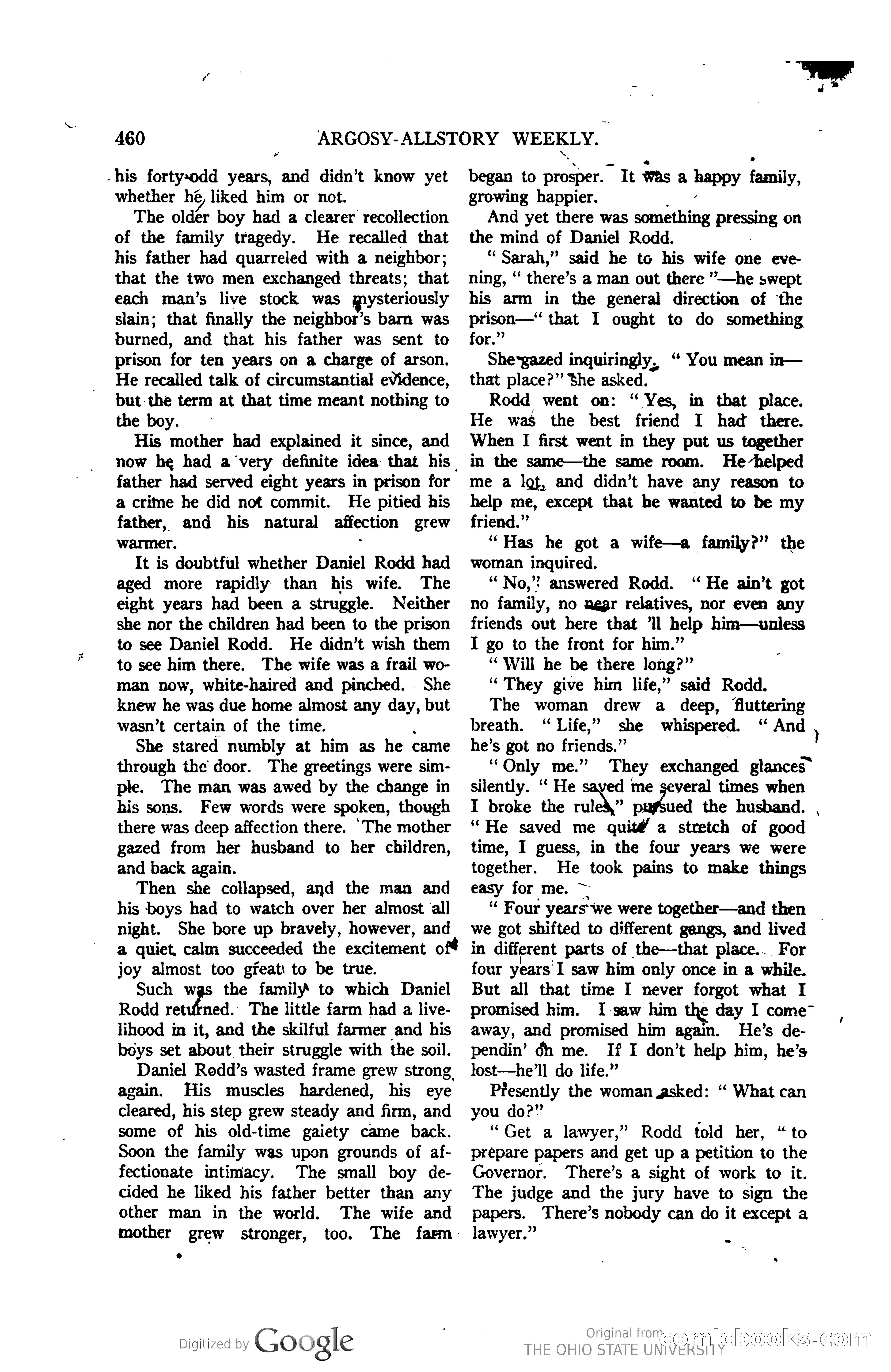
A restored page from Pulp Fiction, 1920. Page through the whole issue in the reader above.
📄 Transcribed text from this page (OCR, searchable)
Machine-transcribed from the original scan — historical spelling and the odd misread are preserved.
460 -his fortysodd years, and didn’t know yet whether he, liked him or not. The older boy had a clearer recollection of the family tragedy. He recalled that his father had quarreled with a neighbor; that the two men exchanged threats; that each man’s live stock was mysteriously slain; that finally the neighbor’s barn was burned, and that his father was sent to prison for ten years on a charge of arson. He recalled talk of circumstantial evidence, but. the term at that time meant nothing to the boy. — His mother had explained it since, and now he had a very definite idea that his father had served eight years in prison for a crime he did not commit. He pitied his father, and his natural affection grew warmer. It is doubtful whether Daniel Rodd had aged more rapidly than his wife. The eight years had been a struggle. Neither she nor the children had been to the prison to see Daniel Rodd. He didn’t wish them to see him there. The wife was a frail wo- man now, white-haired and pinched. . She knew he was due home almost any day, but wasn’t certain of the time. She stared numbly at him as he came through the’ door. The greetings were sim- ple. The man was awed by the change in his sons. Few words were spoken, though there was deep affection there. ‘The mother gazed from her husband to her children, and back again. | Then she collapsed, and the man and his boys had to watch over her almost all night. She bore up bravely, however, and a quiet, calm succeeded the excitement off joy almost too gfeat to be true. Such wgs the family to which Daniel Rodd returned. The little farm had a live- lihood in it, and the skilful farmer and his boys set about their struggle with the soil. Daniel Redd’s wasted frame grew strong. again. His muscles hardened, his eye cleared, his step grew steady and firm, and some of his old-time gaiety came back. Soon the family was upon grounds of af- fectionate intimacy. The small boy de- cided he liked his father better than any other man in the world. The wife and mother grew stronger, too. viatized by GOORle The farm: ARGOSY- ALLSTORY WEEKLY. began to prosper. It Was a happy family, growing happier. And yet there was something Pressing on the mind of Daniel Rodd. “Sarah,” said he to his wife one eve- ning, “ there’ S a man out there ”—he swept his arm in the general direction of the prison—“ that I ought to do something for.” She-gazed inquiringly, that place?” She asked. Rodd went on: “Yes, in that place. He. was the best friend I had there. When I first went in they put us together “ You mean in— _ in the same—the same room. He-helped me a lgf, and didn’t have any reason to help me, except that he wanted to be my friend.” “Has he got a wife—a family?” the woman inquired. ‘““No,”? answered Rodd. ‘“ He ain’t got no family, no negr relatives, nor even any friends out here that ‘Il help him—uniess I go to the front for him.” “Will he be there long?” “They give him life,” said Rodd. The woman drew a deep, fluttering breath. “ Life,” she whispered. ‘“ And he’s got no friends.” | ‘““Only me.” silently. “ He I broke the rul “He saved me quit#@ a stretch of good time, I guess, in the four years we were together. He took pains to make things easy for me. ~ “ Four years’ we were together—and then ved me several times when They exchanged glances” f m } ued the husband. , we got shifted to different gangs, and lived | in different parts of the—that place... For four years I saw him only once in a while. But all that time I never forgot what I promised him. I-saw him the day I come™ away, and promised him again. He’s de- pendin’ dh me. If I don’t help him, he’s lost—he’ll do life.” Presently the woman asked: ‘ What can you do?’’ “Get a lawyer,” Rodd told her, “to prepare papers and get up a petition to the Governor. There’s a sight of work to it. The judge and the jury have to sign the papers. There’s nobody can do it except a lawyer.” = MATE UNG LUD OOO) 4 =) -) CO THE OHIO STATE Uh