
Pulp Fiction, 1928 · page 91 of 150
Argosy All-Story Weekly, July 7, 1928 — page 91: what you’re looking at
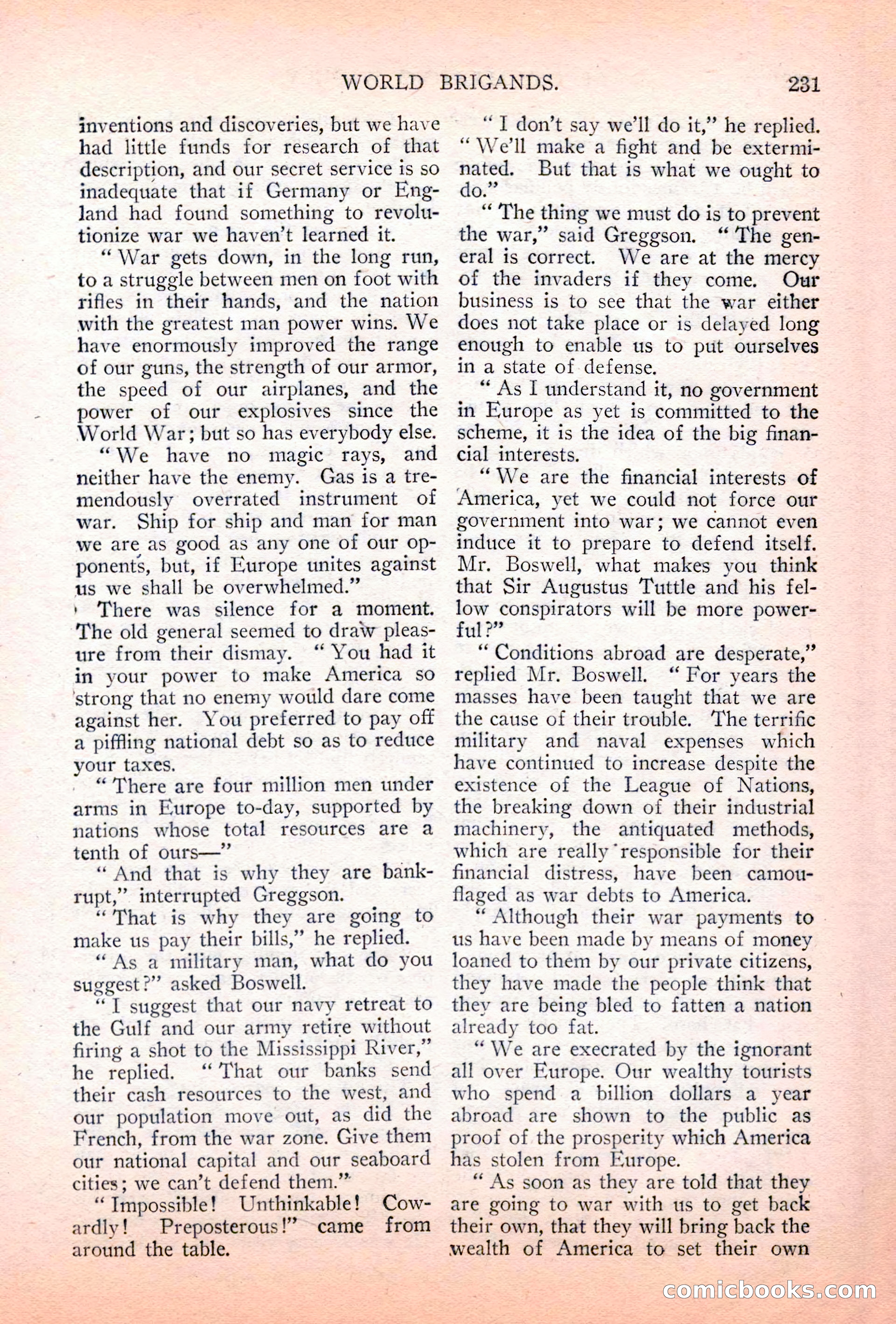
A restored page from Pulp Fiction, 1928. Page through the whole issue in the reader above.
📄 Transcribed text from this page (OCR, searchable)
Machine-transcribed from the original scan — historical spelling and the odd misread are preserved.
WORLD BRIGANDS. inventions and discoveries, but we have had little funds for research of that description, and our secret service is so inadequate that if Germany or Eng- Jand had found something to revolu- tionize war we haven’t learned it. “War gets down, in the long run, to a struggle between men on foot with rifles in their hands, and the nation with the greatest man power wins. We have enormously improved the range of our guns, the strength of our armor, the speed of our airplanes, and the power of our explosives since the World War; but so has everybody else. “We have no magic rays, and neither have the enemy. Gas is a tre- mendously overrated instrument of war. Ship for ship and man for man we are as good as any one of our op- ponents, but, if Europe unites against us we shall be overwhelmed.” ' There was silence for a moment. The old general seemed to draw pleas- ure from their dismay. “ You had it in your power to make America so strong that no enemy would dare come against her. You preferred to pay off a piffing national debt so as to reduce your taxes. “There are four million men under arms in Europe to-day, supported by nations whose total resources are a tenth of ours—” “And that is why they are bank- rupt,” interrupted Greggson. “That is why they are going to make us pay their bills,” he replied. “As a military man, what do you suggest?’ asked Boswell. “T suggest that our navy retreat to the Gulf and our army retire without firing a shot to the Mississippi River,” he replied. “ That our banks send their cash resources to the west, and our population move out, as did the French, from the war zone. Give them our national capital and our seaboard cities; we can’t defend them.” “Impossible! Unthinkable! Cow- ardly! Preposterous!” came from around the table. 201 “I don’t say we'll do it,” he replied. “We'll make a fight and be extermi- roe: But that is what we ought to 0.” “ The thing we must do is to prevent the war,” said Greggson. “ The gen- eral is correct. We are at the mercy of the invaders if they come. Our business is to see that the war either does not take place or is delayed long enough to enable us to ptt ourselves in a state of defense. “ As I understand it, no government in Europe as yet is committed to the scheme, it is the idea of the big finan- cial interests. _ “We are the financial interests of America, yet we could not force our government into war; we cannot even induce it to prepare to defend itself. Mr. Boswell, what makes you think that Sir Augustus Tuttle and his fel- low conspirators will be more power- ful?” “Conditions abroad are desperate,” replied Mr. Boswell. “ For years the masses have been taught that we are the cause of their trouble. The terrific military and naval expenses which have continued to increase despite the existence of the League of Nations, the breaking down of their industrial machinery, the antiquated methods, which are really responsible for their financial distress, have been camou- flaged as war debts to America. “ Although their war payments to - us have been made by means of money loaned to them by our private citizens, they have made the people think that they are being bled to fatten a nation already too fat. “We are execrated by the ignorant all over Europe. Our wealthy tourists who spend a billion dollars a year abroad are shown to the public as proof of the prosperity which America has stolen from Europe. “As soon as they are told that they are going to war with us to get back their own, that they will bring back the wealth of America to set their own GComichbooks GOr