
Pulp Fiction, 1928 · page 90 of 150
Argosy All-Story Weekly, July 7, 1928 — page 90: what you’re looking at
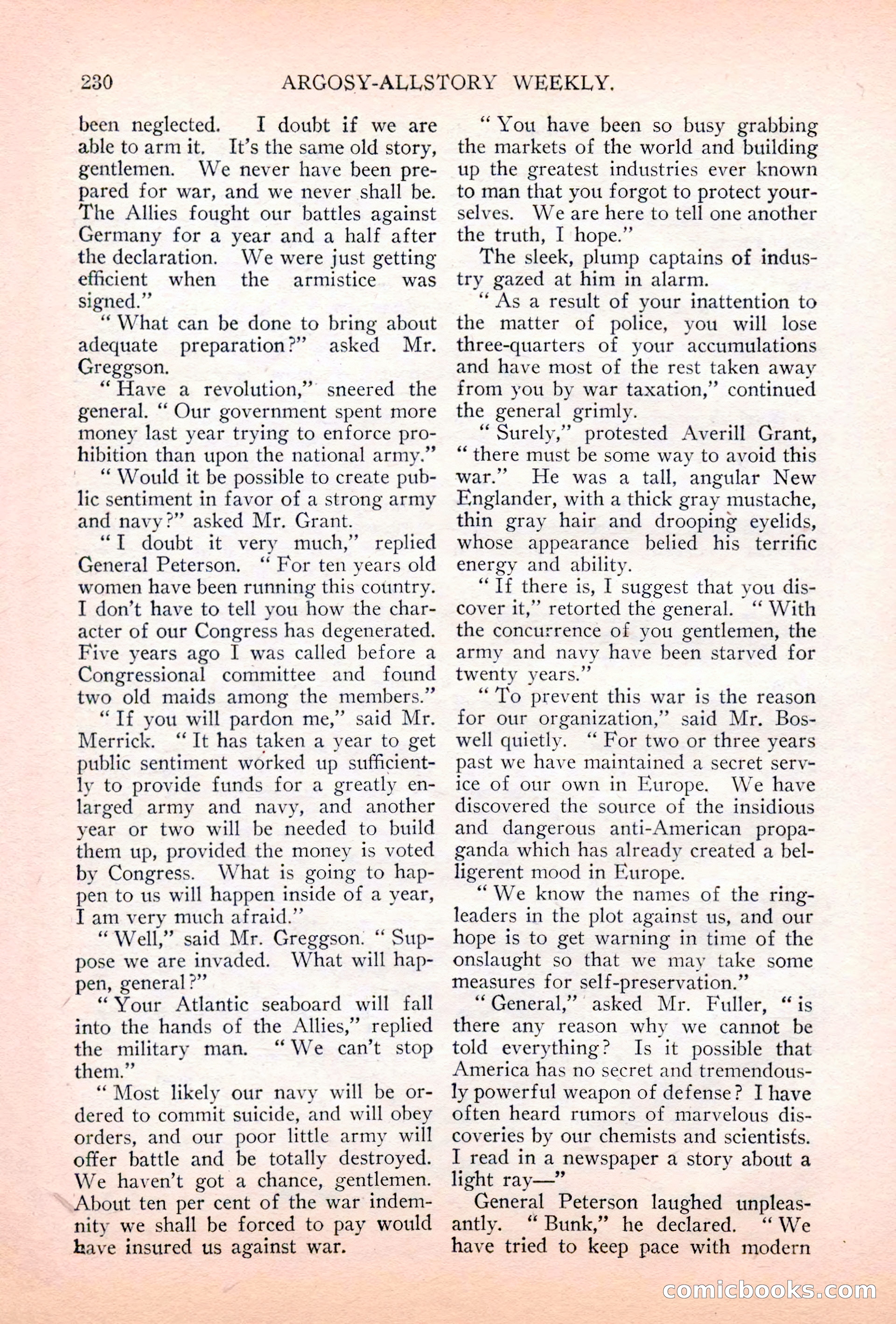
A restored page from Pulp Fiction, 1928. Page through the whole issue in the reader above.
📄 Transcribed text from this page (OCR, searchable)
Machine-transcribed from the original scan — historical spelling and the odd misread are preserved.
230 been neglected. I doubt if we are able toarmit. It’s the same old story, gentlemen. We never have been pre- pared for war, and we never shall be. The Allies fought our battles against Germany for a year and a half after the declaration. We were just getting efficient when the armistice was signed.” “What can be done to bring about adequate preparation?” asked Mr. Greggson. “Have a revolution,” sneered the general. “ Our government spent more money last year trying to enforce pro- hibition than upon the national army.” “Would it be possible to create pub- lic sentiment in favor of a strong army and navy?” asked Mr. Grant. “T doubt it very much,” replied General Peterson. ‘ For ten years old women have been running this country. I don’t have to tell you how the char- acter of our Congress has degenerated. Five years ago I was called before a Congressional committee and found two old maids among the members.” “Tf you will pardon me,” said Mr. Merrick. “It has taken a year to get public sentiment worked up sufficient- ly to provide funds for a greatly en- larged army and navy, and another year or two will be needed to build them up, provided the money is voted by Congress. What is going to hap- pen to us will happen inside of a year, I am very much afraid.” “Well,” said Mr. Greggson. “ Sup- pose we are invaded. What will hap- pen, general ?” “Your Atlantic seaboard will fall into the hands of the Allies,” replied the military man. “ We can’t stop them.” “ Most likely our navy will be or- dered to commit suicide, and will obey orders, and our poor little army will offer battle and be totally destroyed. We haven’t got a chance, gentlemen. About ten per cent of the war indem- nity we shall be forced to pay would have insured us against war. ARGOSY-ALLSTORY WEEKLY. “You have been so busy grabbing the markets of the world and building up the greatest industries ever known to man that you forgot to protect your- selves. Weare here to tell one another the truth, I hope.” The sleek, plump captains of indus- try gazed at him in alarm. ‘As a result of your inattention to the matter of police, you will lose three-quarters of your accumulations and have most of the rest taken away from you by war taxation,” continued the general grimly. “Surely,” protested Averill Grant, “there must be some way to avoid this war.” He was a tall, angular New Englander, with a thick gray mustache, thin gray hair and drooping eyelids, whose appearance belied his terrific energy and ability. “If there is, I suggest that you dis- cover it,” retorted the general. ‘‘ With the concurrence of you gentlemen, the army and navy have been starved for twenty years.” “To prevent this war is the reason for our organization,” said Mr. Bos- well quietly. ‘‘ For two or three years past we have maintained a secret serv- ice of our own in Europe. We have discovered the source of the insidious and dangerous anti-American propa- ganda which has already created a bel- ligerent mood in Europe. “We know the names of the ring- leaders in the plot against us, and our hope is to get warning in time of the onslaught so that we may take some measures for self-preservation.” “General,” asked Mr. Fuller, “ is there any reason why we cannot be told everything? Is it possible that America has no secret and tremendous- ly powerful weapon of defense? I have often heard rumors of marvelous dis- coveries by our chemists and scientists. I read in a newspaper a story about a light ray—” General Peterson laughed unpleas- antly. “ Bunk,” he declared. “We have tried to keep pace with modern COPMICGLOOKS (E@)