
Pulp Fiction, 1928 · page 79 of 150
Argosy All-Story Weekly, July 7, 1928 — page 79: what you’re looking at
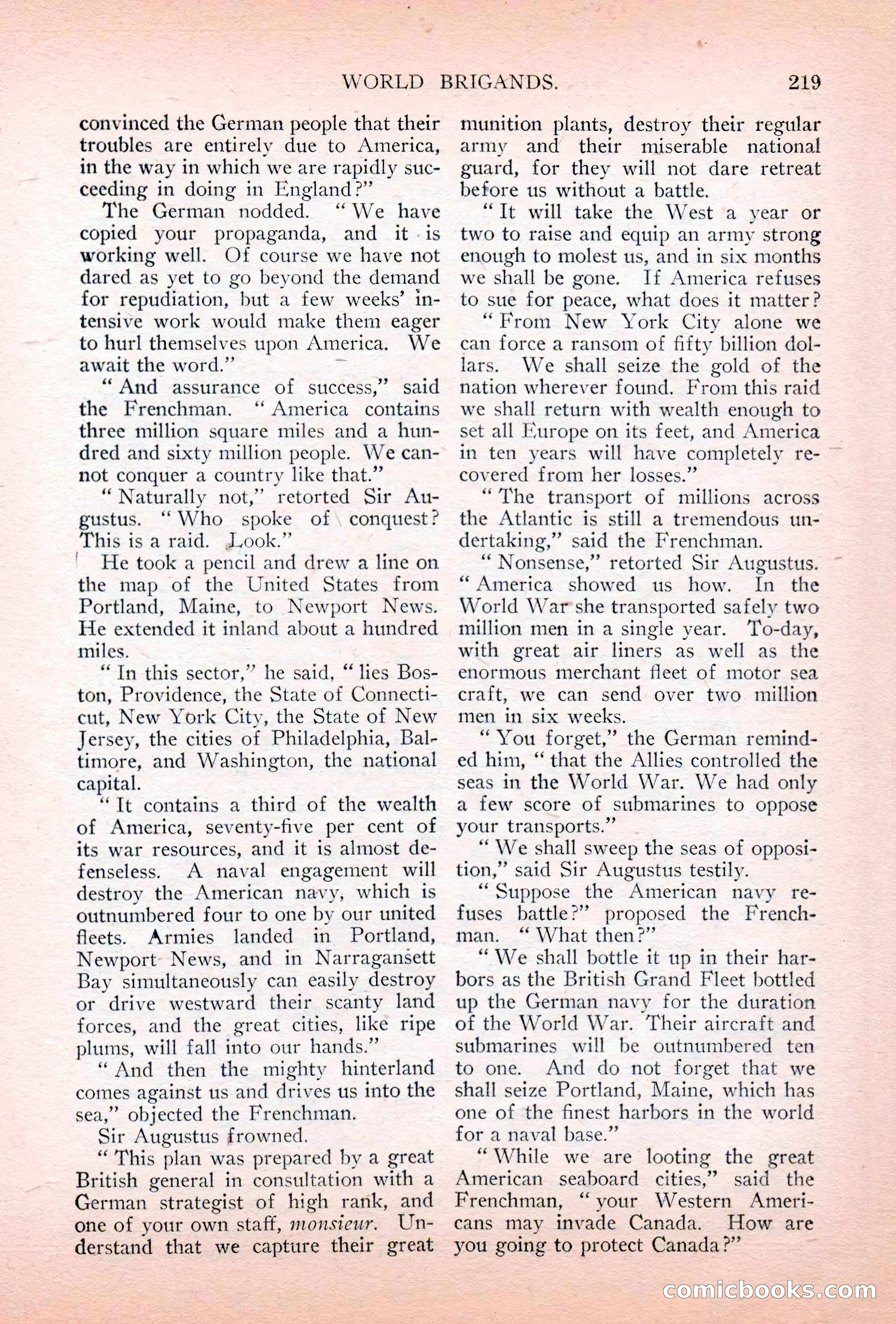
A restored page from Pulp Fiction, 1928. Page through the whole issue in the reader above.
📄 Transcribed text from this page (OCR, searchable)
Machine-transcribed from the original scan — historical spelling and the odd misread are preserved.
WORLD BRIGANDS. convinced the German people that their troubles are entirely due to America, in the way in which we are rapidly suc- ceeding in doing in England?” The German nodded. ‘We have copied your propaganda, and it -is working well. Of course we have not dared as yet to go beyond the demand for repudiation, but a few weeks’ in- tensive work would make them eager to hurl themselves upon America. We await the word.” : “And assurance of success,’ said the Frenchman. “ America contains three million square miles and a hun- dred and sixty million people. We can- not conquer a country like that.” “Naturally not,” retorted Sir Au- gustus. ‘Who spoke of. conquest? 4 Bis -19°% f£aie. 300k.” He took a pencil and drew a line on the map of the United States from Portland, Maine, to Newport News. He extended it inland about a hundred miles. “In this sector,” he said, “ lies Bos- ton, Providence, the State of Connecti- cut, New York City, the State of New Jersey, the cities of Philadelphia, Bal- timore, and Washington, the national capital. “Tt contains a third of the wealth of America, seventy-five per cent of its war resources, and it is almost de- fenseless. A naval engagement will destroy the American navy, which 1s outnumbered four to one by our united fleets. Armies landed in Portland, Newport News, and in Narragansett Bay simultaneously can easily destroy or drive westward their scanty land forces, and the great cities, like ripe plums, will fall into our hands.” “And then the mighty hinterland comes against us and drives us into the sea,” objected the Frenchman. Sir Augustus frowned. “This plan was prepared by a great British general in consultation with a German strategist of high rank, and one of your own staff, monsieur. Un- derstand that we capture their great t 219 munition plants, destroy their regular army and their miserable national guard, for they will not dare retreat before us without a battle. “Tt will take the West a year or two to raise and equip an army strong enough to molest us, and in six months we shall be gone. If America refuses to sue for peace, what does it matter? “From New York City alone we can force a ransom of fifty billion dol- lars. We shall seize the gold of the nation wherever found. From this raid we shall return with wealth enough to set all Europe on its feet, and America in ten years will have completely re- covered from her losses.”’ “The transport of millions across the Atlantic is still a tremendous un- dertaking,” said the Frenchman. “Nonsense,” retorted Sir Augustus. “America showed us how. In the World War'she transported safely two million men in a single year. ‘To-day, with great air liners as well as the enormous merchant fleet of motor sea craft, we can send over two million men in six weeks. “You forget,” the German remind- ed him, ‘‘ that the Allies controlled the seas in the World War. We had only a few score of submarines to oppose your transports.” ‘We shall sweep the seas of opposi- tion,” said Sir Augustus testily. “Suppose the American navy re- fuses battle?” proposed the French- man. “ What then?” “We shall bottle it up in their har- bors as the British Grand Fleet bottled up the German navy for the duration of the World War. Their aircraft and submarines will be outnumbered ten to one. And do not forget that we shall seize Portland, Maine, which has one of the finest harbors in the world for a naval base.” “While we are looting the great American seaboard cities,” said the Frenchman, “ your Western Ameri- cans may invade Canada. How are you going to protect Canada?” Gomichbooks (E@)