
Pulp Fiction, 1928 · page 78 of 150
Argosy All-Story Weekly, July 7, 1928 — page 78: what you’re looking at
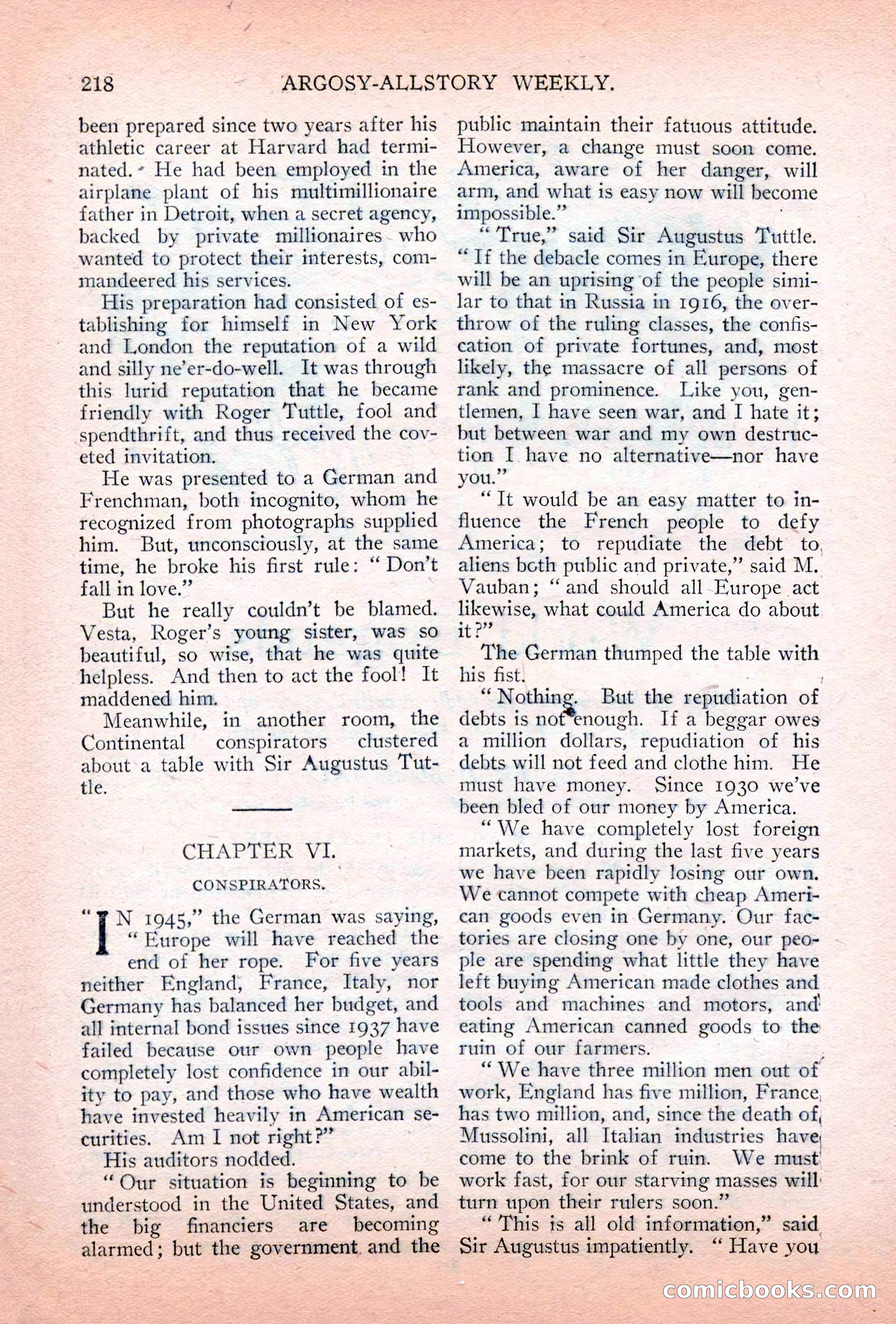
A restored page from Pulp Fiction, 1928. Page through the whole issue in the reader above.
📄 Transcribed text from this page (OCR, searchable)
Machine-transcribed from the original scan — historical spelling and the odd misread are preserved.
218 been prepared since two years after his athletic career at Harvard had termi- nated.* He had been employed in the airplane plant of his multimillionaire father in Detroit, when a secret agency, backed by private millionaires. who wanted to protect their interests, com- mandeered his services. His preparation had consisted of es- tablishing for himself in New York and London the reputation of a wild and silly ne’er-do-well. It was through this lurid reputation that he became friendly with Roger Tuttle, fool and spendthrift, and thus received the cov- eted invitation. He was presented to a German and Frenchman, both incognito, whom he recognized from photographs supplied him. But, unconsciously, at the same time, he broke his first rule: “ Don’t fall in love.” But he really couldn’t be blamed. Vesta, Roger’s young sister, was so beautiful, so wise, that he was quite helpless. And then to act the fool! It maddened him. Meanwhile, in another room, the Continental conspirators clustered about a table with Sir Augustus Tut- tle. CHAPTER VI. CONSPIRATORS. “PN 10945,” the German was saying, “Europe will have reached the end of her rope. For five years neither England, France, Italy, nor Germany has balanced her budget, and all internal bond issttes since 1937 have failed because our own people have completely lost confidence in our abil- ity to pay, and those who have wealth have invested heavily in American se- curities. Am I not right?’ His auditors nodded. “Our situation is beginning to be understood in the United States, and the big financiers are becoming alarmed; but the government. and the ARGOSY-ALLSTORY WEEKLY. public maintain their fatuous attitude. However, a change must soon come. America, aware of her danger, will arm, and what is easy now will become impossible.” “True,” said Sir Augustus Tuttle. “Tf the debacle comes in Europe, there will be an uprising of the people simi- lar to that in Russia in 1916, the over- throw of the ruling classes, the confis- cation of private fortunes, and, most likely, the massacre of all persons of rank and prominence. Like you, gen- tlemen, I have seen war, and I hate it; but between war and my own destruc- tion I have no alternative—nor have you.” “Tt would be an easy matter to in- fluence the French people to defy America; to repudiate the debt to. aliens beth public and private,” said M. Vauban; “and should all-Europe act likewise, what could America do about Sisk The German thumped the table with his fist. “ Nothing. debts is 9? SAN If a beggar owes a million dollars, repudiation of his debts will not feed and clothe him. He must have money. Since 1930 we’ve been bled of our money by America. “We have completely lost foreign markets, and during the last five years we have been rapidly losing our own. We cannot compete with cheap Ameri- can goods even in Germany. Our fac- tories are closing one by one, our peo- ple are spending what little they have left buying American made clothes and tools and machines and motors, and’ eating American canned goods to the ruin of our farmers. But the repudiation of “We have three million men out of work, England has five million, France. has two million, and, since the death of, Mussolini, all Italian industries have come to the brink of ruin. We must work fast, for our starving masses will’ turn upon their rulers soon.” “This is all old information,” said Sir Augustus impatiently. “‘ Have you (E@ AMLICE <S) 200 (E@)