
Pulp Fiction, 1928 · page 28 of 150
Argosy All-Story Weekly, July 7, 1928 — page 28: what you’re looking at
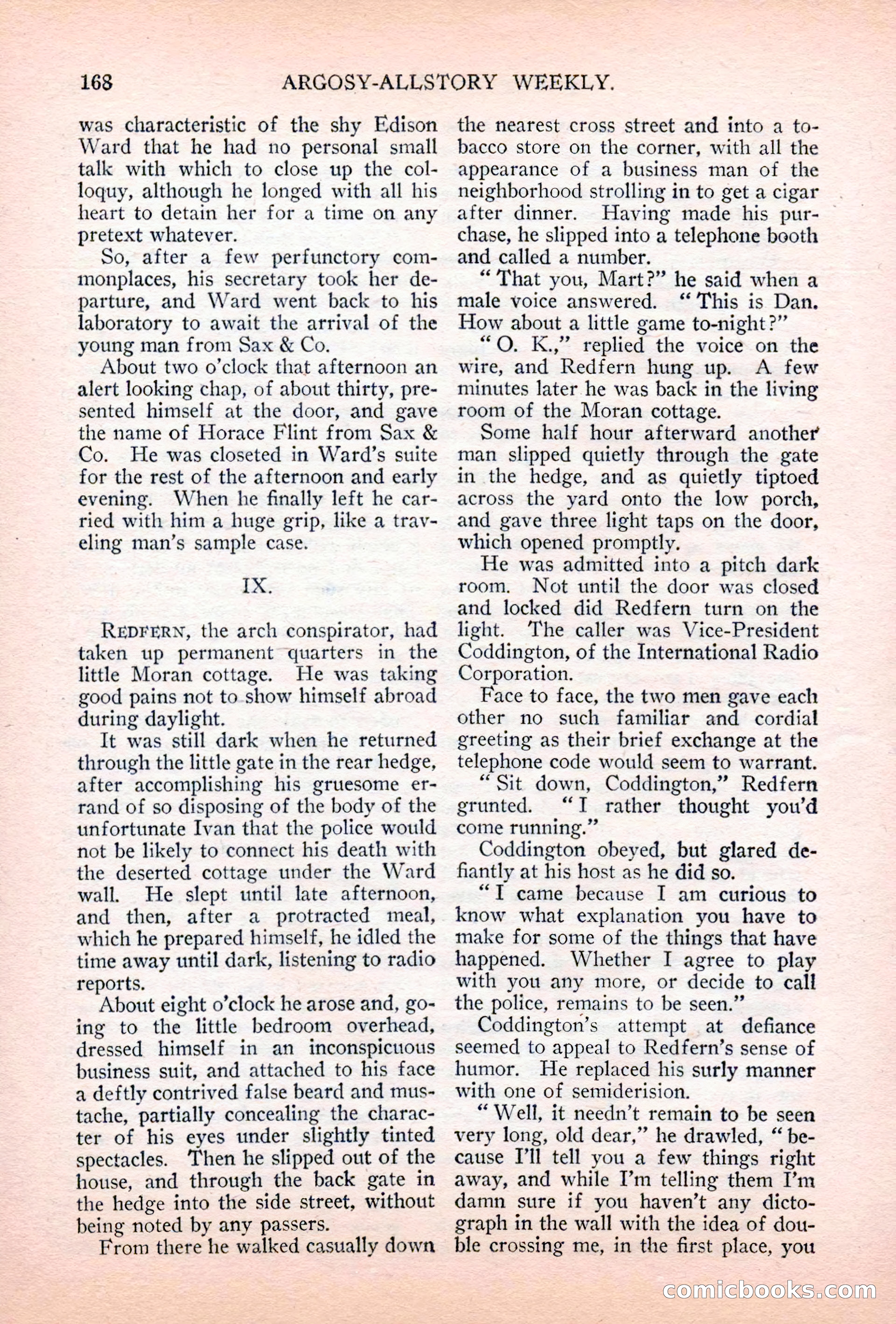
A restored page from Pulp Fiction, 1928. Page through the whole issue in the reader above.
📄 Transcribed text from this page (OCR, searchable)
Machine-transcribed from the original scan — historical spelling and the odd misread are preserved.
168 was characteristic of the shy Edison Ward that he had no personal small talk with which to close up the col- loquy, although he longed with all his heart to detain her for a time on any pretext whatever. So, after a few perfunctory com- monplaces, his secretary took her de- parture, and Ward went back to his laboratory to await the arrival of the young man from Sax & Co. About two o’clock that afternoon an alert looking chap, of about thirty, pre- sented himself at the door, and gave the name of Horace Flint from Sax & Co. He was closeted in Ward’s suite for the rest of the afternoon and early evening. When he finally left he car- ried with him a huge grip, like a trav- eling man’s sample case. IX. REDFERN, the arch conspirator, had taken up permanent quarters in the little Moran cottage. He was taking good pains not to show himself abroad during daylight. It was still dark when he returned through the little gate in the rear hedge, after accomplishing his gruesome er- rand of so disposing of the body of the unfortunate Ivan that the police would not be likely to connect his death with the deserted cottage under the Ward wall. He slept until late afternoon, and then, after a protracted meal, which he prepared himself, he idled the time away until dark, listening to radio reports. About eight o’clock he arose and, go- ing to the little bedroom overhead, dressed himself in an inconspictious business suit, and attached to his face a deftly contrived false beard and mus- tache, partially concealing the charac- ter of his eyes under slightly tinted spectacles. Then he slipped out of the house, and through the back gate in the hedge into the side street, without being noted by any passers. From there he walked casually down ARGOSY-ALLSTORY WEEKLY. the nearest cross street and into a to- bacco store on the corner, with all the appearance of a business man of the neighborhood strolling in to get a cigar after dinner. Having made his pur- chase, he slipped into a telephone booth and called a number. “That you, Mart?” he said when a male voice answered. ‘ This is Dan. How about a little game to-night?” “O. K.,” replied the voice on the wire, and Redfern hung up. A few minutes later he was back in the living room of the Moran cottage. Some half hour afterward another man slipped quietly through the gate in the hedge, and as quietly tiptoed across the yard onto the low porch, and gave three light taps on the door, which opened promptly. He was admitted into a pitch dark room. Not until the door was closed and locked did Redfern turn on the light. The caller was Vice-President Coddington, of the International Radio Corporation. Face to face, the two men gave each other no such familiar and cordial greeting as their brief exchange at the telephone code would seem to warrant. “Sit down, Coddington,” Redfern grunted. “I rather thought you'd come running.” Coddington obeyed, but glared de- fiantly at his host as he did so. “T came because I am curious to know what explanation you have to make for some of the things that have happened. Whether I agree to play with you any more, or decide to call the police, remains to be seen.” Coddington’s attempt at defiance seemed to appeal to Redfern’s sense of humor. He replaced his surly manner with one of semiderision. “Well, it needn’t remain to be seen very long, old dear,” he drawled, “ be- cause [ll tell you a few things right away, and while I’m telling them I’m damn sure if you haven’t any dicto- graph in the wall with the idea of dou- ble crossing me, in the first place, you (e(0) DOOKS AUUNG (E@)