
Pulp Fiction, 1928 · page 27 of 150
Argosy All-Story Weekly, July 7, 1928 — page 27: what you’re looking at
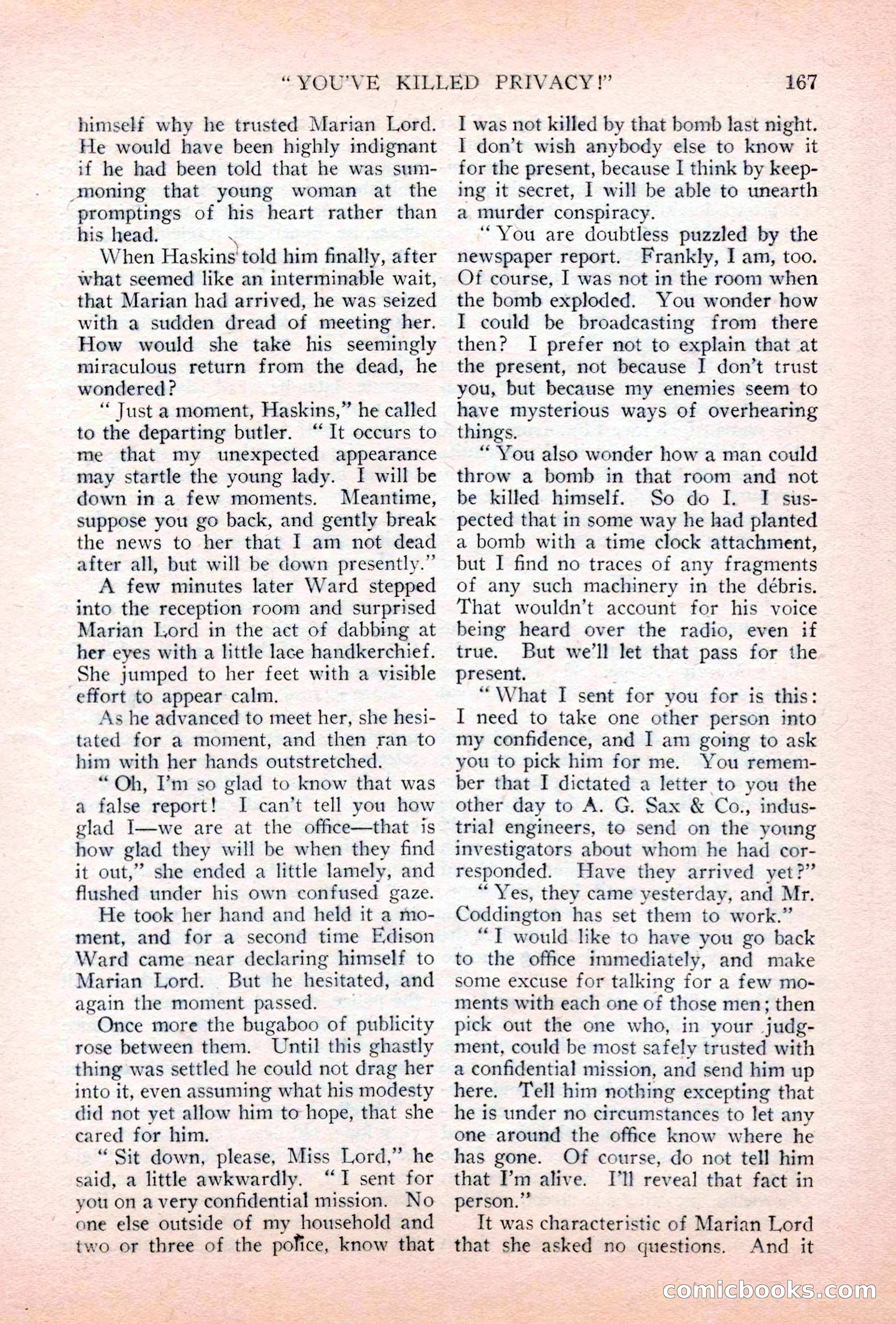
A restored page from Pulp Fiction, 1928. Page through the whole issue in the reader above.
📄 Transcribed text from this page (OCR, searchable)
Machine-transcribed from the original scan — historical spelling and the odd misread are preserved.
“YOU'VE KILLED PRIVACY?!’ himseH why he trusted Marian Lord. He would have been highly indignant if he had been told that he was sum- -moning that young woman at the promptings of his heart rather than his head. \ When Haskins’ told him finally, after what seemed like an interminable wait, that Marian had arrived, he was seized with a sudden dread of meeting her. How would she take his seemingly miraculous return from the dead, he wondered? “ Just a moment, Haskins,” he called to the departing butler. “It occurs to me that my unexpected appearance may startle the young lady. I will be down in a few moments. Meantime, suppose you go back, and gently break the news to her that I am not dead after all, but will be down presently.” A few minutes later Ward stepped into the reception room and surprised Marian Jord in the act of dabbing at her eyes with a little lace handkerchief. She jumped to her feet with a visible effort to appear calm. As he advanced to meet her, she hesi- tated for a moment, and then ran to him with her hands outstretched. “Oh, I’m so glad to know that was a false report! I can’t tell you how glad I—we are at the office—that is how glad they will be when they find it out,” she ended a little lamely, and flushed under his own confused gaze. He took her hand and held it a mo- ment, and for a second time Edison Ward came near declaring himself to Marian Lord. But he hesitated, and again the moment passed. Once more the bugaboo of publicity rose between them. Until this ghastly thing was settled he could not drag her into it, even assuming what his modesty did not yet allow him to hope, that she cared for him. “ Sit down, please, Miss Lord,” he said, a little awkwardly. “I sent for you on avery confidential mission. No one else outside of my household and two or three of the pofice, know that 167 I was not killed by that bomb last night. I don’t wish anybody else to know it for the present, because I think by keep- ing it secret, I will be able to unearth a murder conspiracy. “You are doubtless puzzled by the newspaper report. Frankly, I am, too. Of course, I was not in the room when the bomb exploded. You wonder how I could be broadcasting from there then? I prefer not to explain that at the present, not because ] don’t trust you, but because my enemies seem to have mysterious ways of overhearing things. “You also wonder how a man could throw a bomb in that room and not be killed himself. So do I. J sus- pected that in some way he had planted a bomb with a time clock attachment, but I find no traces of any fragments of any such machinery in the deébris. That wouldn’t account for his voice being heard over the radio, even if true. But we'll let that pass for the present. “What I sent for you for is this: I need to take one other person into my confidence, and I am going to ask you to pick him for me. You remem- ber that I dictated a letter to you the other day to A. G. Sax & Co., indus- trial engineers, to send on the young investigators about whom he had cor- responded. Have they arrived yet?” “Yes, they came yesterday, and Mr. Coddington has set them to work.” “T would like to have you go back to the office immediately, and make some excuse for talking for a few mo- ments with each one of those men; then pick out the one who, in your judg- ment, could be most safely trusted with a confidential mission, and send him up here. Tell him nothing excepting that he 1s under no circumstances to let any one around the office know where he has gone. Of course, do not tell him that I’m alive. I'll reveal that fact in person.” It was characteristic of Marian Lord that she asked no questions. And it EOMICLOOO KS (E@)