
Pulp Fiction, 1928 · page 12 of 150
Argosy All-Story Weekly, July 7, 1928 — page 12: what you’re looking at
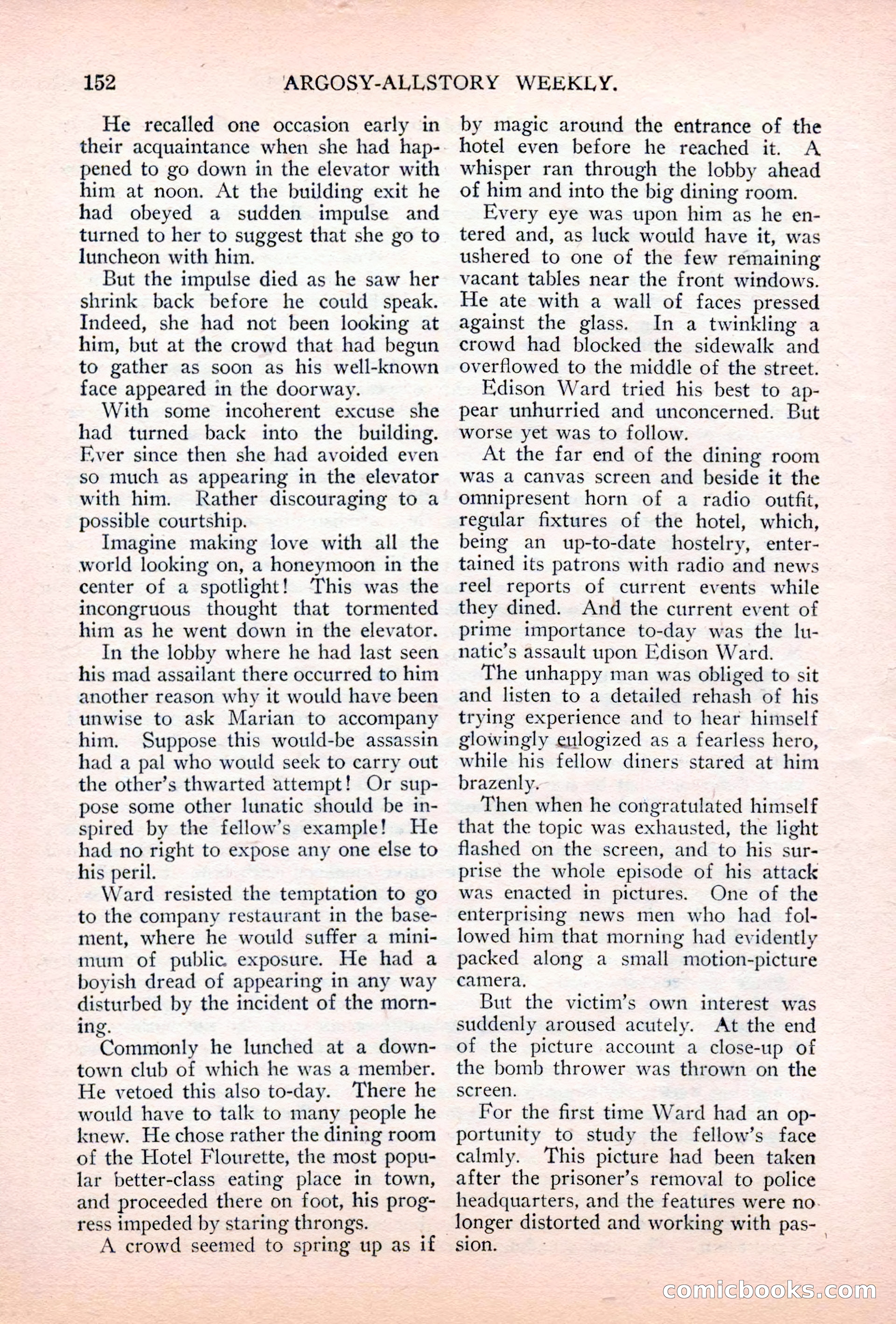
A restored page from Pulp Fiction, 1928. Page through the whole issue in the reader above.
📄 Transcribed text from this page (OCR, searchable)
Machine-transcribed from the original scan — historical spelling and the odd misread are preserved.
152 He recalled one occasion early in their acquaintance when she had hap- pened to go down in the elevator with him at noon. At the building exit he had obeyed a sudden impulse and turned to her to suggest that she go to luncheon with him. But the impulse died as he saw her shrink back before he could speak. Indeed, she had not been looking at him, but at the crowd that had begun to gather as soon as his well-known face appeared in the doorway. With some incoherent excuse she had turned back into the building. Fiver since then she had avoided even so much as appearing in the elevator with him. Rather discouraging to a possible courtship. Imagine making love with all the world looking on, a honeymoon in the center of a spotlight! This was the incongruous thought that tormented him as he went down in the elevator. In the lobby where he had last seen his mad assailant there occurred to him another reason why it would have been unwise to ask Marian to accompany him. Suppose this would-be assassin had a pal who would seek to carry out the other’s thwarted attempt! Or sup- pose some other lunatic should be in- spired by the fellow’s example! He had no right to expose any one else to his peril. Ward resisted the temptation to go to the company restaurant in the base- ment, where he would suffer a mini- mum of public exposure. He had a boyish dread of appearing in any way disturbed by the incident of the morn- ing. ‘Commonly he lunched at a down- town club of which he was a member. He vetoed this also to-day. There he would have to talk to many people he knew. He chose rather the dining room of the Hotel Flourette, the most popu- lar better-class eating place in town, and proceeded there on foot, his prog- ress impeded by staring throngs. A crowd seemed to spring up as if ARGOSY-ALLSTORY WEEKLY. by magic around the entrance of the hotel even before he reached it. A whisper ran through the lobby ahead of him and into the big dining room. Every eye was upon him as he en- tered and, as luck would have it, was ushered to one of the few remaining vacant tables near the front windows. He ate with a wall of faces pressed against the glass. In a twinkling a crowd had blocked the sidewalk and overflowed to the middle of the street. Edison Ward tried his best to ap- pear unhurried and unconcerned. But worse yet was to follow. At the far end of the dining room was a canvas screen and beside it the omnipresent horn of a radio outfit, regular fixtures of the hotel, which, being an up-to-date hostelry, enter- tained its patrons with radio and news reel reports of current events while they dined. And the current event of prime importance to-day was the lu- natic’s assault upon Edison Ward. The unhappy man was obliged to sit and listen to a detailed rehash of his trying experience and to hear himself glowingly eulogized as a fearless hero, while his fellow diners stared at him brazenly. Then when he congratulated himself that the topic was exhausted, the light flashed on the screen, and to his sur- prise the whole episode of his attack was enacted in pictures. One of the enterprising news men who had fol- lowed him that morning had evidently packed along a small motion-picture camera. But the victim’s own interest was suddenly aroused acutely. At the end of the picture account a close-up of the bomb thrower was thrown on the screen. For the first time Ward had an op- portunity to study the fellow’s face calmly. This picture had been taken after the prisoner’s removal to police headquarters, and the features were no. longer distorted and working with pas-_ sion. CORMMICGLOOOKS (E@)