
Pulp Fiction, 1928 · page 11 of 150
Argosy All-Story Weekly, July 7, 1928 — page 11: what you’re looking at
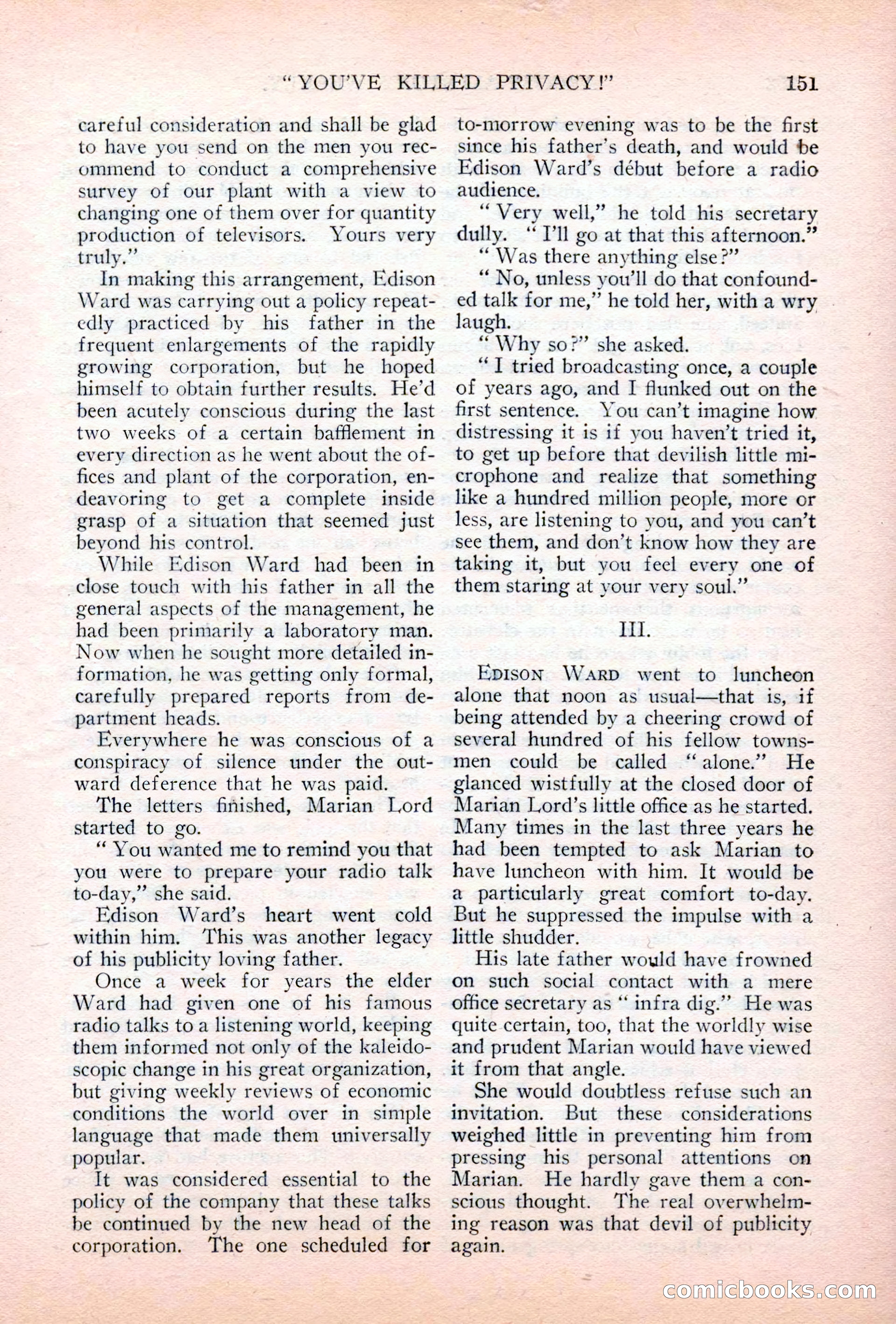
A restored page from Pulp Fiction, 1928. Page through the whole issue in the reader above.
📄 Transcribed text from this page (OCR, searchable)
Machine-transcribed from the original scan — historical spelling and the odd misread are preserved.
“YOU'VE KILLED “PRIVACY!” careful consideration and shall be glad to have you send on the men you rec- ommend to conduct a comprehensive survey of our plant with a view to changing one of them over for quantity production of televisors. Yours very truly.” In making this arrangement, Edison Ward was carrying out a policy repeat- edly practiced by his father in the frequent enlargements of the rapidly growing corporation, but he hoped himself to obtain further results. He’d been acutely conscious during the last two weeks of a certain bafflement in every direction as he went about the of- fices and plant of the corporation, en- deavoring to get a complete inside grasp of a situation that seemed just beyond his control. While Edison Ward had been in close touch with his father in all the general aspects of the management, he had been primarily a laboratory man. Now when he sought more detailed in- formation, he was getting only formal, carefully prepared reports from de- partment heads. Everywhere he was conscious of a conspiracy of silence under the out- ward deference that he was paid. The letters finished, Marian Lord started to go. “You wanted me to remind you that you were to prepare your radio talk to-day,” she said. Edison Ward’s heart went cold within him. ‘This was another legacy of his publicity loving father. Once a week for years the elder Ward had given one of his famous radio talks to a listening world, keeping them informed not only of the kaleido- scopic change in his great organization, but giving weekly reviews of economic conditions the world over in simple language that made them universally popular. It was considered essential to the policy of the company that these talks be continued by the new head of the corporation. The one scheduled for 151 to-morrow evening was to be the first since his father’s death, and would be Edison Ward’s début before a radio audience. “Very well,” he told his secretary dully. “ Dll go at that this afternoon.” “Was there anything else?” “No, unless you'll do that confound- ed talk for me,” he told her, with a wry laugh. “Why so?” she asked. “I tried broadcasting once, a couple of years ago, and I flunked out on the first sentence. You can’t imagine how distressing it is if you haven’t tried it, to get up before that devilish little mi- crophone and realize that something like a hundred million people, more or less, are listening to you, and you can’t see them, and don’t know how they are taking it, but you feel every one of them staring at your very soul.” Til. Epison Warp went to luncheon alone that noon as usual—that is, if being attended by a cheering crowd of several hundred of his fellow towns- men could be called ‘ alone.” He glanced wistfully at the closed door of Marian Lord’s little office as he started. Many times in the last three years he had been tempted to ask Marian to have luncheon with him. It would be a particularly great comfort to-day. But he suppressed the impulse with a little shudder. His late father would have frowned on such social contact with a mere office secretary as “‘ infra dig.””’ He was quite certain, too, that the worldly wise and prudent Marian would have viewed it from that angle. She would doubtless refuse such an invitation. But these considerations weighed little in preventing him from pressing his personal attentions on Marian. He hardly gave them a con- scious thought. The real overwhelm- ing reason was that devil of publicity again. CORNICE OOOKS (E@)