
Pulp Fiction, 1928 · page 101 of 150
Argosy All-Story Weekly, July 7, 1928 — page 101: what you’re looking at
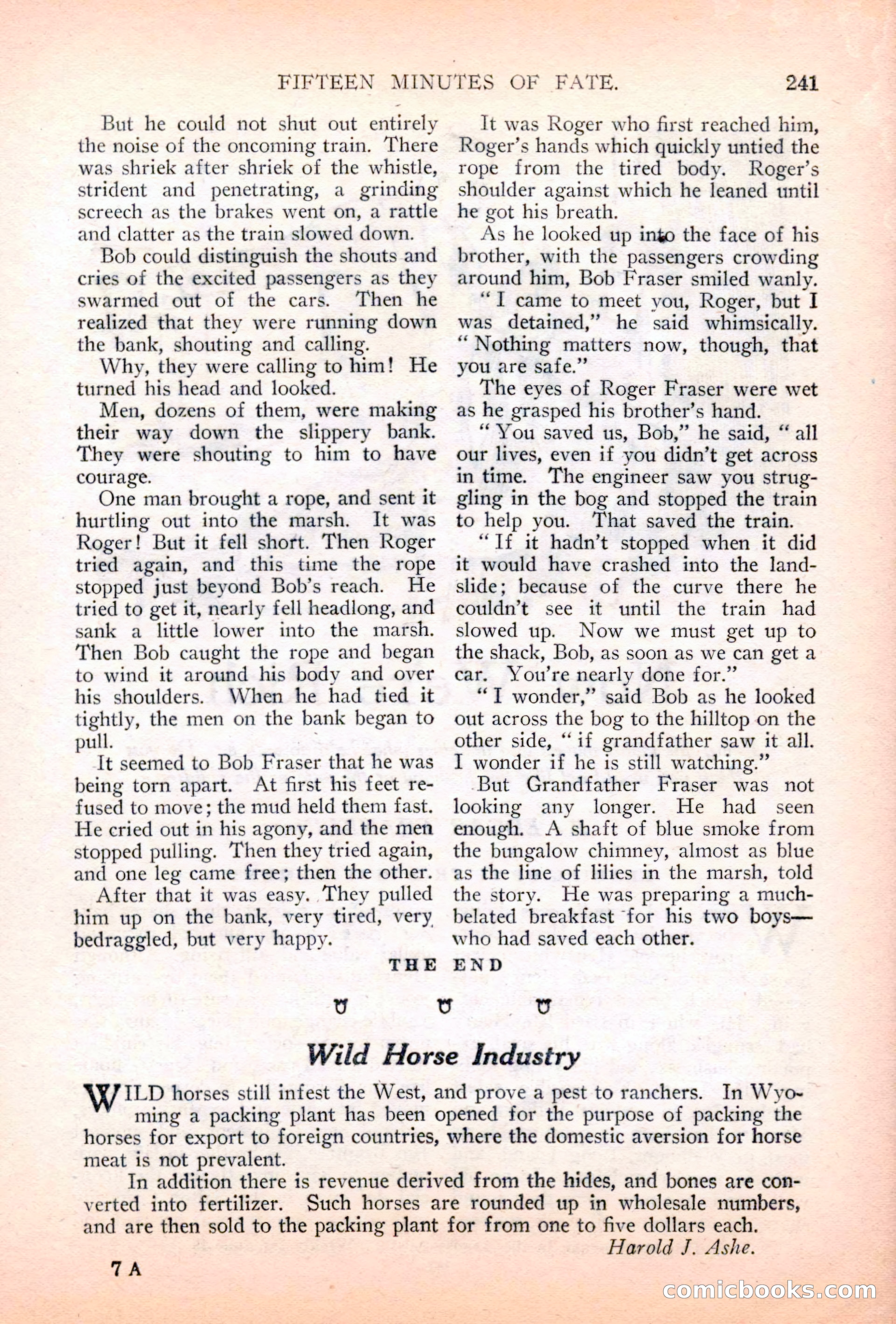
A restored page from Pulp Fiction, 1928. Page through the whole issue in the reader above.
📄 Transcribed text from this page (OCR, searchable)
Machine-transcribed from the original scan — historical spelling and the odd misread are preserved.
FIFTEEN MINUTES OF FATE. But he could not shut out entirely the noise of the oncoming train. There was shriek after shriek of the whistle, strident and penetrating, a grinding screech as the brakes went on, a rattle and clatter as the train slowed down. Bob could distinguish the shouts and cries of the excited passengers as they swarmed out of the cars. Then he realized that they were running down the bank, shouting and calling. Why, they were calling to him! He turned his head and looked. Men, dozens of them, were making their way down the slippery bank. They were shouting to him to have courage. One man brought a rope, and sent it hurtling out into the marsh. It was Roger! But it fell short. Then Roger tried again, and this time the rope stopped just beyond Bob’s reach. He tried to get it, nearly fell headlong, and sank a little lower into the marsh. Then Bob caught the rope and began to wind it around his body and over his shoulders. When he had tied it tightly, the men on the bank began to ull. . : It seemed to Bob Fraser that he was being torn apart. At first his feet re- fused to move; the mud held them fast. He cried out in his agony, and the men stopped pulling. Then they tried again, and one leg came free; then the other. After that it was easy. They pulled him up on the bank, very tired, very bedraggled, but very happy. THE Uv U 241 It was Roger who first reached him, Roger’s hands which quickly untied the rope from the tired body. Roger’s shoulder against which he leaned until he got his breath. As he looked up ingo the face of his brother, with the passengers crowding around him, Bob Fraser smiled wanly. “I came to meet you, Roger, but I was detained,’ he said whimsically. “ Nothing matters now, though, that you are safe.” The eyes of Roger Fraser were wet as he grasped his brother’s hand. “You saved us, Bob,” he said, “ all our lives, even if you didn’t get across in time. The engineer saw you strug- gling in the bog and stopped the train to help you. That saved the train. “If it hadn’t stopped when it did it would have crashed into the land- slide; because of the curve there he couldn’t see it until the train had slowed up. Now we must get up to the shack, Bob, as soon as we can get a car. You're nearly done for.” “TIT wonder,” said Bob as he looked out across the bog to the hilltop on the other side, “if grandfather saw it all. I wonder if he is still watching.” But Grandfather Fraser was not looking any longer. He had seen enough. A shaft of blue smoke from the bungalow chimney, almost as blue as the line of lilies in the marsh, told the story. He was preparing a much- belated breakfast for his two boys— who had saved each other. END U Wild Horse Industry ILD horses still infest the West, and prove a pest to ranchers. In Wyo- ming a packing plant has been opened for the purpose of packing the horses for export to foreign countries, where the domestic aversion for horse meat is not prevalent. In addition there is revenue derived from the hides, and bones are con- verted into fertilizer. Such horses are rounded up in wholesale numbers, and are then sold to the packing plant for from one to five dollars each. TA Harold J. Ashe. COPMICLOOOKS (C@)